


- Claude Code scores 83.8% on Terminal-Bench 2.1 and Codex CLI 83.1% — a gap smaller than the error bars, so they are statistically tied
- The value winner flips by tier: Codex is cheaper at the budget end, Claude Code is better value at every tier above it
- Codex's best run cost $2,059.19 against Claude Code's $552.67 for the same score — 3.7x the money for no measurable gain
- Codex on GPT-5.6 Luna is the most efficient configuration either agent has posted, at $3.19 per accuracy point
- Both cost $20 a month and both pool usage across every surface, so a heavy web session drains your terminal allowance
- The Codex CLI client is Apache-2.0 with 105,700 GitHub stars; Claude Code is proprietary — but neither model is open
- Codex has the cheaper entry at $8 via ChatGPT Go; Claude Code has a free tier and can be bought standalone
- At $20 each with strengths at opposite ends of the price range, running both is a defensible professional setup
Most comparisons of these two tools rely on vendor blog posts and impressions. This one is built from the Terminal-Bench 2.1 leaderboard, which publishes accuracy, error margins and the dollar cost of every verified run. All eight runs from both agents are reproduced in full below so you can check the working.
How do Codex CLI and Claude Code compare on benchmarks?
On Terminal-Bench 2.1, Claude Code’s best verified run scores 83.8% (±1.2) using Fable 5. Codex CLI’s best scores 83.1% (±1.1) using GPT-5.5. The error bars overlap, so the benchmark cannot distinguish between them.
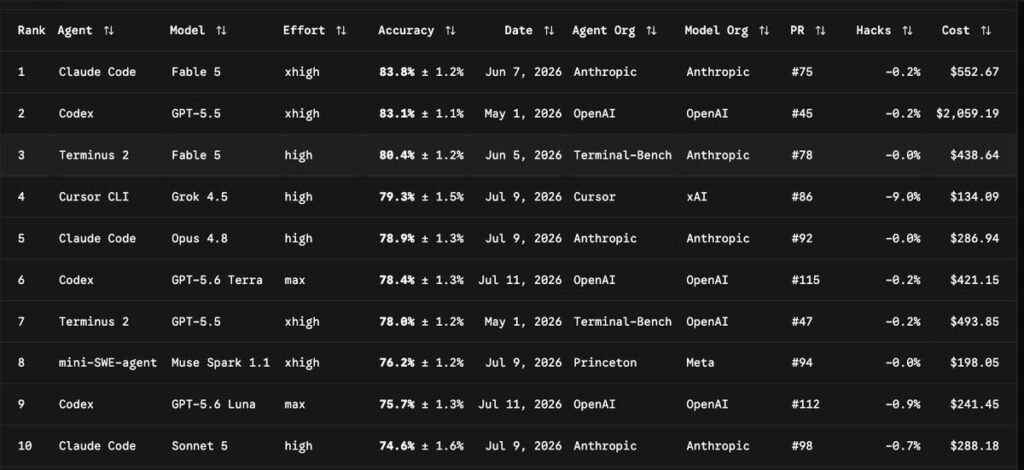
Terminal-Bench 2.1, top ten. Claude Code and Codex hold first and second place.
Terminal-Bench is a benchmark that measures how well an AI agent completes real tasks in a terminal environment — installing dependencies, editing files, running tests, fixing what breaks. Version 2.1 is the current live leaderboard, and submissions must run through the Harbor harness so every result is produced under the same conditions.
A caution about numbers you will find elsewhere. Several widely-shared articles report Codex leading at 83.4% with Claude Code at 78.9%. Others report both agents near 89%. Neither matches the leaderboard as published. Benchmark figures in this field get copied between blogs until they drift from the source. Verify against the leaderboard directly, including anything you read here.
What does each configuration actually cost?
The leaderboard publishes the dollar cost of every run alongside the score. This is the column that decides the comparison, and almost nobody reports it.
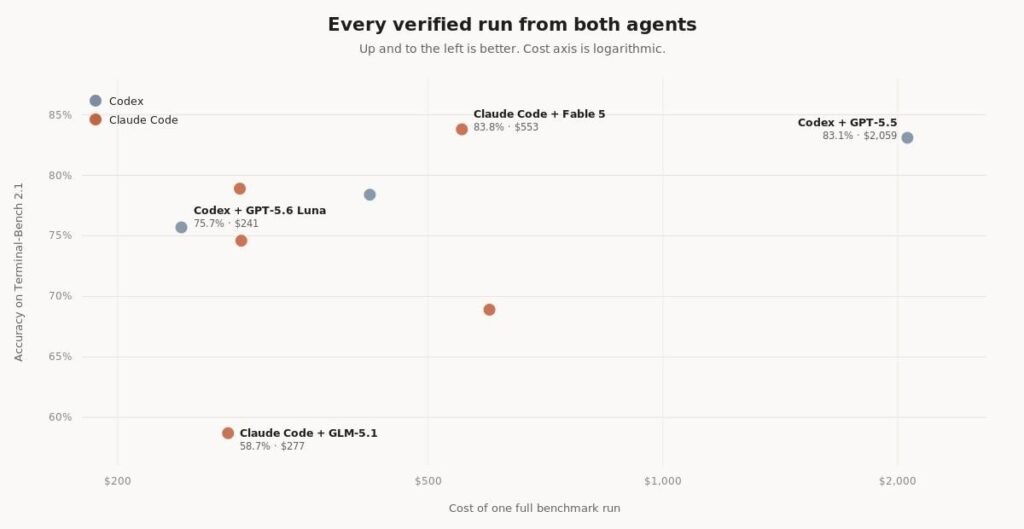
All eight verified runs from both agents. Up and to the left is better value.
The spread is wide. The cheapest run on this chart cost $241.45 and the most expensive cost $2,059.19, a difference of more than eight times, for scores that differ by 7.4 percentage points.
Codex wins the budget tier
Codex on GPT-5.6 Luna scores 75.7% for $241.45. Claude Code on Sonnet 5 scores 74.6% for $288.18. Codex is 1.1 points better and 16% cheaper. If you are cost-constrained and doing routine work, this is the strongest single argument for Codex.
Claude Code wins the middle tier
Codex on GPT-5.6 Terra scores 78.4% for $421.15. Claude Code on Opus 4.8 scores 78.9% for $286.94. Half a point better for 32% less money.
Claude Code wins the top tier decisively
Codex on GPT-5.5 scores 83.1% for $2,059.19. Claude Code on Fable 5 scores 83.8% for $552.67. That is a marginally better score for 3.7 times less money, and it is the largest efficiency gap between the two agents anywhere in the data.
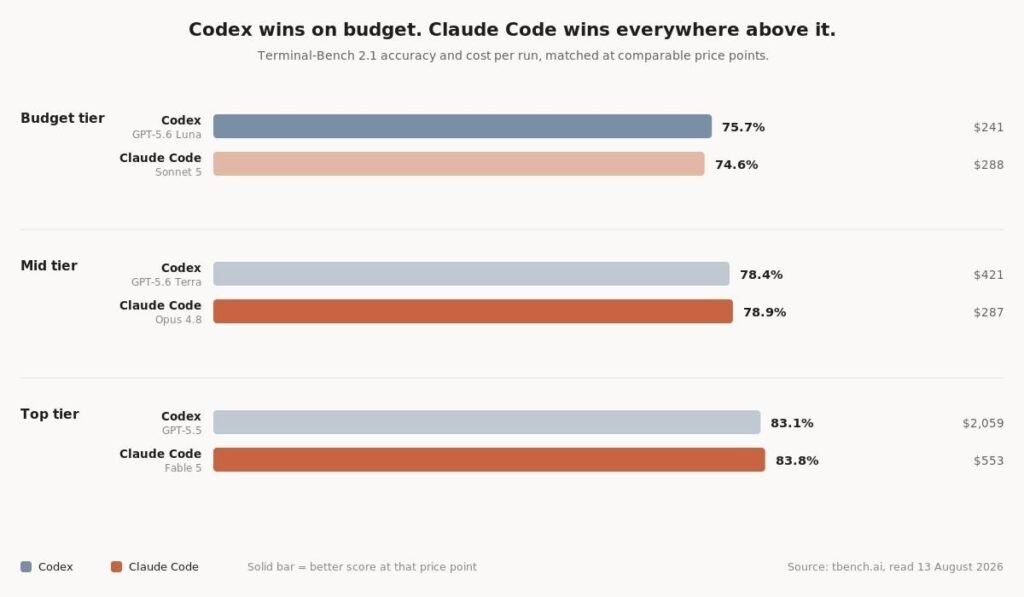
The same benchmark at three matched price points. The solid bar is the better score at that tier.
Which is better value per accuracy point?
Dividing each run’s cost by its score gives a rough efficiency ratio. Codex on GPT-5.6 Luna is the most efficient configuration either agent has posted, at $3.19 per accuracy point. Codex on GPT-5.5 is the least efficient, at $24.78.
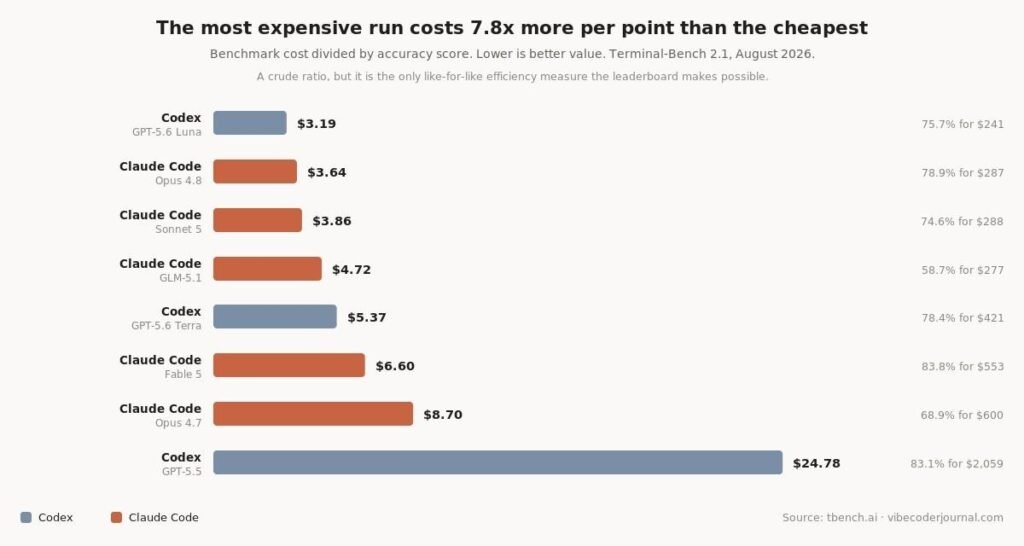
Cost per accuracy point, ranked. Lower is better value.
Treat this ratio as directional, not precise. Cost per point assumes a linear relationship between spend and score, which is not how these systems behave — the last few points are always the most expensive. It is useful for comparing configurations against each other, not for predicting what a given budget buys you.
Read that way, the ranking is still informative: three of the four most efficient configurations are Claude Code, but the single most efficient one is Codex.
Every verified run, in full
All eight results from both agents on Terminal-Bench 2.1, sorted by accuracy. Effort levels are the leaderboard’s own labels for how much compute each run was allowed.
| Agent + model | Effort | Accuracy | Cost | Cost per point |
|---|---|---|---|---|
| Claude Code + Fable 5 | xhigh | 83.8% | $552.67 | $6.60 |
| Codex + GPT-5.5 | xhigh | 83.1% | $2,059.19 | $24.78 |
| Claude Code + Opus 4.8 | high | 78.9% | $286.94 | $3.64 |
| Codex + GPT-5.6 Terra | max | 78.4% | $421.15 | $5.37 |
| Codex + GPT-5.6 Luna | max | 75.7% | $241.45 | $3.19 |
| Claude Code + Sonnet 5 | high | 74.6% | $288.18 | $3.86 |
| Claude Code + Opus 4.7 | max | 68.9% | $599.52 | $8.70 |
| Claude Code + GLM-5.1 | max | 58.7% | $277.14 | $4.72 |
Source: Terminal-Bench 2.1 leaderboard, read 14 August 2026. Cost per point is our calculation.
On effort levels. The leaderboard records the compute budget each run was given — high, xhigh or max. These are not directly comparable between vendors, because each defines its own tiers. It does mean you should not read a single row as “this agent is this good”; read the whole column.
How do the pricing plans compare?
Both agents cost $20 per month at entry. Codex is bundled with ChatGPT rather than sold separately, so there is no standalone Codex subscription. Claude Code is sold on its own and has a free tier.
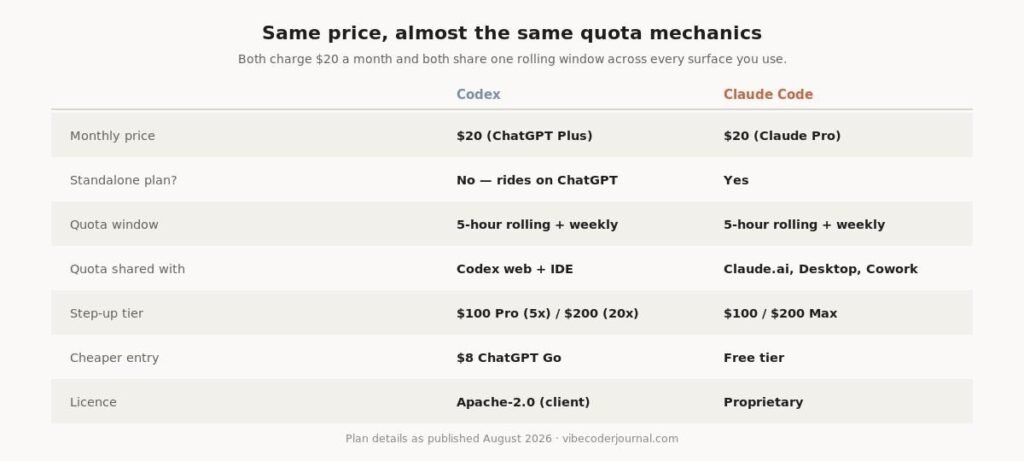
Entry pricing and plan structure for both agents, August 2026.
Codex rides on ChatGPT plans: limited free access, Go at $8, Plus at $20, Pro at $100 for roughly five times Plus usage or $200 for twenty times, and Business at $25 per user. Claude Code has a free tier, Pro at $20, and Max tiers at $100 and $200.
The cheapest paid way in is Codex, through ChatGPT Go at $8 a month — below anything Anthropic offers on a paid tier.
Both cost $20 a month, so if you’re weighing Codex against an editor-based workflow instead, see our Cursor Pro vs ChatGPT Plus comparison.
How do the usage limits work?
Both agents use a rolling five-hour window with a weekly cap on top, and both draw that quota from one pool shared across every surface you use. This is the mechanic that surprises people most often on both platforms.
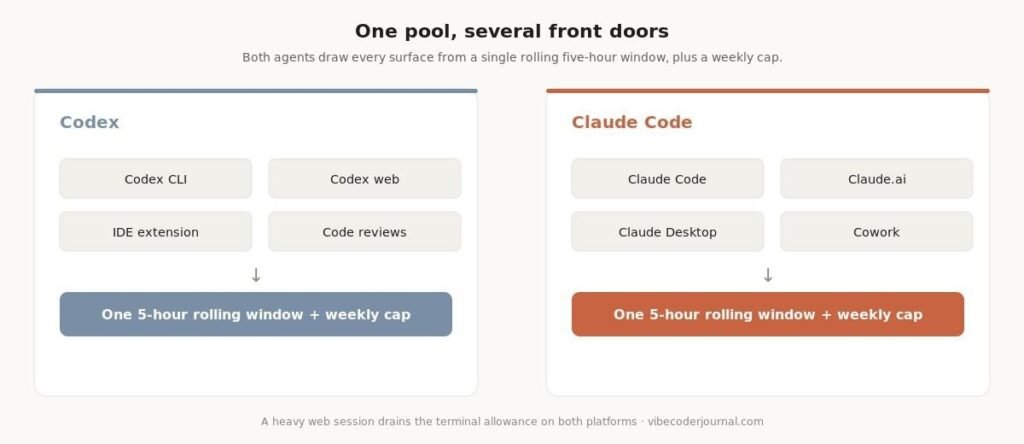
Both agents pool usage across every surface rather than metering the terminal separately.
On Codex, a heavy web session and a heavy CLI session compete for the same allowance. On Claude Code, the pool covers Claude.ai, Claude Desktop and Cowork as well as the terminal. Neither tool warns you in the terminal that this is what drained your quota — here is how to check what you are actually using.
ChatGPT Plus publishes indicative figures of 10–60 cloud tasks and 20–50 code reviews per five-hour window, though what you get in practice depends on task size.
Is Codex CLI open source?
The Codex CLI client is open source under Apache-2.0. Claude Code is proprietary. Neither model is open.
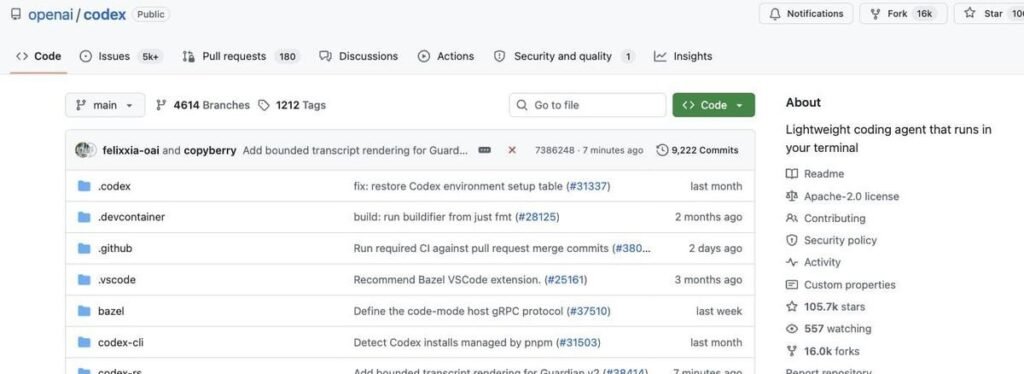
The openai/codex repository: 105.7k stars, Apache-2.0, and a commit merged minutes before this screenshot.
The repository has 105,700 stars, 16,000 forks, 9,222 commits and 983 releases, with the latest release 0.147.0 shipped last week. It is actively maintained by a large team.
Do not over-read the licence, though. An Apache-2.0 client calling a closed, hosted model is not an open stack. If licence freedom is your actual requirement — the ability to swap the model, run locally, or avoid a vendor withdrawing access — neither of these tools delivers it, and you want an agent built for model portability instead.
We compared twelve alternatives that do offer that, with benchmark data.
Full specification comparison
| Codex CLI | Claude Code | |
|---|---|---|
| Best verified score | 83.1% (GPT-5.5) | 83.8% (Fable 5) |
| Cost of that run | $2,059.19 | $552.67 |
| Best value per point | $3.19 (GPT-5.6 Luna) | $3.64 (Opus 4.8) |
| Verified runs on record | 3 | 5 |
| Entry price | $20/mo ChatGPT Plus | $20/mo Claude Pro |
| Cheapest paid entry | $8/mo ChatGPT Go | $20/mo Claude Pro |
| Standalone subscription | No | Yes |
| Free tier | Limited | Yes |
| Quota window | 5-hour rolling + weekly | 5-hour rolling + weekly |
| Quota shared across | CLI, web, IDE, code reviews | Claude Code, Claude.ai, Desktop, Cowork |
| Step-up tiers | $100 (5x), $200 (20x) | $100, $200 Max |
| Client licence | Apache-2.0 | Proprietary |
| GitHub stars | 105.7k | Not published |
Benchmark figures from the Terminal-Bench 2.1 leaderboard; repository data from GitHub; plan details as published. All read 14 August 2026.
Which one should you choose?
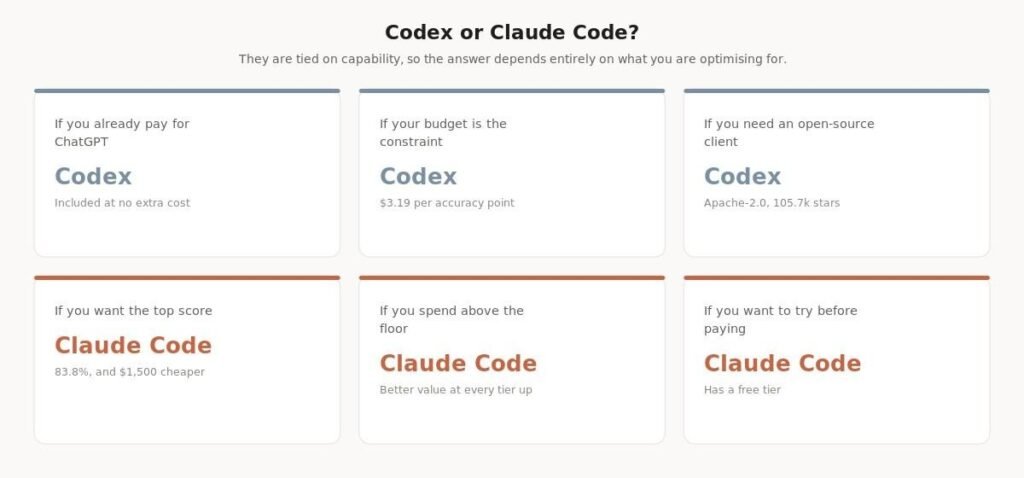
Six situations and the agent that fits each one.
Choose Codex CLI if
- You already pay for ChatGPT. Codex is included, so trying it costs nothing extra.
- Cost is your binding constraint. Its GPT-5.6 Luna configuration is the most efficient run either agent has posted.
- You need an Apache-2.0 licensed client for procurement reasons.
- You want the cheapest paid entry point, at $8 a month through ChatGPT Go.
Choose Claude Code if
- You want the highest verified score without paying nearly four times over for it.
- You spend anything above the budget tier, where its efficiency is consistently better.
- You want a standalone subscription rather than one bundled into a consumer chat product.
- You want to evaluate on a free tier before committing.
Or run both
They cost $20 each, they are tied on capability, and their strengths sit at opposite ends of the price range. For anyone doing this professionally, $40 a month to have both is defensible — and it removes the risk that a pricing or quota change on one platform strands you.
Frequently asked questions
Is Codex CLI better than Claude Code?
Not on measured capability. On Terminal-Bench 2.1, Claude Code scores 83.8% and Codex CLI scores 83.1%, a difference smaller than the error margin on either. Codex offers better value at the cheapest tier; Claude Code offers better value at every tier above it.
How much does Codex CLI cost?
Codex CLI has no standalone price. It is included with ChatGPT plans: limited free access, Go at $8 per month, Plus at $20, Pro at $100 or $200, and Business at $25 per user. If you already subscribe to ChatGPT, you are not paying twice.
How much does Claude Code cost?
Claude Code has a free tier, Pro at $20 per month, and Max tiers at $100 and $200. Unlike Codex it can be bought on its own.
Do Codex CLI and Claude Code share usage limits with other apps?
Yes, both do. Codex CLI shares a five-hour rolling window with Codex web, the IDE extension and code reviews. Claude Code shares its quota with Claude.ai, Claude Desktop and Cowork. On both platforms, usage elsewhere reduces what is available in the terminal.
Which is cheaper, Codex CLI or Claude Code?
Both start at $20 per month, and Codex has a cheaper $8 entry through ChatGPT Go. On benchmark cost the answer depends on tier: Codex’s cheapest run cost $241.45 against Claude Code’s $288.18 at a comparable score, but Codex’s top run cost $2,059.19 against Claude Code’s $552.67.
Is Codex CLI open source?
The client is, under Apache-2.0, with 105,700 GitHub stars. The GPT models it calls are not open. Claude Code is proprietary throughout.
What is Terminal-Bench?
Terminal-Bench is a benchmark that measures how well AI agents complete real tasks in a terminal — installing dependencies, editing files, running tests and fixing failures. Version 2.1 is the current live leaderboard, and it publishes accuracy, error margins and the dollar cost of each run.
Can I use Codex CLI and Claude Code together?
Yes. They are separate tools with separate subscriptions and no technical conflict. Because their cost efficiency peaks at different price points, running both is a reasonable strategy for professional use.
Methodology
Benchmark figures are taken from the public Terminal-Bench 2.1 leaderboard, which requires submissions to run through the Harbor harness so that results are comparable. We reproduce every verified run for both agents rather than selecting favourable ones. Cost per accuracy point is our own calculation, dividing each run’s published cost by its published score.
Repository statistics were read directly from GitHub rather than taken from secondary sources. Pricing reflects published list prices for individual plans in August 2026. Where a figure could not be verified against a primary source, we say so in the text rather than publishing it.
We have no commercial relationship with Anthropic or OpenAI, and this page contains no affiliate links.
Sources
- Terminal-Bench 2.1 leaderboard — accuracy, error margins and cost for all eight runs cited
- openai/codex on GitHub — 105.7k stars, Apache-2.0, read 14 August 2026
- Terminal-Bench — benchmark methodology and Harbor harness
Every figure on this page was verified against a primary source on 14 August 2026. Both platforms changed pricing within the last six months, and the leaderboard updates continuously — if a number here no longer matches its source, tell us and we will re-verify.