


Most comparisons of these two treat them as a straight choice: pay Anthropic or pay GitHub. That framing broke sometime this year, and almost nothing written about it has caught up.
GitHub Copilot Pro, at $10 a month, lists “Access to 3rd party agents (Claude Code and Codex)” among its features. You can run Claude’s coding agent from inside Copilot without an Anthropic subscription at all.
That does not make the comparison pointless. It makes it a different comparison, and a more interesting one.
The complication: Copilot Pro includes Claude
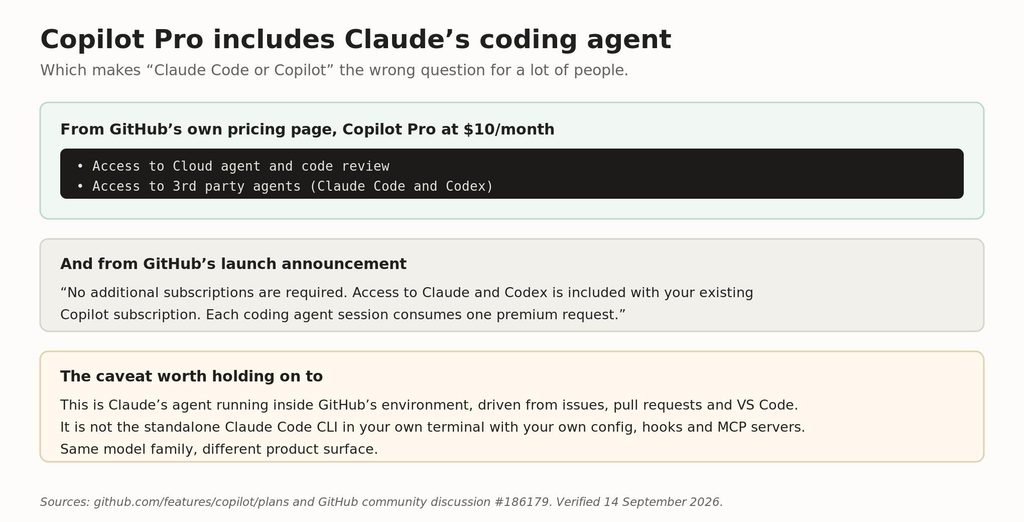
GitHub’s own pricing page and launch announcement, quoted directly.
GitHub’s announcement when this shipped was unambiguous: “No additional subscriptions are required. Access to Claude and Codex is included with your existing Copilot subscription. Each coding agent session consumes one premium request.”
At launch this was limited to Copilot Pro+ and Enterprise. The current pricing page lists it under Pro, which means it has moved down a tier since.
What you are actually getting
This is the part worth being careful about, because the marketing language and the product are not quite the same thing.
Inside Copilot, you assign work to Claude’s agent from a GitHub issue, a pull request, the Agents tab, or the agent sessions view in VS Code. It runs in GitHub’s environment, on GitHub’s infrastructure, under GitHub’s billing.
Standalone Claude Code is a CLI in your own terminal. It reads your CLAUDE.md, runs your hooks, connects to your MCP servers, and operates on your local filesystem with whatever permissions you have given it.
Same model family, different product. If what you want is a model that can work through a GitHub issue, Copilot Pro is a remarkably cheap way to get it. If what you want is an agent embedded in your local development loop with your own configuration, that is still the standalone tool.
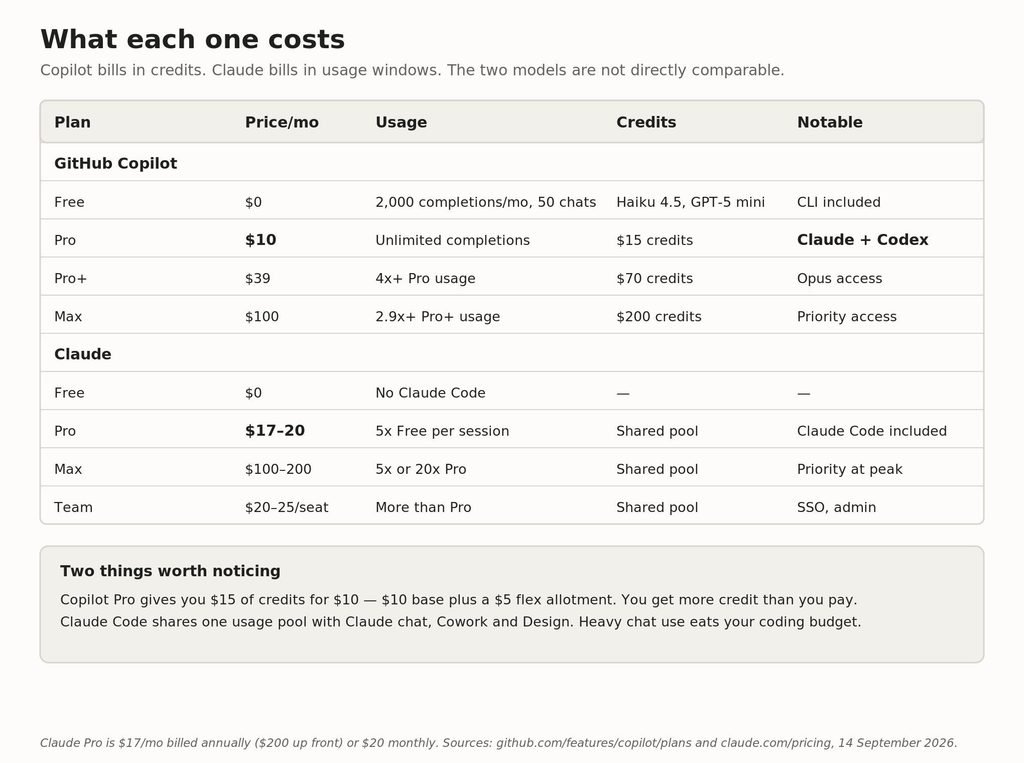
What each one costs
xd
The two bill in ways that resist direct comparison, and that is worth understanding before you try to work out which is cheaper.
Copilot bills in credits
Copilot Pro is $10 a month and carries $15 in total GitHub AI Credits — $10 of base credits plus a $5 flex allotment. Pro+ is $39 for $70 of credits. Max is $100 for $200. You are consistently given more credit value than you pay, which is an unusual and welcome structure.
Credits are consumed by chat, agent mode, code review, the cloud agent, the CLI and Copilot Apps. Inline completions are unlimited on every paid tier and do not draw from credits at all.
Claude bills in usage windows
Claude Pro is $17 a month billed annually ($200 up front) or $20 monthly. Max starts at $100. There are no credits — instead there is a rolling five-hour session window, with weekly caps on top for paid plans.
The trap in that model: Claude Code shares one usage pool with Claude chat, Cowork, Design and everything else on your account. A long afternoon of conversation in the web app leaves you with less coding capacity in the terminal. Copilot’s credits are similarly shared, but inline completions — the thing you use most — are exempt.
On raw price, Copilot Pro at $10 is cheaper than Claude Pro at $17–20. But Claude Pro also buys you the Claude apps, Cowork, Design and Science, which Copilot has no equivalent for. Whether that is worth $7–10 depends entirely on whether you would use them.
What each one is actually for
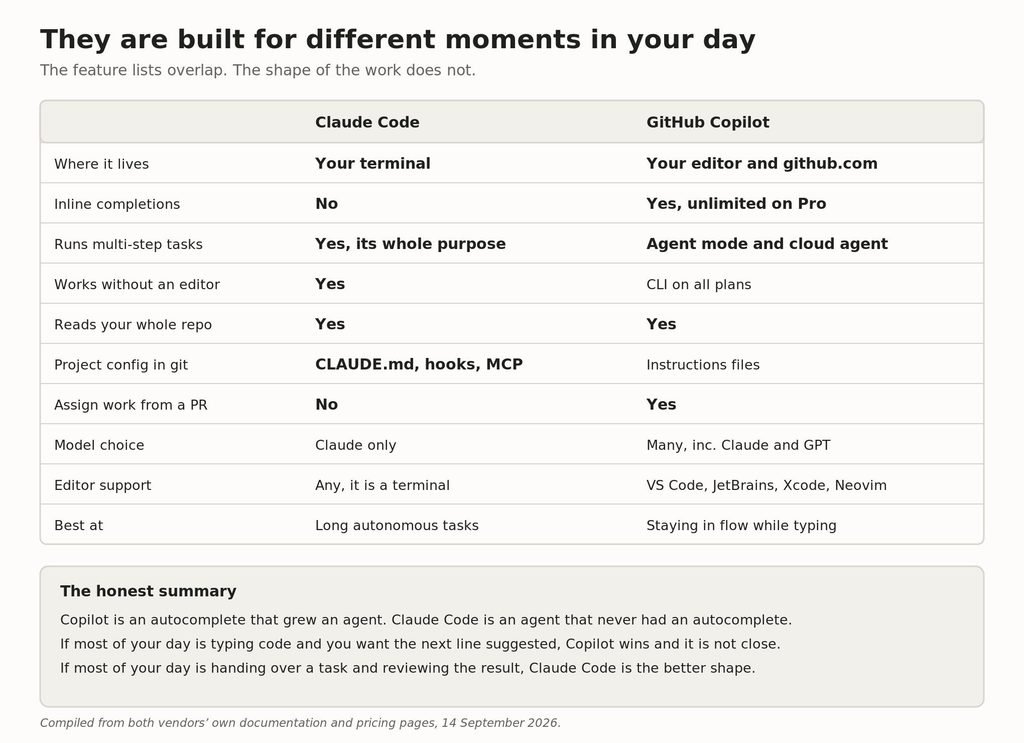
Capability by capability, and the shape of work each suits.
Strip away the overlapping feature lists and the difference is about where the tool sits in your day.
Copilot is an autocomplete that grew an agent
It started as inline completion and that is still what it is best at. You type, it suggests the rest of the line or the next edit, and on any paid plan that is unlimited. The agent capabilities arrived later and are genuinely good, but the core loop is you writing code with assistance.
It also lives where your work already is. Assigning a task from a pull request, or having it review a diff, is native in a way a terminal tool cannot match. And it runs in VS Code, Visual Studio, JetBrains, Xcode, Neovim, Eclipse and Zed — Claude Code runs in a terminal, which is either universal or nowhere depending on your temperament.
Claude Code is an agent that never had an autocomplete
There are no inline suggestions. The interaction is: describe a task, let it work, review what it did. It reads the whole repository, runs commands, edits multiple files and iterates against your tests.
Its configuration story is also deeper. CLAUDE.md, hooks, subagents, MCP servers and settings.json all live in your repository and travel with it — we covered the whole set in Claude Code templates. Copilot has instructions files, which are useful but a smaller surface.
The honest split: if most of your day is typing code and you want the next line suggested, Copilot wins and it is not close. If most of your day is handing over a task and reviewing the result, Claude Code is the better shape.
Which is better at coding? The benchmark problem
This is the question everyone asks and the one where most comparison articles do their readers a disservice.
You will find articles quoting a SWE-bench or Terminal-Bench figure for “Claude Code” next to one for “Copilot” as though the two numbers can be placed side by side. They cannot.
Why the numbers do not compare
Agentic benchmarks measure a model plus a scaffold, not a model alone. The harness decides how many attempts the agent gets, what tools it has, how errors are fed back, and when it is allowed to stop. Change the harness and the same model moves several points.
Claude Code’s published results come from Anthropic running its own agent. Copilot’s come from GitHub running a different agent, frequently over a different model. A number from each is two measurements of two different systems that happen to share a benchmark name.
There is a further complication now: since Copilot can run Claude’s agent, a Copilot result may itself be a Claude result. Quoting them as opposing data points is not just imprecise, it can be circular.
What we would say instead: on the underlying model, Claude’s coding models benchmark at or near the top of the agentic leaderboards. On the scaffold, the comparison depends entirely on which harness you are running. If you want the actual leaderboard figures rather than a vendor’s slide, we maintain them at our benchmark pages.
Can you use both?
Yes, and for a lot of developers this is the right answer rather than a cop-out.
They do not conflict. Copilot lives in your editor providing completions as you type. Claude Code lives in a terminal window handling the tasks you would rather delegate. Running both is a normal setup, and at $10 plus $17–20 it is roughly $30 a month.
If that is too much, the interesting middle path is the one this article opened with: Copilot Pro alone, at $10, gives you unlimited completions and access to Claude’s agent. That is not the full standalone Claude Code experience, but it covers a surprising amount of it for less than either tool alone at the next tier up.
Which should you choose?
| If this is you | Take |
|---|---|
| You mostly write code by hand and want it faster | Copilot Pro, $10 |
| You mostly delegate whole tasks | Claude Pro, $17–20 |
| You want both, on a budget | Copilot Pro alone and use its Claude agent |
| You live in pull requests and issues | Copilot — assignment from a PR is native |
| You want local config, hooks and MCP | Claude Code standalone |
| You already pay for Claude for other work | Claude Code, it is already included |
| Your team needs one tool with admin controls | Copilot Business, or Claude Team |
| You want to try before paying | Copilot Free — Claude has no free Claude Code |
The last row is worth its own sentence. Copilot has a genuine free tier with 2,000 completions and 50 chat requests a month, and the CLI is included. Claude Code has no free option at all — the Claude free plan explicitly excludes it. If you want to evaluate before committing money, that asymmetry decides where you start.
Frequently asked questions
Is Claude Code better than GitHub Copilot?
They do different jobs. Copilot is best at inline completions while you type; Claude Code is best at working through a whole task autonomously. For most developers the honest answer is that Copilot is better at one thing and Claude Code at the other.
Can I use Claude Code with GitHub Copilot?
Yes, in two senses. You can run both tools side by side, and Copilot Pro at $10/month includes access to Claude’s coding agent inside GitHub with no Anthropic subscription.
Is GitHub Copilot cheaper than Claude Code?
On headline price, yes — $10 versus $17–20. But Claude Pro also includes the Claude apps, Cowork and Design, which Copilot has no equivalent for. Compare what you would actually use.
Does GitHub Copilot use Claude?
Yes. Copilot offers model selection including Claude models, and Copilot Pro and above can run Claude as a third-party coding agent.
Does Claude Code do autocomplete?
No. It has no inline completion feature at all. If suggestions as you type are what you want, you need Copilot or a similar tool.
Is there a free version of Claude Code?
No. Claude Code requires a paid plan — Pro, Max, Team, Enterprise or a Console account. The free Claude tier explicitly excludes it.
Which has better benchmark scores?
The question is not answerable as asked. Agentic benchmarks measure a model plus its harness, and the two tools use different harnesses. Any article placing one figure beside the other is comparing different systems.
What editors does each support?
Copilot supports VS Code, Visual Studio, JetBrains IDEs, Xcode, Neovim, Eclipse, Zed and more. Claude Code is a terminal application, so it works alongside any editor without integrating with one.
Related guides
- How to install Claude Code
- Claude Code templates: every file you should commit
- Claude pricing plans compared
- Codex CLI vs Claude Code
- Claude Code alternatives: 12 tools compared
- How to see Claude Code usage
Methodology and sources
Prices and feature lists were read directly from each vendor’s pricing page rather than from secondary reporting. The third-party agent claim was verified against both GitHub’s pricing page and its public launch announcement. We did not benchmark either tool ourselves, and we have deliberately not quoted a head-to-head score, for the reasons set out above.
- GitHub Copilot plans and pricing
- GitHub — Claude and Codex available in public preview
- Claude plans and pricing
- Anthropic — Claude Code
Verified 14 September 2026. Both products change quickly and the third-party agent arrangement in particular has already moved down a pricing tier once since launch. If something here disagrees with the current pages, the vendor pages are right and we want to know. Vibe Coder Journal accepts no sponsorship or affiliate commission from GitHub, Microsoft or Anthropic.