
By Abdullah Zulfiqar · Published 6 October 2026 · Prices and limits checked against OpenAI’s pages on 5 October 2026
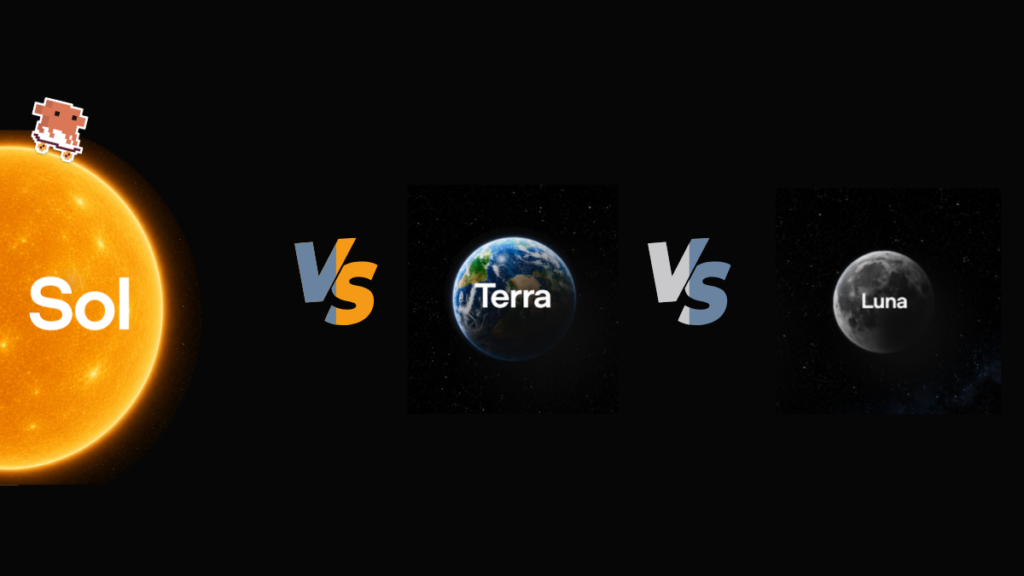
GPT-5.6 Sol, Terra and Luna all have the same 1,050,000-token context window and 128,000-token output limit in the API. The difference is price and quality. Sol is the flagship at $4/$20 per million tokens. Terra is the mid tier at $2/$12. Luna is the budget model at $0.20/$1.20. On the ChatGPT website, though, you don’t get 1.05 million tokens. You get 27K to 400K, depending on your plan and whether the model is reasoning.
| GPT-5.6 Sol | GPT-5.6 Terra | GPT-5.6 Luna | |
| Role | Flagship (replaces the unsuffixed GPT-5 tier) | Balanced (replaces “mini”) | Cheapest (replaces “nano”) |
| API context window | 1,050,000 tokens | 1,050,000 tokens | 1,050,000 tokens |
| Max input / max output | 922,000 / 128,000 | 922,000 / 128,000 | 922,000 / 128,000 |
| API price (input / output per 1M) | $4 / $20 (promo) | $2 / $12 | $0.20 / $1.20 |
| Knowledge cutoff | 16 Feb 2026 | 16 Feb 2026 | 16 Feb 2026 |
| SWE-Bench Pro | 64.6% | 63.4% | 62.7% |
| In ChatGPT | Plus and Pro | Plus and Pro (limited on Free/Go in Work and Codex) | All plans, including Free |
| Best for | Hard agentic and computer-use work | Most production and coding work | High-volume, simple tasks |
What are GPT-5.6 Sol, Terra and Luna?
They’re the three sizes of OpenAI’s GPT-5.6 family, from largest to smallest: Sol, Terra and Luna. OpenAI released them generally on 9 July 2026, after a limited partner preview from late June. The names replace the old suffixes. OpenAI’s model pages say Sol “roughly corresponds to the unsuffixed model tier”, Terra to the “mini” tier and Luna to the “nano” tier.
The plain gpt-5.6 model ID routes to Sol. If your code calls gpt-5.6 without a suffix, you’re paying Sol prices.
One thing to know before you build on these: GPT-5.6 is no longer OpenAI’s newest family. The ChatGPT pricing page now also lists GPT-6 Sol, GPT-6 Luna, GPT-6 Astra and GPT-6.1 Sol. GPT-5.6 is still widely used in the API because of its pricing, and it remains available in ChatGPT.
What is the GPT-5.6 Sol context window size on the web?
On the ChatGPT website, GPT-5.6 Sol doesn’t get its full 1.05 million tokens. It runs inside your plan’s window: 256K tokens on Plus and Go for reasoning answers, and 400K on Pro. Instant answers get even less: 27K on Free, 54K on Go and Plus, 128K on Pro.
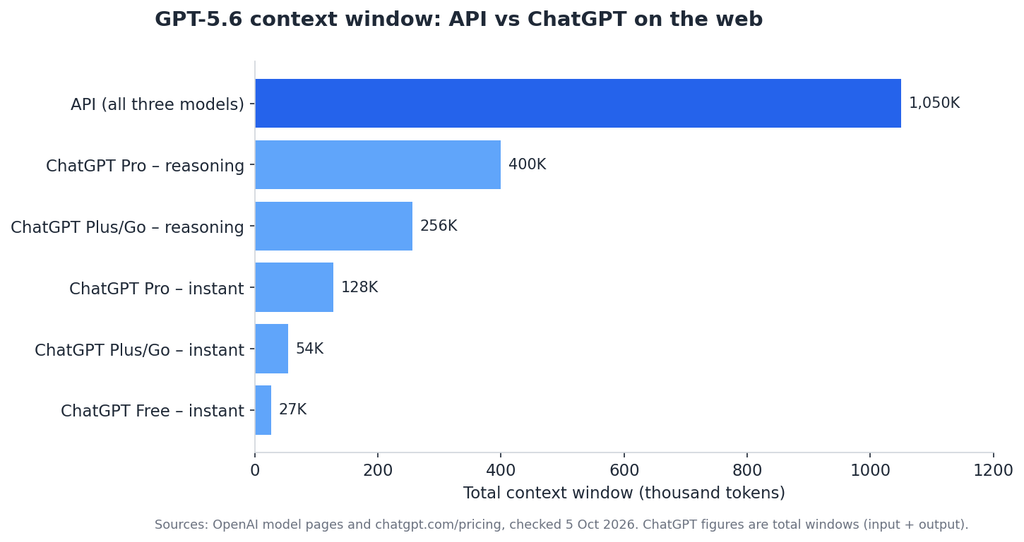
GPT-5.6 context window in the API compared with ChatGPT plans on the web
API window from OpenAI’s model pages; ChatGPT windows from chatgpt.com/pricing, both checked 5 October 2026.
| Where you use GPT-5.6 | Total context window | Rough input you can paste (OpenAI’s estimate) |
| API (Sol, Terra or Luna) | 1,050,000 tokens (max 922,000 input) | About 690,000 words |
| ChatGPT Pro, reasoning | 400K tokens | ~680 pages |
| ChatGPT Plus or Go, reasoning | 256K tokens | ~320 pages |
| ChatGPT Pro, instant | 128K tokens | ~250 pages |
| ChatGPT Plus or Go, instant | 54K tokens | ~40 pages |
| ChatGPT Free, instant | 27K tokens | ~12 pages |
Two details explain why the numbers you see quoted don’t match:
- ChatGPT’s figures are total windows. They include the reply, system instructions, memory and tool output, not just what you paste. OpenAI’s pricing page says the space left for your input “is smaller than the total window”.
- Plus doesn’t get more context than Go. Both have 54K instant and 256K reasoning. Plus adds models and higher limits, not a bigger window.
If you need the full million tokens, for example to load a large codebase or a stack of contracts in one go, you have to use the API, or a tool that calls the API, such as Codex or a coding agent with your own key.
How much do Sol, Terra and Luna cost?
Per million tokens: Sol $4 input / $20 output, Terra $2 / $12, Luna $0.20 / $1.20. Cached input is 90% cheaper for all three.
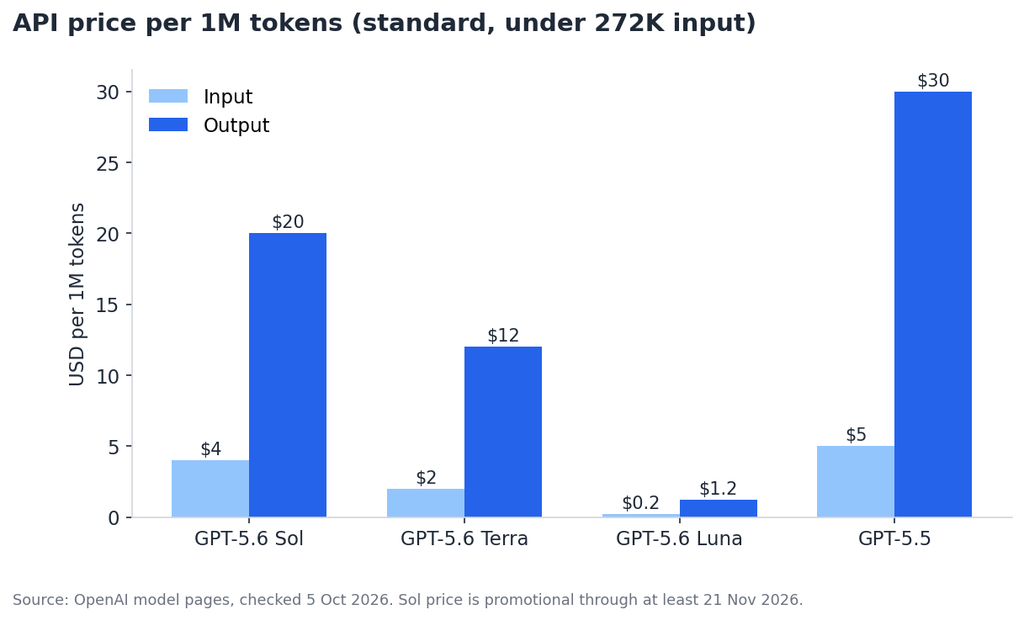
API price per million tokens for GPT-5.6 Sol, Terra, Luna and GPT-5.5
OpenAI model pages, checked 5 October 2026.
These aren’t the launch prices. At launch on 9 July, Luna cost $1/$6, Terra $2.50/$15 and Sol $5/$30. OpenAI cut Terra and Luna on 30 July. Sol is now on promotional pricing of $4/$20, which OpenAI says is available “at least through November 21, 2026”, so check before you budget past that date.
What the same workload costs on each tier, with 50 million input and 10 million output tokens a month at standard rates:
| Model | Monthly cost | vs Sol |
| GPT-5.6 Sol | $400 | — |
| GPT-5.6 Terra | $220 | 45% cheaper |
| GPT-5.6 Luna | $22 | 94.5% cheaper |
| GPT-5.5 (for reference) | $550 | 38% more |
The 272K pricing trap
All three models charge double for input and 1.5x for output on the whole request once input goes over 272,000 tokens. It’s not just the tokens above the line. The full request moves to the higher rate.
Example on Sol: a 500,000-token prompt with a 20,000-token answer costs $4.60 at the long-context rate. Split into two 250,000-token requests, the same work costs about $2.40 plus the second answer. If you use the big window often, chunking or caching can halve your bill.
Sol vs Terra vs Luna: which performs best?
Sol leads on almost every benchmark OpenAI published, but Terra is close on coding, and Luna is surprisingly strong for its price. The biggest gaps are in computer use and long-context retrieval, not coding.
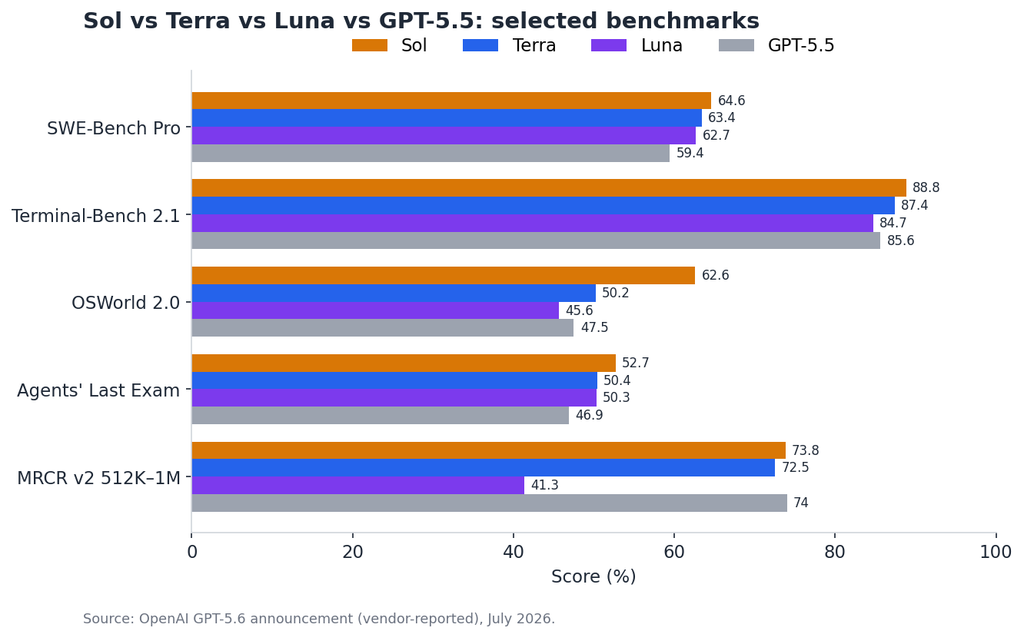
Benchmark scores for GPT-5.6 Sol, Terra, Luna and GPT-5.5
OpenAI’s own figures from the GPT-5.6 launch. These are vendor-reported, not independent tests.
| Benchmark | Sol | Terra | Luna | GPT-5.5 |
| SWE-Bench Pro (coding) | 64.6% | 63.4% | 62.7% | 59.4% |
| Terminal-Bench 2.1 (terminal tasks) | 88.8% | 87.4% | 84.7% | 85.6% |
| DeepSWE v1.1 | 72.7% | 69.6% | 67.2% | 67.0% |
| OSWorld 2.0 (computer use) | 62.6% | 50.2% | 45.6% | 47.5% |
| Agents’ Last Exam | 52.7% | 50.4% | 50.3% | 46.9% |
| GPQA Diamond (science) | 94.6% | 92.9% | 92.3% | 93.6% |
| MRCR v2 8-needle, 512K–1M (long context) | 73.8% | 72.5% | 41.3% | 74.0% |
| Artificial Analysis Intelligence Index v4.1 | 58.9 | 55.0 | 51.2 | 54.8 |
What stands out:
- Coding is nearly a tie. Only 1.9 points separate Sol and Luna on SWE-Bench Pro. For everyday code edits, Terra or even Luna may be enough.
- Computer use is where Sol earns its price. On OSWorld 2.0 Sol scores 62.6%, about 12 points ahead of Terra.
- Don’t use Luna for long documents. On the 512K–1M long-context test, Luna drops to 41.3% while Sol and Terra stay above 72%. Luna has the same million-token window on paper, but it is much worse at finding things in it.
- Claude is still ahead on SWE-Bench Pro. OpenAI’s own table shows Claude Fable 5 at 80% and Claude Opus 4.8 at 69.2%. Note that OpenAI published an audit the day before launch estimating that about 30% of SWE-Bench Pro tasks are broken.
GPT-5.6 Terra vs GPT-5.5: is Terra a good replacement?
Yes, for most work. Terra matches or beats GPT-5.5 on most of OpenAI’s benchmarks and costs less than half as much. At $2/$12 against GPT-5.5’s $5/$30, Terra is 60% cheaper on both input and output.
| GPT-5.6 Terra | GPT-5.5 | |
| Price (input / output per 1M) | $2 / $12 | $5 / $30 |
| Context window | 1,050,000 | 1,050,000 |
| SWE-Bench Pro | 63.4% | 59.4% |
| Terminal-Bench 2.1 | 87.4% | 85.6% |
| OSWorld 2.0 | 50.2% | 47.5% |
| Agents’ Last Exam | 50.4% | 46.9% |
| GPQA Diamond | 92.9% | 93.6% |
| FrontierMath Tier 4 | 68.3% | 72.5% |
| Long context (MRCR 512K–1M) | 72.5% | 74.0% |
GPT-5.5 is still slightly better on hard maths and science and on very long documents. For coding agents, tool use and general production traffic, Terra is the better buy.
Which GPT-5.6 model should you use?
Default to Terra. Move up to Sol for computer use, long multi-step agents and very long documents. Move down to Luna for simple, high-volume tasks.
- Use Sol for agents that operate a browser or desktop, long-horizon tasks across many tools, and anything where a mistake costs more than the tokens. Watch the bill: Sol is 2x Terra on input.
- Use Terra for coding assistants, chat products, RAG over normal-length documents, and most API work. It’s the best quality per dollar in the family.
- Use Luna for classification, extraction, routing, short summaries and autocomplete. Avoid it for prompts over a few hundred thousand tokens.
A practical setup is to route by task: Luna first for cheap work, Terra as the default, and Sol only when a task fails or is flagged as hard.
FAQ
What is the GPT-5.6 Sol context window?
1,050,000 tokens in the API, with up to 922,000 tokens of input and 128,000 tokens of output. That’s about 690,000 words of input. In ChatGPT it is lower: 256K on Plus and Go for reasoning answers, and 400K on Pro.
Do Sol, Terra and Luna have different context windows?
No. All three have the same 1,050,000-token API window, the same 922,000 maximum input and the same 128,000 maximum output. They differ in price and in how well they use long context: Luna scores far lower than Sol and Terra on OpenAI’s 512K–1M retrieval test.
Can I use GPT-5.6 Sol for free?
Not in ChatGPT. The pricing page lists Sol for Plus and Pro only. Free users get GPT-5.6 Luna, and limited access to Terra in ChatGPT Work and Codex on desktop.
Is the plain “gpt-5.6” model Sol?
Yes. OpenAI’s documentation says the gpt-5.6 alias routes to GPT-5.6 Sol, so unsuffixed calls are billed at Sol rates.
When was GPT-5.6 released?
OpenAI opened a limited preview in late June 2026, and Sol, Terra and Luna became generally available on 9 July 2026.
Why does my long prompt cost more than expected?
Requests with more than 272,000 input tokens are billed at 2x the input rate and 1.5x the output rate for the entire request, on all three models.
Sources
- OpenAI: GPT-5.6 Sol model page, checked 5 October 2026
- OpenAI: GPT-5.6 Terra model page, checked 5 October 2026
- OpenAI: GPT-5.6 Luna model page, checked 5 October 2026
- OpenAI: GPT-5.6 announcement and benchmark tables
- ChatGPT pricing and plan context windows, checked 5 October 2026
- Simon Willison: The new GPT-5.6 family (launch prices and SWE-Bench Pro audit)
- CloudZero: GPT-5.6 pricing (30 July price cut)
Related reading
- Claude Opus 5 vs Opus 4.8
- GPT-OSS 120B vs Gemini 3 Pro
- Codex CLI vs Claude Code
- Claude pricing plans