


- Claude Pro costs $20/month, Max 5x costs $100 and Max 20x costs $200. Using Anthropic's own published limits, Pro and Max 5x work out at exactly the same rate — about $0.80 per Claude Code prompt. Max 5x buys you headroom, not better value. Only Max 20x changes the rate, at roughly $0.40 per prompt. And there is one hard cutoff that matters more than any of the pricing: Pro cannot run Opus in Claude Code at all.
Most comparisons of these plans list the prices and stop. The interesting question is what you get per pound spent, and Anthropic publishes enough detail to work that out.
What do Claude Pro and Max cost?
Pro is $20 per month. Max comes in two tiers: 5x Pro usage at $100 per month, and 20x Pro usage at $200 per month. All three share their usage limits across Claude on the web, desktop and mobile, and Claude Code in the terminal.
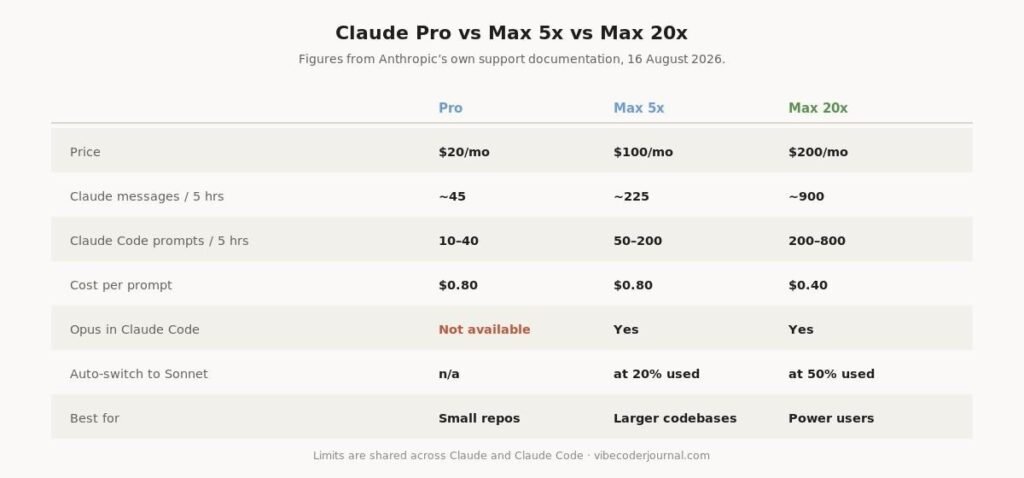
Every published figure for the three consumer plans, side by side.
| Pro | Max 5x | Max 20x | |
|---|---|---|---|
| Price | $20/month | $100/month | $200/month |
| Claude messages per 5 hours | ~45 | ~225 | ~900 |
| Claude Code prompts per 5 hours | 10–40 | 50–200 | 200–800 |
| Cost per Claude Code prompt | $0.80 | $0.80 | $0.40 |
| Opus in Claude Code | Not available | Yes | Yes |
| Weekly Sonnet hours | 40–80 | 140–280 | 240–480 |
| Weekly Opus hours | None | 15–35 | 24–40 |
| Auto-switch to Sonnet | n/a | At 20% used | At 50% used |
| Anthropic’s guidance | Small repos | Larger codebases | Power users |
Source: Anthropic support documentation, updated August 2026. Cost per prompt is our calculation from the midpoint of Anthropic’s own ranges.
Is Max 5x worth it over Pro?
Only if you need the headroom or you need Opus. It does not make your usage cheaper.
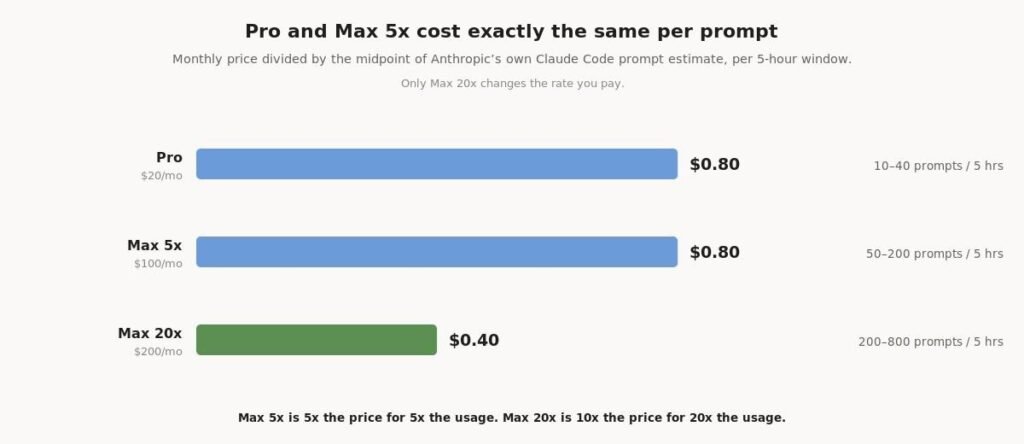
Price divided by prompts. Pro and Max 5x land on the same number.
Anthropic estimates 10–40 Claude Code prompts per five-hour window on Pro, 50–200 on Max 5x and 200–800 on Max 20x. Take the midpoints and divide by the monthly price:
- Pro: $20 ÷ 25 prompts = $0.80 per prompt
- Max 5x: $100 ÷ 125 prompts = $0.80 per prompt
- Max 20x: $200 ÷ 500 prompts = $0.40 per prompt
The naming gives it away once you see it. Max 5x is five times the usage for five times the price — a pure capacity upgrade at an identical rate. Max 20x is twenty times the usage for ten times the price. It is the only tier where the arithmetic moves in your favour.
So if you are choosing between Pro and Max 5x purely on cost efficiency, there is nothing to choose. You upgrade because you keep running out, or because you need a model Pro does not give you.
Can you use Opus with Claude Pro?
No. Pro subscribers can access Sonnet in Claude Code but cannot use Opus. Max subscribers can use either and switch between them with the /model command.
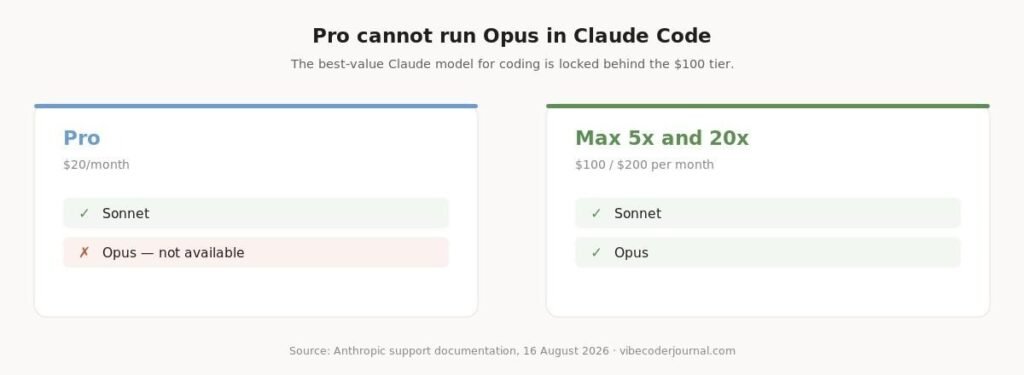
Model access by plan. This is the hard cutoff between the tiers.
This matters more than the price difference. On Terminal-Bench 2.1, Opus 4.8 is the best-value Claude model for coding — 78.9% accuracy at the lowest cost per accuracy point of any Claude model tested. On Pro you cannot run it. You are limited to Sonnet, which scored 74.6% in the same benchmark.
Put plainly: the $80/month gap between Pro and Max 5x is not really buying you more prompts at a better rate. It is buying you access to a better coding model.
How do Claude’s usage limits actually work?
Two limits run simultaneously: a rolling five-hour window and a weekly cap. Both are shared across every Claude surface you use — the web app, desktop, Cowork and Claude Code all draw from one pool.
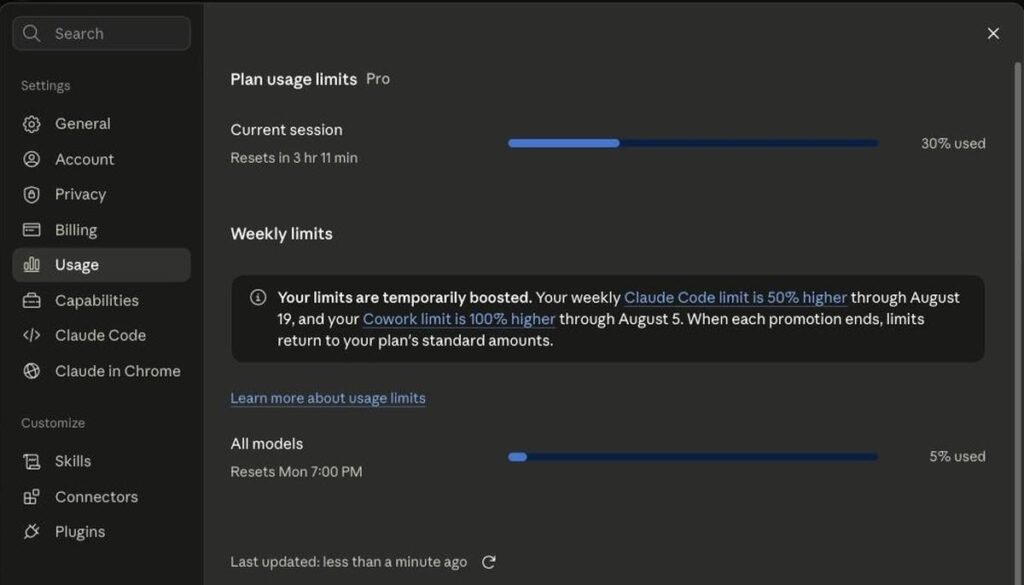
The usage panel on a live Pro account, showing the rolling session window and the separate weekly cap.
The session window shows a live countdown rather than a fixed reset time. The weekly cap resets on a specific day and hour. You can be comfortably inside one and blocked by the other.
Because the pool is shared, a morning spent chatting on the web leaves less for the terminal, and nothing in Claude Code warns you that is what happened. We covered every way to check this in our guide to seeing your Claude Code usage.
A note on Anthropic’s own figures. The support page quotes weekly hours in terms of “Sonnet 4” and “Opus 4”, model names that predate the current Sonnet 5 and Opus 5 lineup. The document was updated recently but those figures appear to be carried over. Treat the hour estimates as indicative rather than current.
The downgrade nobody warns you about
Max plans switch you from Opus to Sonnet automatically once you cross a usage threshold, mid-session, without asking.
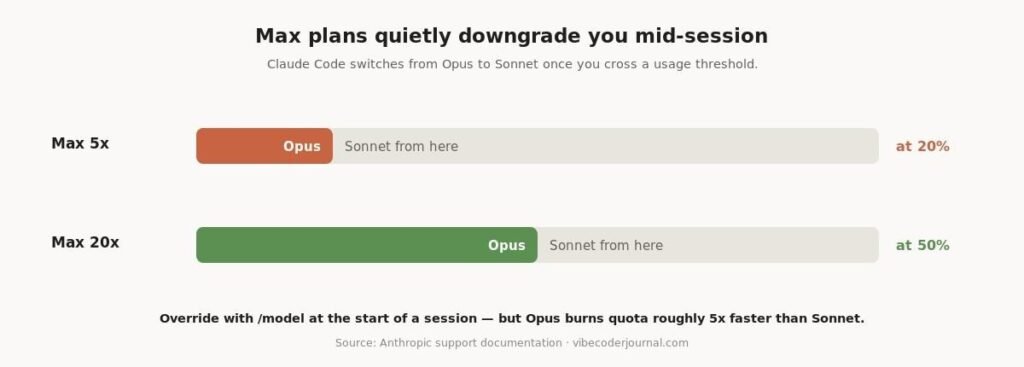
Where each Max tier stops giving you Opus.
On Max 5x the switch happens at 20% of your usage limit. On Max 20x it happens at 50%. Anthropic frames this as protecting you from burning through your quota, which is fair — Opus consumes limits roughly five times faster than Sonnet.
But it means a Max 5x subscriber gets Opus for only the first fifth of their allowance. If you bought Max specifically for Opus access, that is worth knowing. You can override it by running /model at the start of a session, and then you will simply hit your limit sooner.
What happens when you hit the limit?
You have four options: wait for the reset, enable usage credits and pay for the overflow, switch to pay-as-you-go through a Console account, or upgrade a tier.
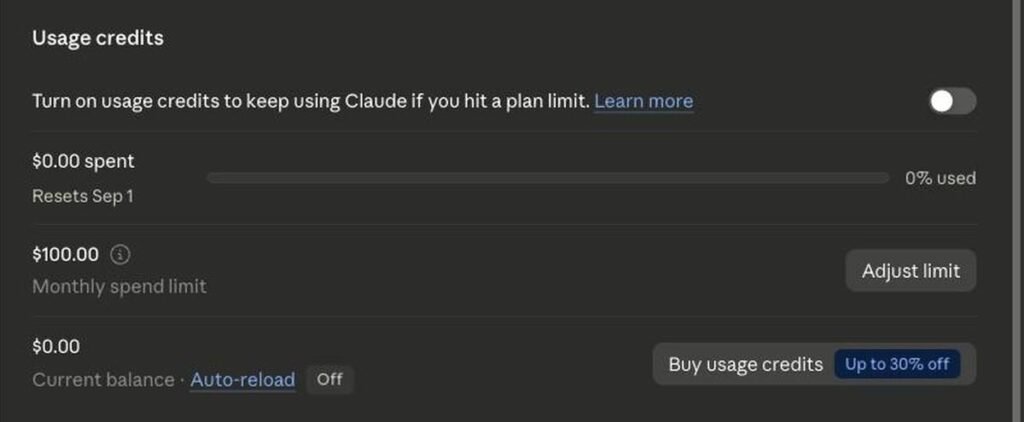
The usage credits panel. Off by default, with a $100 monthly ceiling you can adjust.
Usage credits are off by default, with a monthly spend limit that defaults to $100 and auto-reload switched off. Nothing is charged while the toggle is off — you simply get blocked.
For occasional heavy weeks, credits beat upgrading. If you exceed Pro’s limits two or three times a month, paying for that overflow is cheaper than the $80/month step up to Max 5x — which, remember, does not improve your rate anyway.
One gotcha worth checking. If you have an ANTHROPIC_API_KEY environment variable set, Claude Code uses it instead of your subscription, and you are billed at API rates on top of the plan you are already paying for. People discover this on their first Console invoice.
Which plan should you buy?
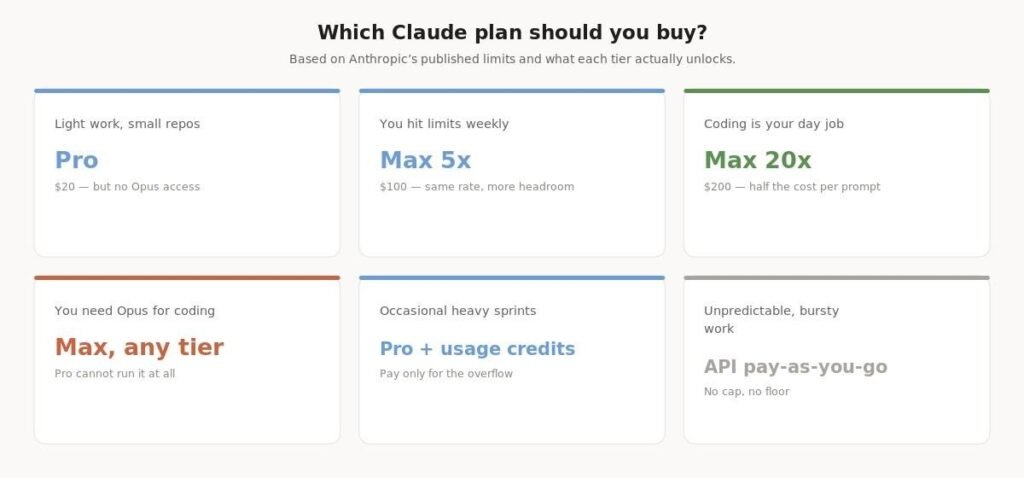
Six situations and the plan that fits each.
Stay on Pro if
- You work on small repositories and rarely hit the limit.
- You are happy with Sonnet and do not need Opus.
- You overflow occasionally — enable usage credits instead of upgrading.
Move to Max 5x if
- You hit your limit most weeks and waiting for resets is costing you time.
- You need Opus in Claude Code, which Pro does not offer at any price.
- Understand you are buying capacity, not a better rate.
Move to Max 20x if
- Coding with Claude is a daily part of your job.
- You run multiple Claude Code instances in parallel.
- You want the only tier where the cost per prompt actually halves — and you keep Opus for the first half of your allowance rather than the first fifth.
Skip subscriptions entirely if
- Your usage is unpredictable and bursty. Pay-as-you-go through the Console has no cap and no floor, though it also has no ceiling on your bill.
Comparing the $20 coding tiers? Our Cursor Pro vs ChatGPT Plus comparison breaks down which $20 plan is better for coding.
Frequently asked questions
Is Claude Max worth it over Pro?
Max 5x is worth it if you regularly hit Pro’s limits or you need Opus, which Pro cannot run in Claude Code. It is not worth it for cost efficiency: at Anthropic’s published estimates, Pro and Max 5x both work out at roughly $0.80 per Claude Code prompt. Max 20x is the only tier that improves the rate, at about $0.40.
What is the difference between Claude Max 5x and 20x?
Max 5x is $100 per month for five times Pro’s usage. Max 20x is $200 for twenty times Pro’s usage. Max 20x is therefore twice as cost-efficient. It also keeps you on Opus for the first 50% of your allowance, against 20% on Max 5x.
Does Claude Pro have usage limits?
Yes. Anthropic estimates roughly 45 Claude messages, or 10 to 40 Claude Code prompts, per rolling five-hour window, with a weekly cap on top. Limits are shared across Claude on the web, desktop, Cowork and Claude Code.
Can I use Opus with Claude Pro?
Not in Claude Code. Pro subscribers can access Sonnet only. Opus in Claude Code requires a Max plan.
How much is Claude Max?
$100 per month for Max 5x and $200 per month for Max 20x.
What happens when I hit my Claude limit?
You can wait for the window to reset, enable usage credits to pay for overflow up to a spend limit you set, switch to pay-as-you-go via a Console account, or upgrade. Usage credits are off by default and default to a $100 monthly ceiling.
Why did Claude Code switch me from Opus to Sonnet?
Max plans switch automatically to preserve your quota — at 20% of your limit on Max 5x and 50% on Max 20x. Opus consumes limits roughly five times faster than Sonnet. Override it with the /model command at the start of a session.
Methodology
All prices and usage figures are taken from Anthropic’s own support documentation and pricing pages, read on 16 August 2026, rather than from secondary sources. Cost per prompt is our calculation, dividing the monthly price by the midpoint of Anthropic’s published prompt range for each plan; it is a comparative ratio, not a guarantee of what you will get, and Anthropic is explicit that actual usage varies with codebase size, model choice and settings.
Screenshots are from a live Claude Pro account. We have no commercial relationship with Anthropic and this page contains no affiliate links.
Sources
- Using Claude Code with your Pro or Max plan — prices, prompt estimates, model access and auto-switching thresholds
- Claude plans and pricing — current consumer tiers
- Anthropic API pricing — per-token rates for pay-as-you-go comparison
Verified against primary sources on 16 August 2026. Anthropic has changed these limits several times in the past year — if a figure here no longer matches its source, tell us and we will re-verify.

[…] Codex CLI in shape and in pricing model. We cover its plan structure and usage limits separately in our Claude pricing breakdown, and compare the two agents directly in Codex CLI vs Claude […]
[…] No. API key accounts have no quota to report. Use /cost for the current session and the Anthropic Console Usage tab for history. If you are comparing monthly usage limits against subscription tiers, see our evaluation of Claude Pro vs Max pricing plans. […]
[…] Want to compare what you will lose? See our breakdown of Claude pricing plans. […]
[…] AI tools for school? See how the Claude student discount works, what Claude’s plans cost, and whether Cursor is […]
[…] on any plan, so check how much Claude Code usage you have left before starting one, and compare Claude’s plans if you plan to build pages […]