
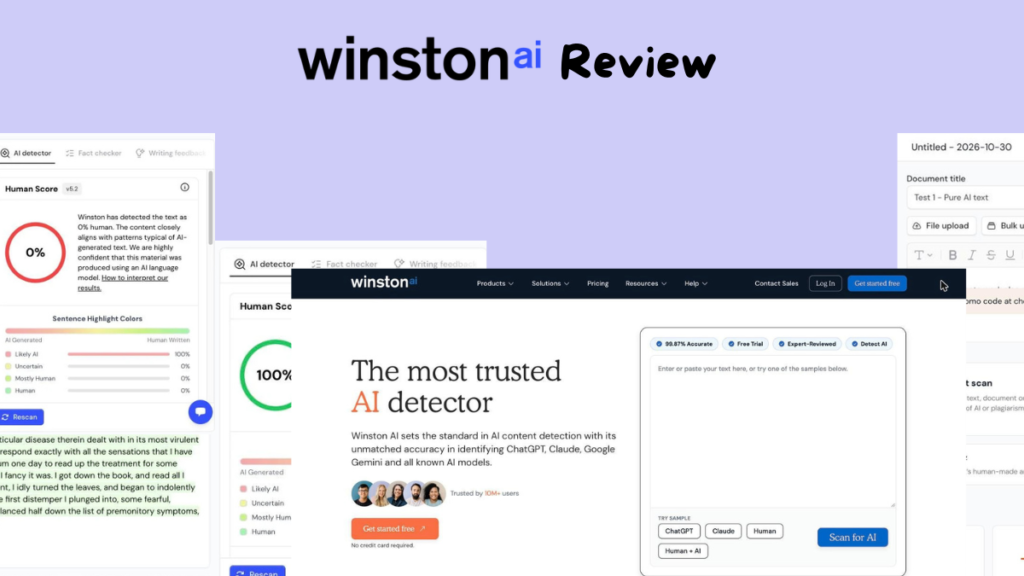
Tested and data verified on 30 October 2026 · Winston detection model v5.2
Our verdict · Tested 30 Oct 2026
Winston AI Detector
Got 4 out of 4 of our tests right, including AI text written to sound casual. Great for checking drafts, but its scores are probabilities, not proof.
Our ratings
Our 4 tests (Human Score)
| Pure AI text | 0% ✓ |
| Human text (1889 novel) | 100% ✓ |
| Half human, half AI | 55% ✓ |
| AI told to sound casual | 0% ✓ |
✓ = Winston got it right. 0% = AI, 100% = human.
Pros
- Caught casual, “human-sounding” AI text
- Sentence map found the AI half of a mixed text
- Shows the credit cost before every scan
- Plagiarism, image detection and OCR in one account
Cons
- Only a 14-day free trial, no free plan
- Plagiarism needs Advanced plan or higher
- Headline accuracy figures are self-reported
- Needs at least 500 characters per scan
Short answer: The Winston AI detector is a paid tool that gives your text a “Human Score” from 0% to 100% and colours each sentence by how AI-like it looks. In our four tests it got every one right: 0% on AI text, 100% on human text, 55% on a half-and-half mix, and 0% on AI text we told to sound casual. The free trial gives you 2,000 words over 14 days. Paid plans start at $18 a month, or half that with the WINSTON50 promo it was running in October 2026. It’s a good tool for checking drafts. It is not proof that someone cheated.
What is Winston AI?
Winston AI (gowinston.ai) is an AI writing detector from a Montreal, Canada-based company, used mostly by teachers, schools, publishers and SEO teams. You paste text or upload a file, and it estimates how likely the text was written by a person or by a model like ChatGPT, Claude or Gemini.
The same account also includes:
- Plagiarism checker that shows matching sources (Advanced plan and up)
- AI image and deepfake detection for photos made with tools like Midjourney or Nano Banana
- OCR, so you can scan photos of handwritten or printed pages
- Readability score and writing feedback
- Integrations: a Chrome extension, WordPress plugin, Google Classroom, Zapier and an API
AI detection works in English, French, Spanish, German, Portuguese, Dutch, Polish, Italian, Romanian, Indonesian, Chinese (simplified) and a few more languages (checked 30 October 2026; the list differs slightly between Winston’s homepage and help pages). Winston says it is GDPR compliant and doesn’t use your scanned text to train its models.
How we tested the Winston AI detector
We signed up for the free trial and ran four scans on 30 October 2026. Each text was 190 to 302 words, because Winston needs at least 500 characters (roughly 80 to 100 words) to scan.
The most important one is test 4. Most people trying to fool a detector don’t paste raw ChatGPT output. They ask the AI to “write like a normal person”. We wanted to see if that alone gets past Winston.
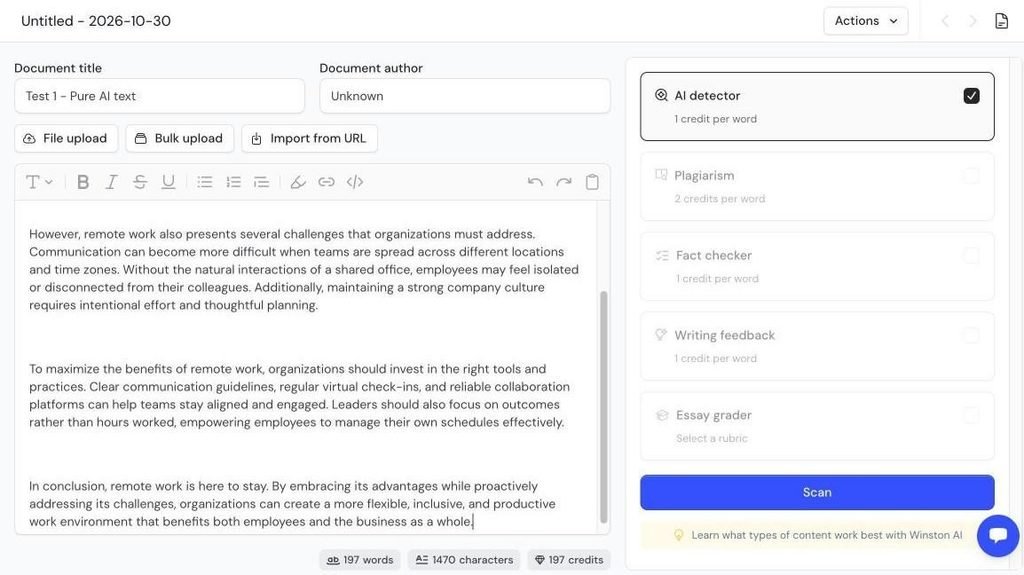
The scan screen. The counter under the text shows the cost before you scan: 197 words = 197 credits.
Winston AI review: our results (4 out of 4 correct)
In four scans on 30 October 2026 (model v5.2, free trial), Winston AI classified all four texts correctly.
| Test | What we pasted | Words | Human Score | Correct? |
|---|---|---|---|---|
| 1 | Formal AI essay on remote work | 197 | 0% | Yes |
| 2 | Opening of Three Men in a Boat (Jerome K. Jerome, 1889) | 302 | 100% | Yes |
| 3 | Half of test 2 plus an AI paragraph | 191 | 55% | Yes, and it marked the right half |
| 4 | AI text told to sound casual | 190 | 0% | Yes |
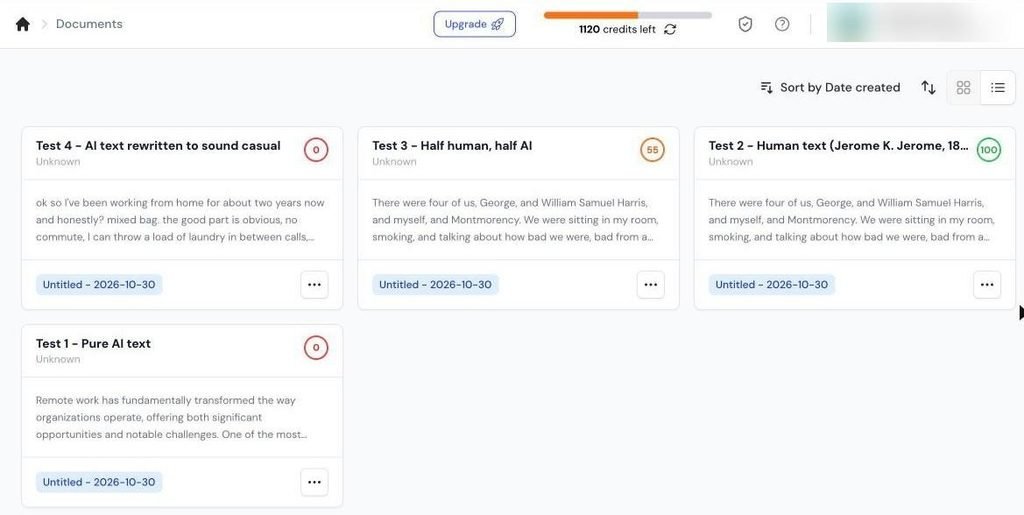
All four test scans in the Documents view. The circle on each card is the Human Score.
Test 1: Pure AI text scored 0% human
Winston was “highly confident” the remote-work essay was AI and highlighted every sentence red. No surprise: the text was full of phrases like “fundamentally transformed” and “In conclusion”, which every detector catches.
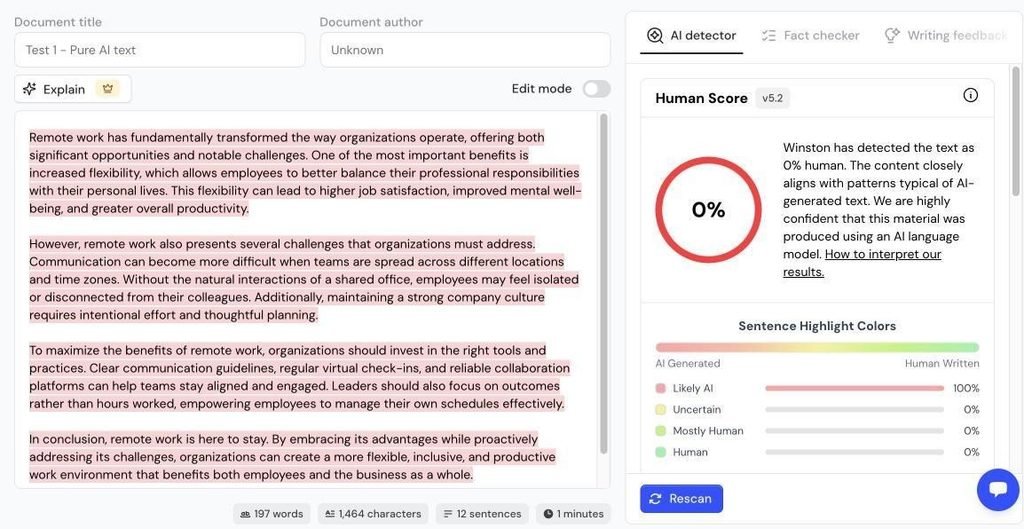
Winston AI result for AI-written text: 0% human score with every sentence highlighted red
Test 2: Human text scored 100% human
The 1889 passage came back 100% human, every sentence green. One caveat: it’s a famous public-domain book, so it may be easier to recognise than a student essay written last week. Still, Winston didn’t mistake old-fashioned, long-sentence writing for AI, which some detectors do.
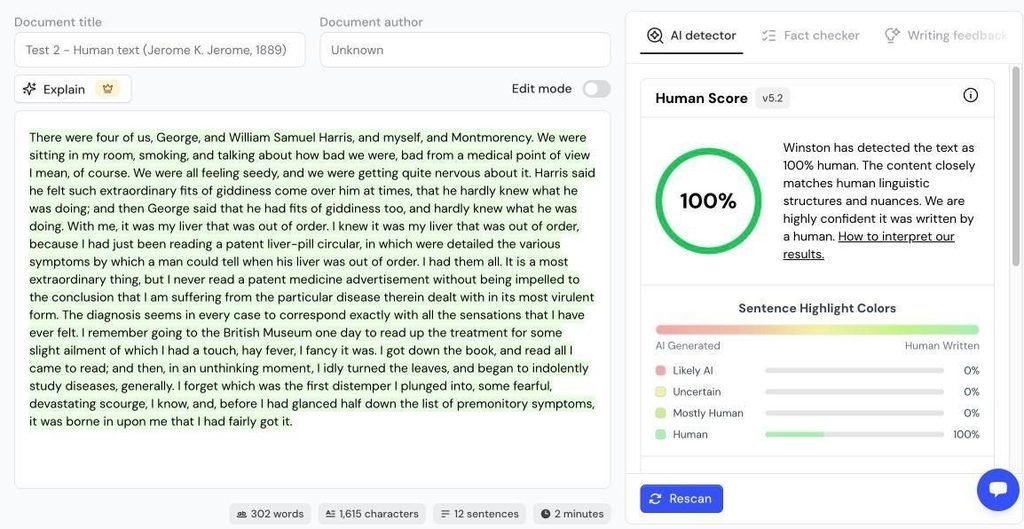
Winston AI result for human-written text: 100% human score with all sentences highlighted green
Test 3: Mixed text scored 55%, and the map found the AI half
This is where Winston is most useful. A 55% score on its own tells you very little. But the sentence map coloured the human paragraph green and the AI paragraph red, almost exactly where we joined them. The breakdown was 44% “Likely AI”, 11% “Uncertain” and 44% “Human” (rounded).
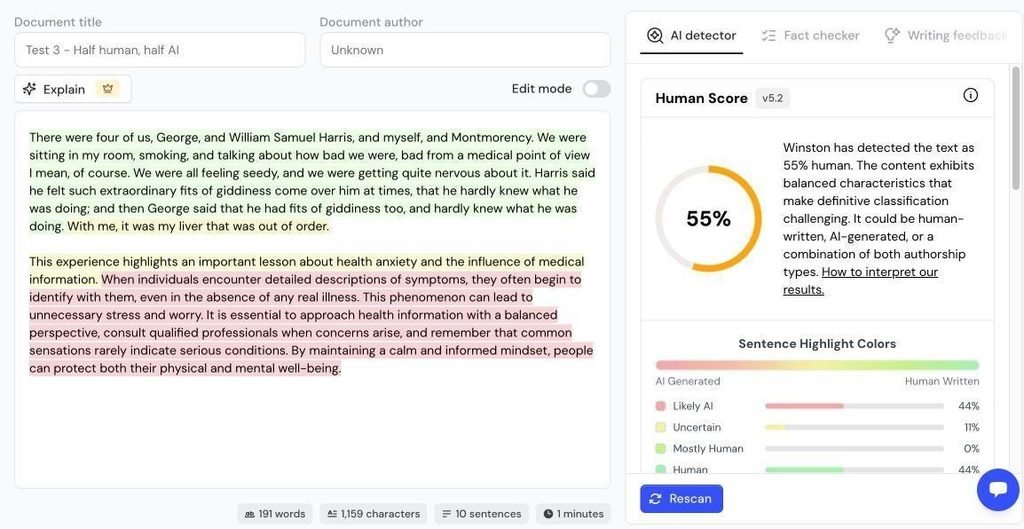
Winston AI result for mixed text: 55% human score, human paragraph in green and AI paragraph in red
Test 4: Casual AI rewrite still scored 0% human
We expected this one to slip through. It had lowercase sentences, slang (“nah”, “stir crazy”), a made-up coworker in Denver and a joke about coffee. Winston still scored it 0% human.
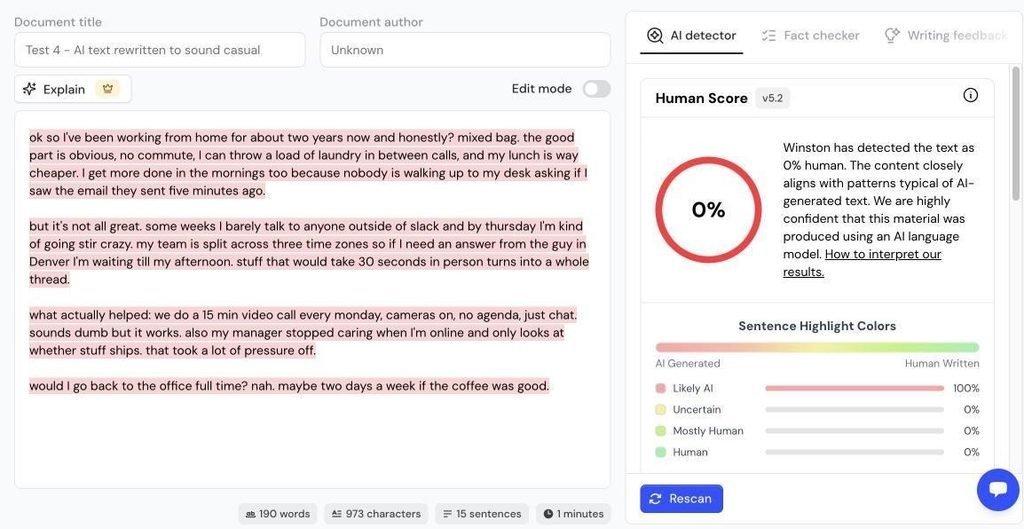
Winston AI result for AI text written in a casual style: still 0% human
So asking an AI to “sound human” is not enough to fool Winston. We didn’t test paid AI humanizer tools, which rewrite text more heavily.
How to read a Winston AI score
The Human Score is Winston’s estimate of how likely the whole text is human-written. It is not the share of words written by AI. Each sentence also gets a colour:
| Sentence score | Label |
|---|---|
| 0–20 | AI generated |
| 20–40 | Likely AI |
| 40–60 | Uncertain |
| 60–80 | Mostly human |
| 80–100 | Human written |
Winston’s own help centre says the sentence map is less accurate than the overall score, because it judges small pieces of text. Use the map to see where to look, and the overall score to decide how much to worry.
What is a good Winston AI score? For your own writing, aim for above 80%, which Winston labels “Human written”. Under 20% means Winston is confident the text is AI. Anything between 40% and 60% means “can’t tell”: read the text closely or talk to the writer, don’t treat it as a verdict.
Is Winston AI accurate?
Winston AI was accurate in our tests, 4 out of 4, but its headline accuracy figures come from Winston itself. The company advertises 99.87% accuracy for its Winston 5.0 model (we tested v5.2, which has no separate published figure). On its research page, Winston reports catching 99.89% of AI text on the RAID benchmark at a 1% false-positive rate, 100% on a University of Chicago Booth test set, and zero false positives on 25,996 PERSUADE 2.0 student essays.
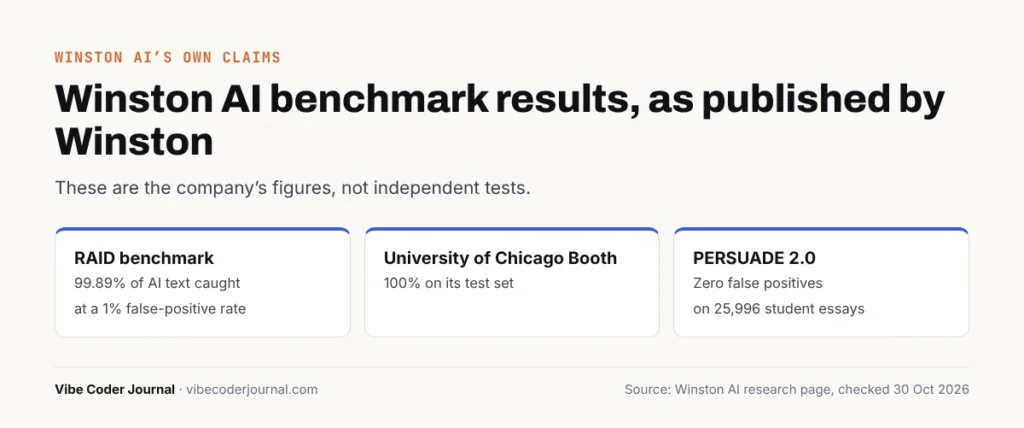
Benchmark results as published by Winston on its research page. These are the company’s own claims.
Four tests are not a study. Keep these in mind:
- Outside reviews vary. Some of the lowest scores come from competitors such as GPTZero, which published its own Winston AI review, so weigh those with care too.
- Long documents can hide AI. In GPTZero’s January 2025 test (on an older Winston model), two AI paragraphs added to a 22,000-word human novel still came back 100% human. All our tests were under 310 words.
- Short and heavily edited texts are harder for every detector.
- Non-native English writers are a known risk. A 2023 Stanford study (Liang et al., Patterns) found AI detectors flagged non-native English essays as AI far more often than native ones. It didn’t test Winston, and Winston doesn’t publish a separate false-positive rate for non-native writers.
Our view: Winston is one of the stronger detectors and did well in our tests. It is still a probability score, so never punish a student or reject a writer on a Winston score alone.
Winston AI pricing in 2026
Winston AI costs $18, $29 or $49 a month for its Essential, Advanced and Elite plans (30 October 2026), or $9, $14.50 or $24.50 with the WINSTON50 promo code. There is no permanent free plan, only a 14-day trial.
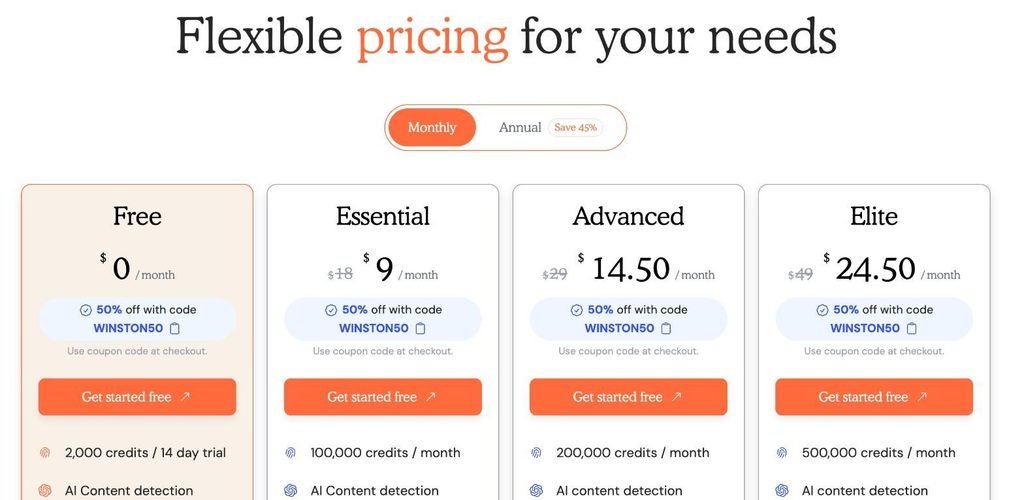
Monthly prices on 30 October 2026. Source: gowinston.ai/pricing
| Plan | Monthly | With WINSTON50 (promo, may end) | Credits | Adds |
|---|---|---|---|---|
| Free trial | $0 | – | 2,000 for 14 days | AI text and image detection, OCR |
| Essential | $18 | $9 | 100,000 / month | Writing feedback, PDF reports |
| Advanced | $29 | $14.50 | 200,000 / month | Plagiarism checker, up to 5 team members |
| Elite | $49 | $24.50 | 500,000 / month | Plagiarism, unlimited team members |
Annual billing is cheaper: $120, $192 or $312 a year, or $60, $96 or $156 with the code.
How Winston AI credits work
| Feature | Cost |
|---|---|
| AI text detection | 1 credit per word |
| Plagiarism check | 2 credits per word |
| Fact checker | 1 credit per word |
| Writing feedback | 1 credit per word |
| AI image detection | 200 credits (basic) or 500 (advanced) |
So 100,000 credits is about 100,000 words of AI checks a month, or about 33,000 words if you also run plagiarism on everything. Credits don’t roll over, and a rescan costs credits again. Our four tests used 880 of the 2,000 free credits.
Winston AI free trial: what you get
The trial gives you 2,000 credits for 14 days, roughly 2,000 words of AI detection or 5 to 10 essays. No credit card is needed. In our trial account, downloading reports and the “Explain” button were locked behind paid plans, and plagiarism checks weren’t available.
How to use the Winston AI detector
- Go to gowinston.ai and click Get started free. Sign up with email or Google.
- Click New text scan in the left sidebar.
- Paste at least 500 characters, or upload a .docx, .pdf or .txt file. You can also import a URL or a Google Drive file.
- Leave AI detector ticked, and tick Plagiarism if your plan includes it. Check the credit counter under the text box.
- Click Scan. Results take a few seconds.
- Read the Human Score first, then scroll the text to see which sentences are red, yellow or green.
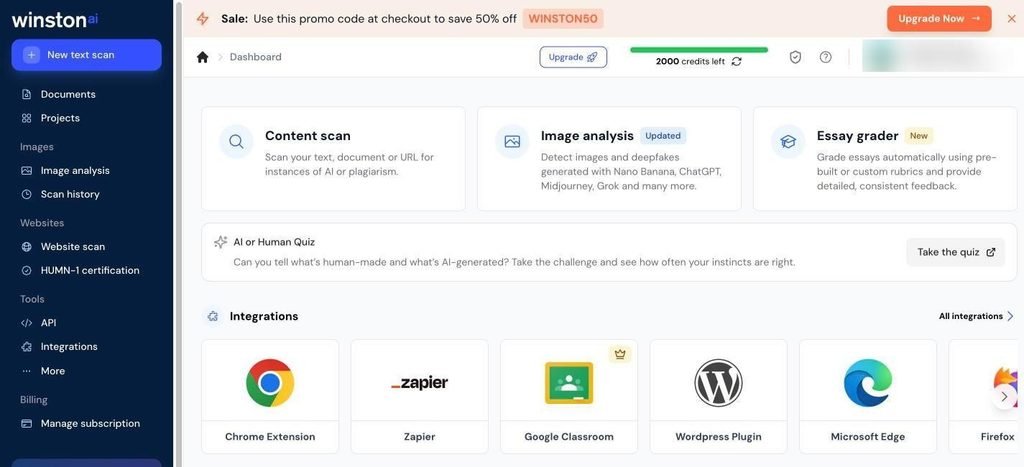
The Winston dashboard after signing up. Account details blurred.
Who should use Winston AI?
Winston AI is best for people who check text every week. It isn’t worth paying for if you only scan a few short texts a year.
Good fit:
- Teachers who want a second opinion on essays, now that students can get tools like Claude cheaply (see our Claude student discount guide), with highlights they can discuss with the student
- Editors and SEO teams checking freelance articles before publishing
- Writers who want to make sure their own work won’t be wrongly flagged by a client
Skip it if:
- You need a final verdict for a disciplinary decision. No detector should be used that way.
- Your text is under about 100 words. Winston won’t scan it.
Winston AI alternatives
- GPTZero: popular with teachers and has a free tier.
- Originality.ai: aimed at SEO and publishing teams, with pay-as-you-go credits.
- Turnitin: only sold to schools; use it if your institution already has it.
Winston AI pros and cons
Pros
- Got all four of our tests right, including AI text written to sound casual
- The sentence map found the AI half of a mixed text
- Clear credit counter before every scan
- Plagiarism, image detection and OCR in one account
- Google Classroom, WordPress, Zapier and API integrations
Cons
- No permanent free plan, only a 14-day trial
- Plagiarism costs double and needs the Advanced plan or higher
- Headline accuracy figures are the company’s own
- 500-character minimum rules out short answers and social posts
- The 50% discount is a promotion and may end
FAQ
Is Winston AI free?
Partly. Winston AI has a 14-day free trial with 2,000 credits, about 2,000 words of AI detection, and no credit card is needed. After that you need a paid plan from $18 a month, or $9 with the WINSTON50 promo code it was offering in October 2026.
Is Winston AI legit?
Yes. Winston AI is a real, paid detection service at gowinston.ai, run by a company based in Montreal, with a public API and integrations for Google Classroom, WordPress and Zapier. In our 30 October 2026 tests it classified all four texts correctly. Like every detector, though, its scores are probabilities, not proof.
How accurate is Winston AI?
Winston claims 99.87% accuracy for its 5.0 model. In our four tests on 30 October 2026 (model v5.2), it scored pure AI text 0% human, human text 100%, a half-and-half text 55% and casual AI text 0%, all correct. Treat any single score as a probability, not proof.
Can Winston AI detect ChatGPT and Claude?
Yes. Winston AI says its detector is trained on text from ChatGPT, Claude, Gemini, Llama and other major models. In our 30 October 2026 tests on model v5.2, both AI-written texts scored 0% human, including one we told the AI to write in a casual, human-sounding style.
Does Winston AI detect humanized AI text?
Partly tested. Asking an AI to “sound like a real person” did not fool Winston: our casual AI text still scored 0% human on 30 October 2026. We didn’t test paid AI humanizer tools, which rewrite text more heavily, so we can’t confirm how Winston handles those.
What does the Winston AI Human Score mean?
The Human Score is Winston’s estimate, from 0% to 100%, of how likely the whole text was written by a person. Near 0% means almost certainly AI, near 100% means human, and around 40–60% means it can’t tell. It is not the percentage of words written by AI.
How many words can I check with Winston AI?
Winston charges 1 credit per word for AI detection and needs at least 500 characters per scan. The trial covers about 2,000 words, and Essential, Advanced and Elite cover 100,000, 200,000 and 500,000 words a month. Plagiarism costs 2 credits per word, and unused credits don’t roll over.
Winston AI vs Turnitin: which is better?
They do different jobs. Turnitin is sold only to schools and built into their assignment systems, so students and freelance writers can’t buy it to check their own work. Winston is open to anyone and adds image detection and OCR. If your school already has Turnitin, use it and add Winston as a second opinion.
Can Winston AI be wrong?
Yes. Every AI detector can flag human writing as AI or miss AI text, especially in short, long, heavily edited or non-native English writing. Winston’s own help centre says its sentence highlights are less accurate than the overall score. Use it as one piece of evidence, never the only one.
Final verdict
Winston AI did better in our tests than we expected, including spotting the exact AI paragraph in a mixed document. The credit system is clear and the discounted price is fair for regular users. Just remember that the big accuracy numbers are its own, and no detector should decide someone’s grade or job alone. Use Winston to find text worth a closer look, then let a person make the call.

Keep exploring