
By Abdullah Zulfiqar · Data checked 27 October 2026 · 9 min read
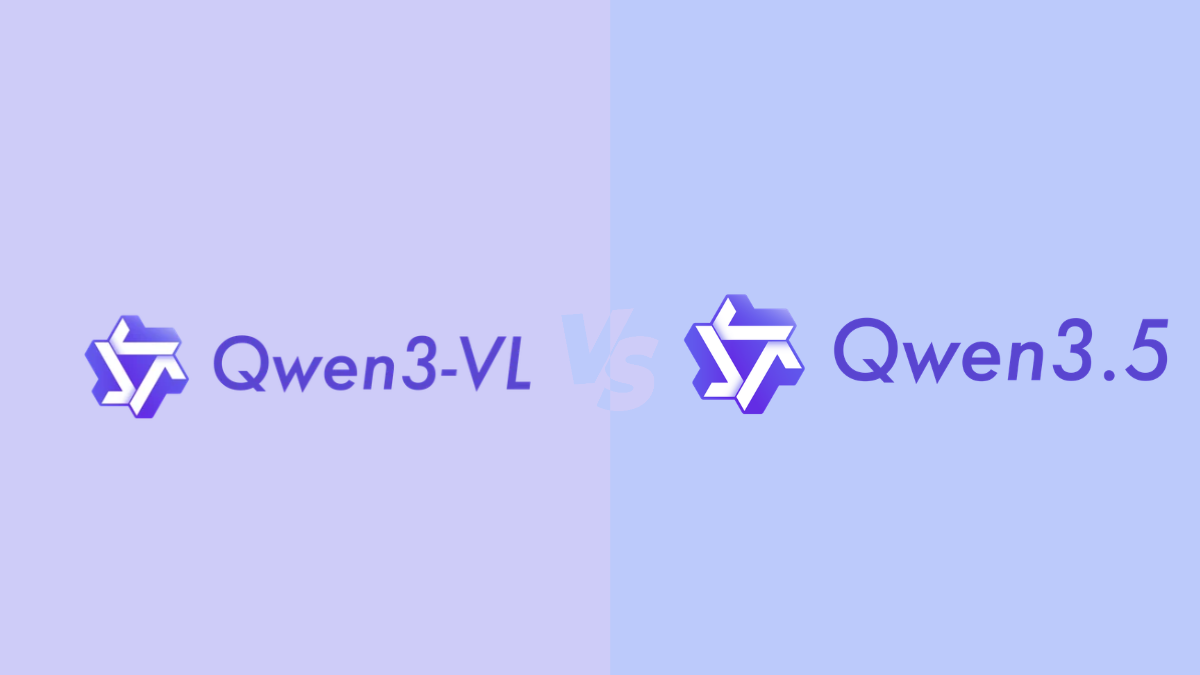
Gemma 4 E4B vs Qwen 3.5 9B: which is better? Qwen 3.5 9B wins almost every benchmark, often by a lot. On the official model cards it beats Gemma 4 E4B on GPQA Diamond (81.7 vs 58.6), LiveCodeBench (65.6 vs 52.0) and the TAU2 agent test (79.1 vs 42.2). Both need about 6GB of memory at 4-bit, so for most laptop and desktop users Qwen 3.5 9B is the easy pick. Gemma 4 E4B still makes sense on phones and edge devices, and when you need audio input, which Qwen doesn’t have.
Verdict: For coding, agents, reasoning and image understanding on a laptop or desktop, pick Qwen 3.5 9B. Pick Gemma 4 E4B if you’re building for phones or low-power devices, or you need speech or audio input. Even Qwen’s smaller 4B model beats Gemma 4 E4B on most of the tests below.
How to read these numbers: all scores are self-reported by Google and Alibaba on their official Hugging Face model cards. Neither card compares against the other, so each score comes from that lab’s own test setup. Treat small gaps as noise. The gaps here are mostly large. We haven’t run our own tests on these two models.
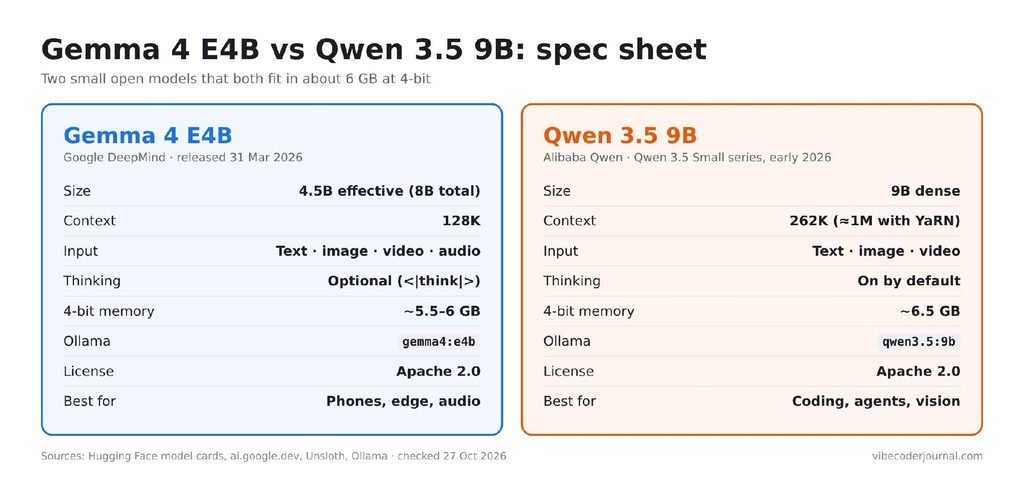
| Gemma 4 E4B | Qwen 3.5 9B | |
|---|---|---|
| Maker | Google DeepMind | Alibaba (Qwen team) |
| Released | 31 March 2026 | Early 2026 (Qwen 3.5 family) |
| Size | 4.5B effective (8B with embeddings) | 9B dense |
| Context | 128K | 262K native (up to ~1M with YaRN) |
| Input | Text, image, audio, video | Text, image, video |
| Thinking mode | Yes, optional | Yes, on by default (can switch off) |
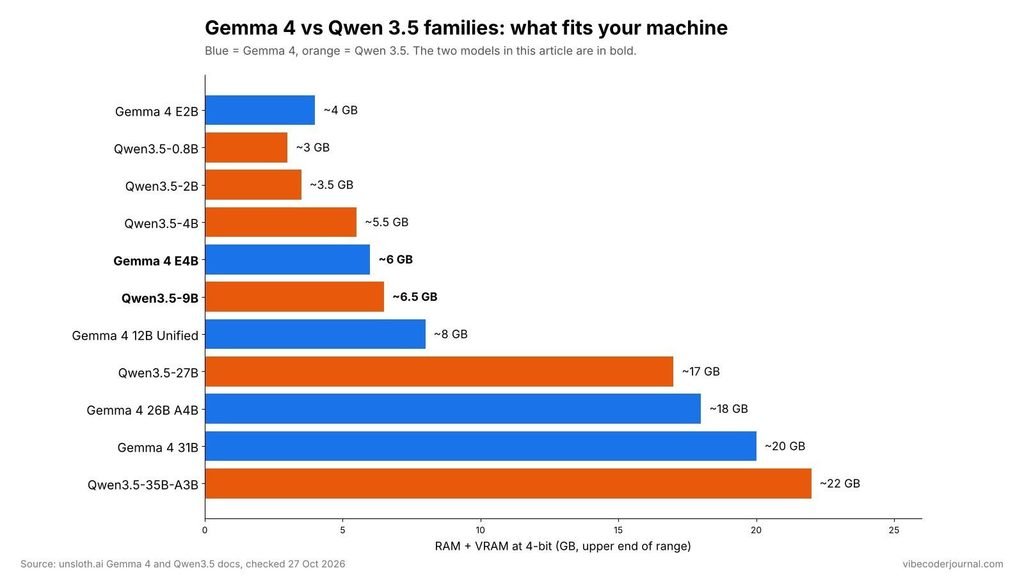
| Memory at 4-bit | ~5.5–6GB | ~6.5GB |
| Ollama tag | gemma4:e4b | qwen3.5:9b |
| License | Apache 2.0 | Apache 2.0 |
What are Gemma 4 E4B and Qwen 3.5 9B?
Gemma 4 E4B is one of Google’s two small “edge” models in the Gemma 4 family, released on 31 March 2026. The “E” stands for effective parameters. It uses Per-Layer Embeddings (PLE), so it has about 8B parameters in total but behaves like a 4.5B model when it runs. Google built E2B and E4B for phones and laptops. It’s one of the few small open models that also takes audio input: up to 30 seconds of speech or sound, plus images and short video.
Qwen 3.5 9B is the largest model in Alibaba’s Qwen 3.5 “Small” series (0.8B, 2B, 4B and 9B), from early 2026. It’s a dense 9B model with the same hybrid Gated DeltaNet design as the bigger Qwen 3.5 models. It reads text, images and video, has a 262K context window, and thinks before answering by default.
Strictly, they’re not the same size class. Qwen 3.5 9B runs about twice as many parameters per token as Gemma 4 E4B. But in practice they compete for the same spot, because both download as roughly 6–7GB files and fit the same 8GB to 16GB machines.
Benchmarks: Qwen 3.5 9B wins clearly
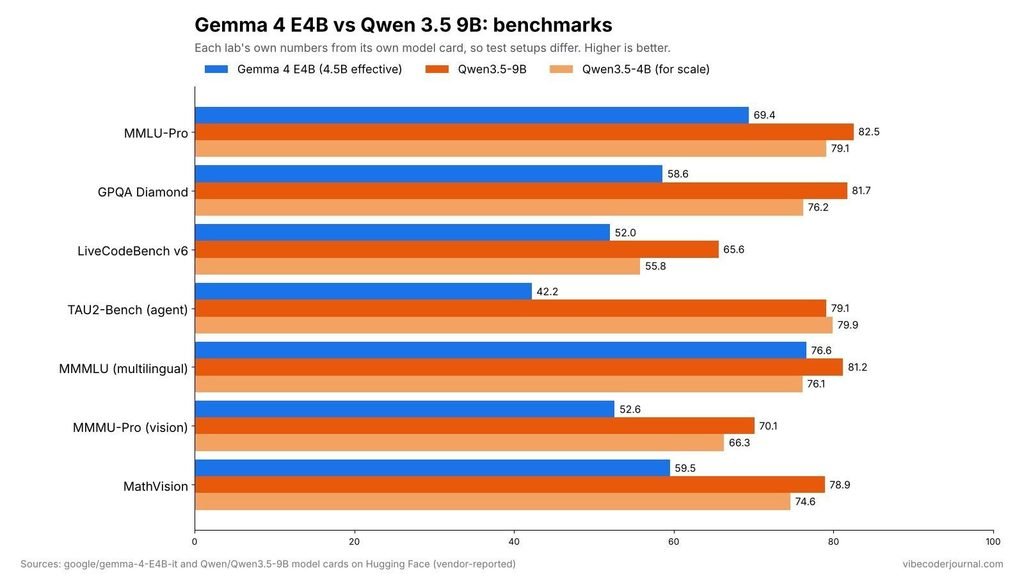
| Benchmark | Gemma 4 E4B | Qwen3.5-9B | Qwen3.5-4B |
|---|---|---|---|
| MMLU-Pro (knowledge) | 69.4 | 82.5 | 79.1 |
| GPQA Diamond (science reasoning) | 58.6 | 81.7 | 76.2 |
| LiveCodeBench v6 (coding) | 52.0 | 65.6 | 55.8 |
| TAU2-Bench (agents and tools) | 42.2 | 79.1 | 79.9 |
| MMMLU (multilingual) | 76.6 | 81.2 | 76.1 |
| MMMU-Pro (image reasoning) | 52.6 | 70.1 | 66.3 |
| MathVision (visual math) | 59.5 | 78.9 | 74.6 |
| MedXpertQA multimodal | 28.7 | 49.9 | 42.9 |
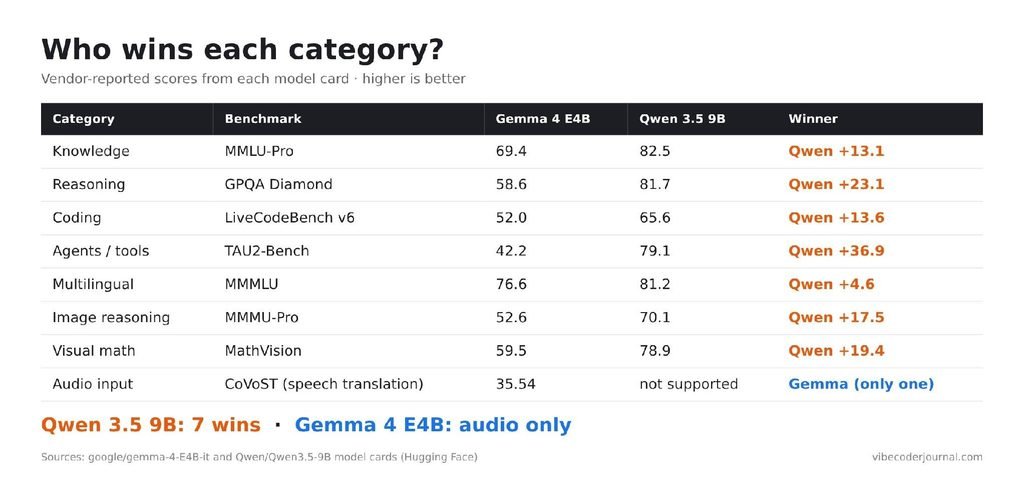
Qwen 3.5 9B leads every shared test. The biggest gaps: – Agents and tool use: TAU2-Bench 79.1 vs 42.2. If you want a small model to call tools or drive an agent loop, Qwen is in a different league. – Reasoning: GPQA Diamond 81.7 vs 58.6. – Images: MMMU-Pro 70.1 vs 52.6, and MathVision 78.9 vs 59.5.
Coding is closer but still a clear win for Qwen: 65.6 vs 52.0 on LiveCodeBench v6. Google also reports a Codeforces Elo of 940 for Gemma 4 E4B. Qwen doesn’t report Elo for the 9B, so there’s no direct comparison there.
Qwen’s own 4B model also beats Gemma 4 E4B on most of these tests, and it’s an even smaller download (qwen3.5:4b is 3.3–4.0GB on Ollama).
Where Gemma 4 E4B does well
- Audio: Gemma 4 E4B accepts audio input, with 35.54 on CoVoST speech translation per Google’s card. Qwen 3.5 9B doesn’t take audio at all.
- Multilingual: MMMLU 76.6, only 4.6 points behind Qwen. This is its closest result.
- Built for devices: Google designed E2B and E4B to run on phones and laptops, and the PLE design keeps the compute per token at the 4.5B level.
Memory and local setup
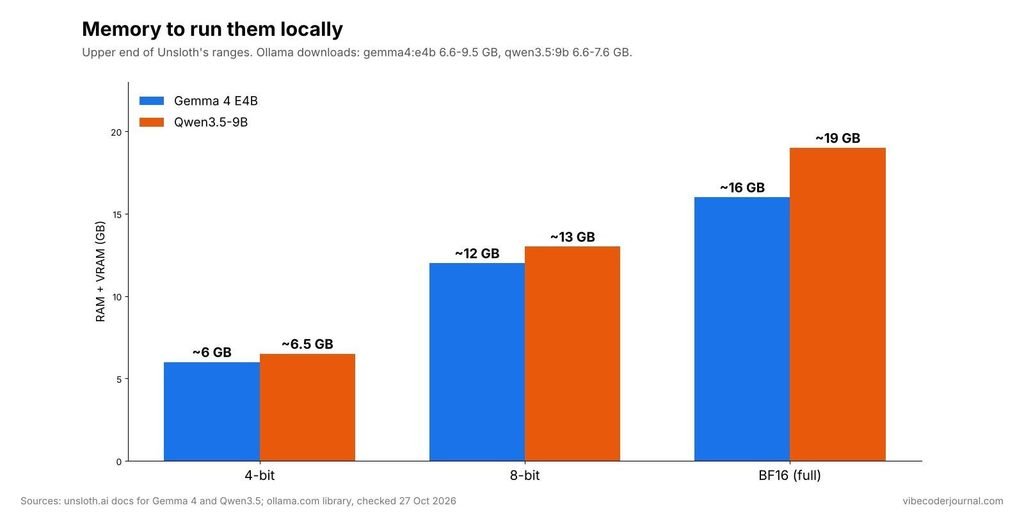
| Gemma 4 E4B | Qwen 3.5 9B | |
|---|---|---|
| 4-bit | 5.5–6GB | 6.5GB |
| 8-bit | 9–12GB | 13GB |
| Full precision (BF16) | 16GB | 19GB |
| Ollama download | 6.6–9.5GB (gemma4:e4b) | 6.6–7.6GB (qwen3.5:9b) |
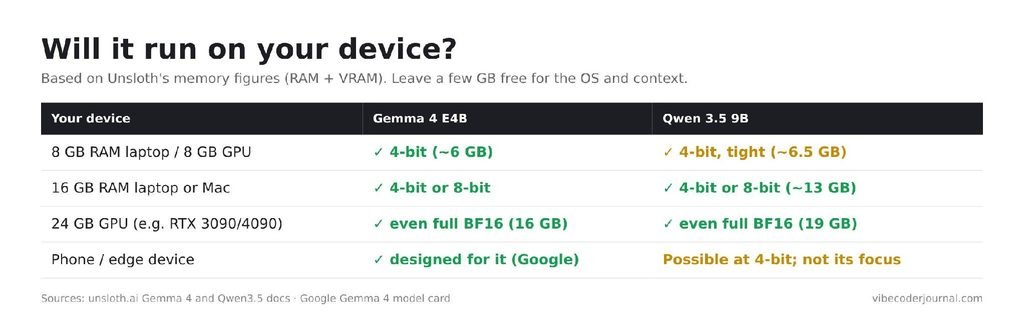
At 4-bit both fit an 8GB GPU, or any laptop with 16GB of RAM.
ollama run gemma4:e4b
ollama run qwen3.5:9b
On Ollama both list text and image input. Gemma’s audio input is documented on its Hugging Face card for Transformers, but Ollama’s library page lists only text and image for gemma4:e4b.
For more local setup help, see our run LLMs locally, what fits in 32GB and Ollama troubleshooting guides.
Context window, thinking and license
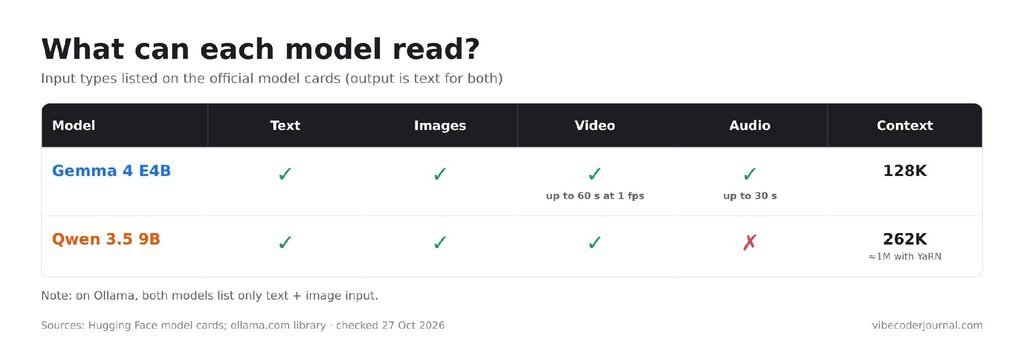
- Context: Qwen 3.5 9B handles 262K tokens natively, and up to about 1M with YaRN scaling. Gemma 4 E4B handles 128K. For long codebases or documents, Qwen holds twice as much. Qwen’s card also reports strong long-context scores, such as 63.0 on AA-LCR.
- Thinking: both can reason step by step before answering. Qwen thinks by default, and you turn it off with enable_thinking: False. Gemma 4 thinks only when you add the <|think|> token to the system prompt. How to switch thinking on and off with Hugging Face Transformers (from the official model cards):
# Qwen 3.5 9B: thinking is ON by default; turn it off like this
text = tokenizer.apply_chat_template(
messages, tokenize=False, add_generation_prompt=True,
enable_thinking=False,
)
# Gemma 4 E4B: thinking is OFF unless you ask for it
text = processor.apply_chat_template(
messages, tokenize=False, add_generation_prompt=True,
enable_thinking=True,
)
Qwen’s card also says it doesn’t support the old Qwen 3 /think and /nothink switches. Use the enable_thinking setting instead.
- License: both use Apache 2.0. Gemma 4’s card also links to Google’s Gemma 4 terms. Both allow commercial use.
Need more power? The bigger Gemma 4 and Qwen 3.5 models
Both models are part of larger families, so you can step up or down without changing ecosystem:
- Smaller: Gemma 4 E2B (about 4GB), and Qwen3.5-0.8B, 2B and 4B (about 3 to 5.5GB). For an 8GB machine, Qwen3.5-4B is the sweet spot.
- Middle: Gemma 4 12B Unified (about 8GB), added on 3 June 2026.
- Big but still local: Qwen3.5-27B (about 17GB), Gemma 4 26B A4B (about 18GB), Gemma 4 31B (about 20GB) and Qwen3.5-35B-A3B (about 22GB). Any of these fits a 24GB GPU or a 32GB Mac, and they’re far stronger than either 9B-class model.
Which should you choose?
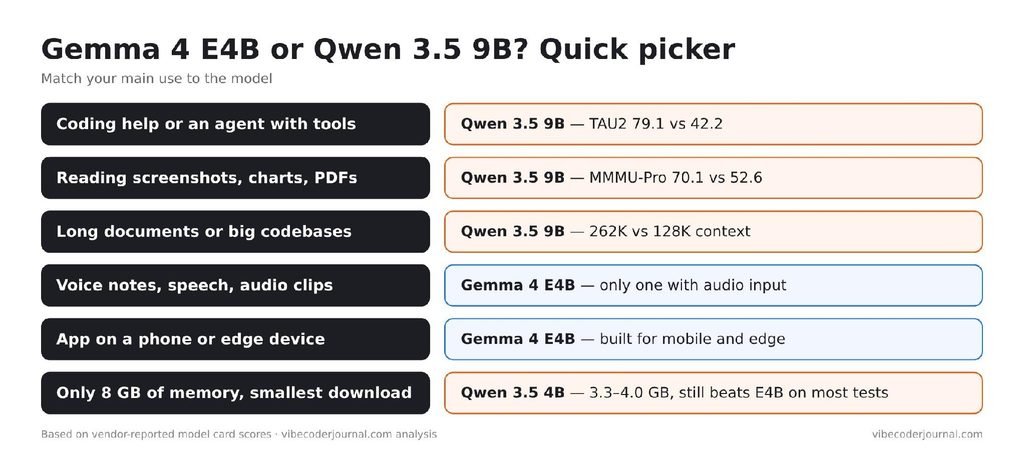
Choose Qwen 3.5 9B if: – you want the best small local model for coding help, reasoning or agents – you use tools, function calling or MCP with a local model (TAU2 79.1 vs 42.2) – you work with screenshots, charts or documents as images – you need a long context (262K vs 128K)
Choose Gemma 4 E4B if: – you’re building for phones or low-power edge devices – you need audio input, like voice notes, speech translation or transcription – you want a model that keeps compute per token at the 4.5B level
For vibe coding on a laptop: Qwen 3.5 9B is the better default. If you have about 17–22GB of memory, the larger Qwen3.5-27B or 35B-A3B, or Gemma 4’s 26B A4B, will be much stronger again. See our local coding models benchmark.
Related comparisons: Kimi K2.5 vs Qwen 3.5, GLM-5.2 vs Qwen 3.6 and Qwen 2.5 vs Qwen 3.5.
Frequently asked questions
Is Gemma 4 E4B better than Qwen 3.5 9B?
No, not on benchmarks. Qwen 3.5 9B beats Gemma 4 E4B on every test both labs report, including GPQA Diamond (81.7 vs 58.6), LiveCodeBench (65.6 vs 52.0) and TAU2-Bench (79.1 vs 42.2). Gemma 4 E4B’s advantages are audio input and its design for phones and edge devices.
Which is better for coding, Gemma 4 E4B or Qwen 3.5 9B?
Qwen 3.5 9B. It scores 65.6 on LiveCodeBench v6, against 52.0 for Gemma 4 E4B. It’s also much better at agent and tool tasks, which matters for coding assistants. For serious local coding, consider Qwen3.5-27B if you have about 17GB of memory.
How much RAM do Gemma 4 E4B and Qwen 3.5 9B need?
At 4-bit, Gemma 4 E4B needs about 5.5 to 6GB and Qwen 3.5 9B about 6.5GB of RAM plus VRAM, according to Unsloth. At full precision it’s about 16GB and 19GB. Both run on an 8GB GPU or a 16GB laptop at 4-bit.
Does Qwen 3.5 9B support audio?
No. Qwen 3.5 9B accepts text, images and video. Gemma 4 E4B accepts text, images, video and audio of up to 30 seconds, according to Google’s model card. Ollama’s library currently lists only text and image input for both.
What is the context window of Gemma 4 E4B vs Qwen 3.5 9B?
Gemma 4 E4B supports 128K tokens. Qwen 3.5 9B supports 262,144 tokens natively and up to about 1,010,000 with YaRN scaling. Ollama lists 128K for gemma4:e4b and 256K for qwen3.5:9b.
What does the “E” in Gemma 4 E4B mean?
It means “effective” parameters. Gemma 4 E4B uses Per-Layer Embeddings, which add large lookup tables that are cheap to use. It has about 8B parameters including embeddings but behaves like a 4.5B model in compute, which is why it suits phones and laptops.
Are Gemma 4 and Qwen 3.5 free to use commercially?
Yes. Both are open-weight under Apache 2.0, and Gemma 4’s card also links to Google’s Gemma 4 terms. You can download them from Hugging Face or run them with Ollama for free.
Sources
Checked 27 October 2026:
- Gemma 4 E4B model card (Google): https://huggingface.co/google/gemma-4-E4B-it
- Gemma releases page (Google AI for Developers): https://ai.google.dev/gemma/docs/releases
- Qwen3.5-9B model card (Qwen): https://huggingface.co/Qwen/Qwen3.5-9B
- Ollama library: ollama.com/library/gemma4 and ollama.com/library/qwen3.5

Keep exploring