
Tested and data verified on 4 November 2026 · Originality model 5.0 and 5.0 Max
Final verdict · Tested 4 Nov 2026
Originality.ai vs Winston AI: same 4 tests
| What we checked | Originality.ai | Winston AI | Winner |
|---|---|---|---|
| Overall accuracy | 4 of 4 correct | 4 of 4 correct | Tie |
| Casual AI text | 87% AI, caught | 0% human, caught | Tie |
| Sentence highlights | Blurry on mixed text | Split the AI and human halves cleanly | Winston |
| Free use | 100 credits (~10,000 words), no account needed | 2,000 words for 14 days, sign-up needed | Originality |
| Paid price | $14.95/mo for 200,000 words | $18/mo for 100,000 words | Originality |
| Minimum length | 100 words | 500 characters (~80–100 words) | Tie |
| Extra tools | Plagiarism, grammar, readability, fact-checking | Plagiarism, image detection, OCR | Depends |
Our verdict: Originality.ai is the better value for publishers, SEO agencies and editors. Its overall scores were right every time, but read the score, not the highlights. Use model 5.0, because 5.0 Max cost 10x the credits for the same result.
Prices checked 4 Nov 2026 (Originality.ai) and 30 Oct 2026 (Winston AI). Scores come from our own tests, not the companies’ claims.
Short answer: The Originality AI detector is a paid AI checker built mainly for publishers, SEO teams and editors. It tells you what percentage of your text is likely AI and highlights each sentence. In our four tests it labelled every text correctly: 98% AI on AI text, 100% original on human text, “Mixed” (54% AI) on a half-and-half text, and 87% AI on AI text we told to sound casual. You get 100 free credits (about 10,000 words) without signing up. The Pro plan costs $14.95 a month ($12.95 billed annually). Its sentence highlights were less precise than its overall score, so read the score first.
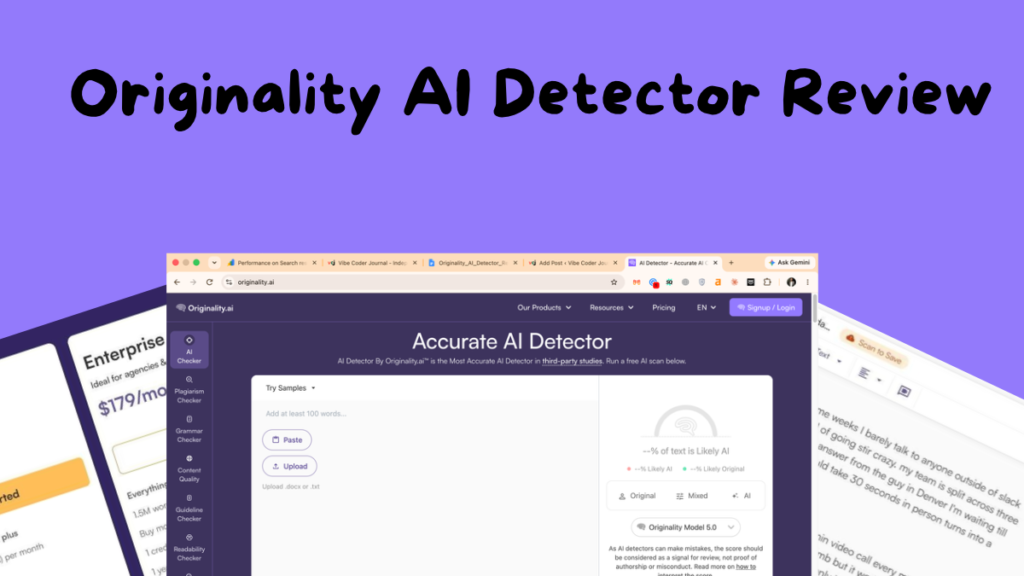
Originality.ai’s free AI scan box, November 2026. Source: originality.ai
What is Originality.ai?
Originality.ai (often searched as “Originality AI”) is an AI content detector and plagiarism checker from a company based in Collingwood, Ontario, Canada. It was built for people who buy or publish content, like website owners, agencies and editors, and is now also used by teachers.
You paste text, upload a file or scan a URL, and it gives you:
- AI score: the share of the text that is likely AI, with three labels: Original, Mixed or AI
- Sentence highlights from green (likely original) to red (likely AI)
- Plagiarism checker with matching sources
- Extra checks: readability, grammar and spelling, content quality, a style-guide checker and a fact-checking aid
- Integrations: a Chrome extension (with a “writing replay” that shows a document being typed), Firefox extension, Google Classroom, Moodle and an API
There are two AI models to choose from: Originality 5.0 (the default) and 5.0 Max. According to its homepage (checked 4 November 2026), 5.0 detects multiple languages automatically and is accurate on the latest models, including GPT-6, Claude, Gemini, DeepSeek and Kimi.
How we tested the Originality AI detector
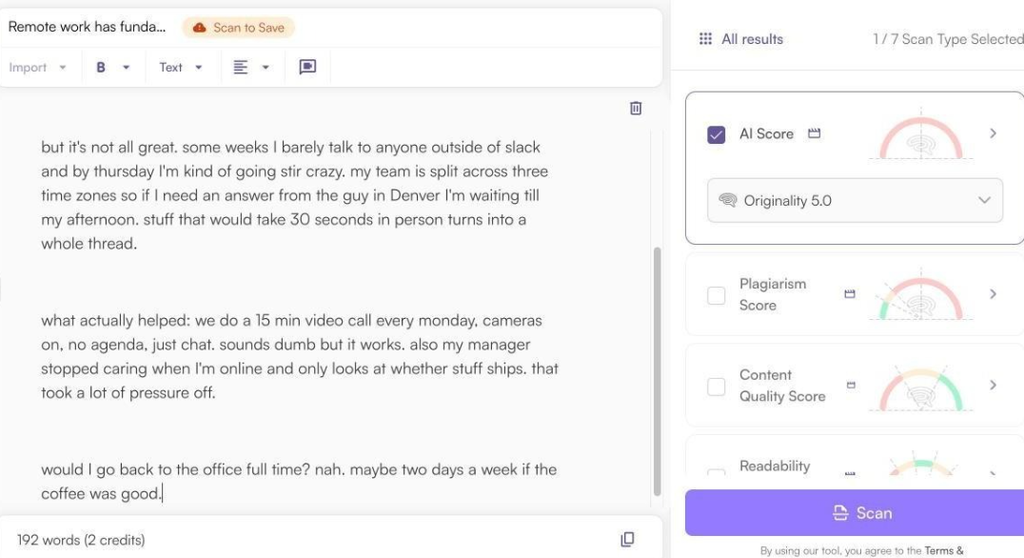
We tested Originality.ai on 4 November 2026 with four texts of 190 to 302 words: pure AI, pure human, half and half, and AI told to sound casual. The AI parts were written by an AI model (Claude). We scanned all four on model 5.0, re-ran two on 5.0 Max, and used only the free credits, with no account. These are the exact same texts as in our Winston AI detector review, so you can compare the two tools directly.
The most important one is test 4. Most people trying to fool a detector don’t paste raw ChatGPT output. They ask the AI to “write like a normal person”. We wanted to see if that alone gets past Originality.
Originality AI review: our results (4 out of 4 correct)
In four scans on 4 November 2026 (model 5.0), Originality.ai labelled all four texts correctly.
| Test | What we pasted | Words | Result | Correct? |
|---|---|---|---|---|
| 1 | Formal AI essay on remote work | 197 | 98% AI (“AI”) | Yes |
| 2 | Opening of Three Men in a Boat (Jerome K. Jerome, 1889) | 302 | 0% AI (“Original”) | Yes |
| 3 | Half of test 2 plus an AI paragraph | 191 | 54% AI (“Mixed”) | Yes, but the highlights were messy |
| 4 | AI text told to sound casual | 192 | 87% AI (“AI”) | Yes |
Test 1: Pure AI text scored 98% AI
The remote-work essay came back “98% of text is Likely AI”, with every paragraph highlighted red. Phrases like “fundamentally transformed” and “In conclusion” give this kind of text away to every detector.

Originality.ai result for AI text: 98% likely AI, every paragraph highlighted red
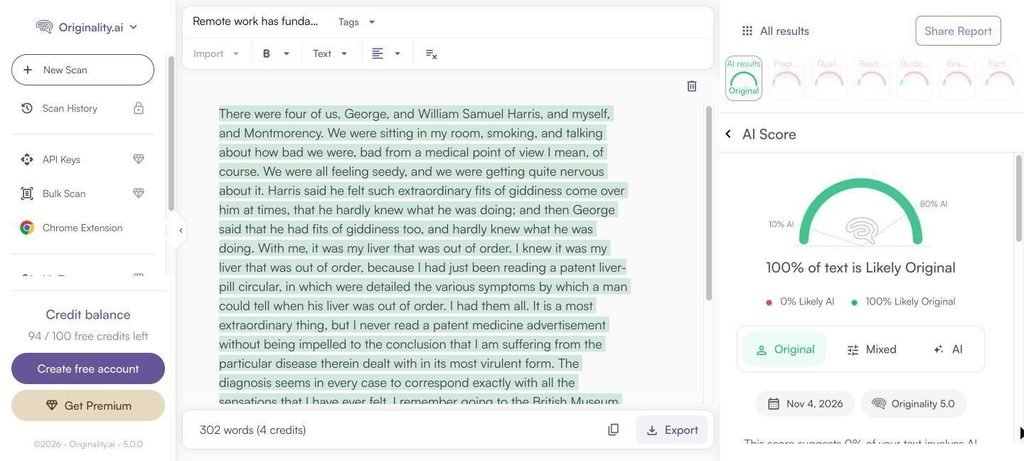
Test 2: Human text scored 100% original
The 1889 passage came back “100% of text is Likely Original”, every sentence green. One caveat: it’s a famous public-domain book, so it may be easier to recognise than a student essay written last week.
Originality.ai result for human text: 100% likely original, all sentences green
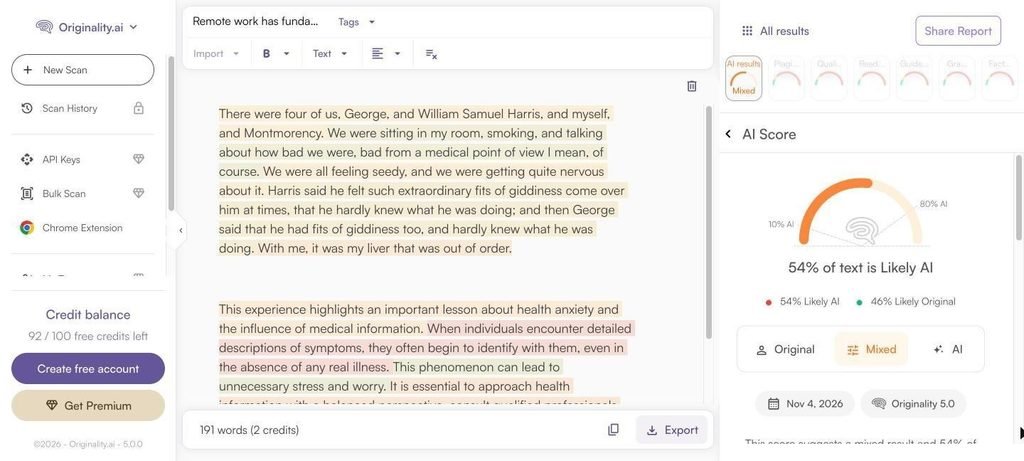
Test 3: Mixed text scored 54% AI, but the highlights were blurry
On our half-human, half-AI text, Originality.ai 5.0 returned “Mixed” (54% AI, 46% original). That is the right overall label. But the sentence highlights didn’t separate the two halves cleanly. The human paragraph came back light orange (uncertain), not green. The AI paragraph was a patchwork: some sentences red, some orange and one green.
Originality.ai result for mixed text: 54% likely AI, labelled Mixed, with orange and red sentence highlights
In the same test, Winston AI coloured the human half green and the AI half red almost exactly where we joined them. So if you need to know which paragraph a writer generated, Originality’s overall score is useful, but its highlights alone won’t show you clearly.
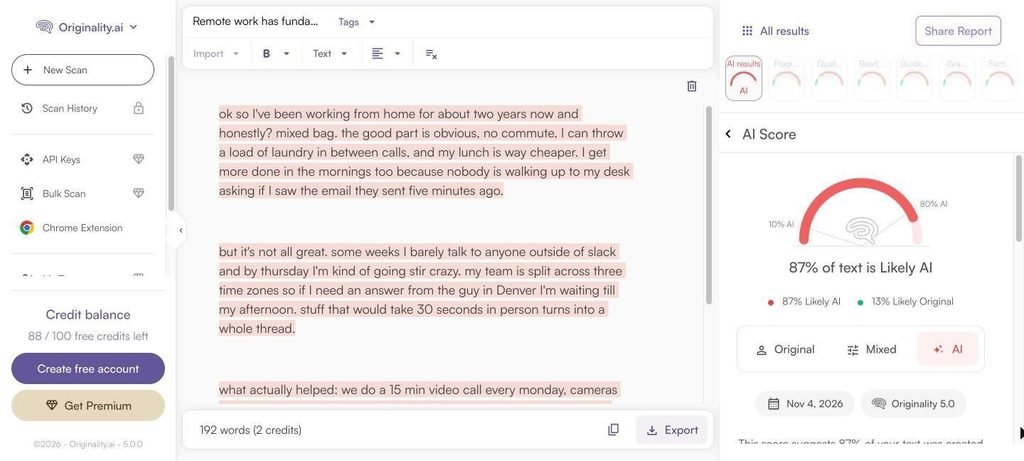
Test 4: Casual AI rewrite still scored 87% AI
Originality.ai 5.0 scored AI text written to sound casual at 87% AI and labelled it “AI”. The text had lowercase sentences, slang (“nah”, “stir crazy”), a made-up coworker in Denver and a joke about coffee. So asking an AI to “sound human” isn’t enough to fool it. We didn’t test paid AI humanizer tools, which rewrite text more heavily.
Originality.ai result for casual AI text: 87% likely AI
Bonus: what about Originality 5.0 Max?
We ran the human and mixed texts again on 5.0 Max. The results were identical: 100% original for the human text and 54% AI (“Mixed”) for the mixed one.
The big difference was cost. Max charged 10 times more credits: 40 credits for the 302-word human text (5.0 charged 4), and 20 for the 191-word mixed text (5.0 charged 2). Originality’s help docs confirm it: Max costs 10 credits per 100 words. On our short texts, Max gave us nothing extra for that price.
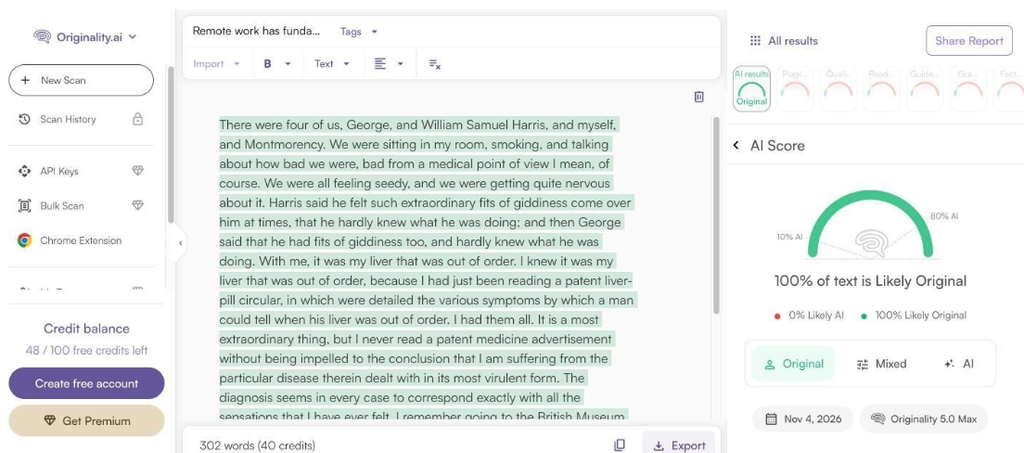
Same human text on 5.0 Max: same result, 40 credits instead of 4.
Originality.ai vs Winston AI: same 4 texts
| Test | Originality.ai (5.0) | Winston AI (v5.2) |
|---|---|---|
| Pure AI | 98% AI | 0% human |
| Pure human | 0% AI | 100% human |
| Half and half | 54% AI, messy highlights | 55% human, clean highlights |
| Casual AI | 87% AI | 0% human |
Both got all four right. A few differences matter. Winston’s sentence map was much cleaner on the mixed text. Originality has a free allowance you can use without an account, and is cheaper per word on its paid plans (see pricing below). Note that the two scores mean different things: Originality shows the share of text that’s likely AI, while Winston shows the chance the whole text is human.
How to read an Originality.ai score (and what’s a good score)
An Originality.ai score is the percentage of your text that is likely AI, so for human writing, lower is better. The headline number is “X% of text is Likely AI”. It’s split into Likely AI and Likely Original, and the result gets one of three labels:
- Original: most of the text reads as human-written
- Mixed: a real mix, which “needs to be reviewed”
- AI: most of the text reads as AI-generated
The gauge has markers at 10% AI and 80% AI, and our results fit those points: under 10% was labelled “Original”, over 80% was “AI”, and 54% was “Mixed”. There is no official pass mark. Sentence highlights run on a scale from green (100% likely original) to red (100% likely AI), with yellow and orange in between.
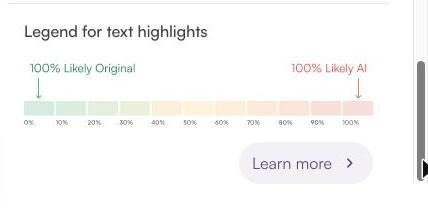
Originality.ai highlight legend: green for likely original through to red for likely AI
Originality itself says AI scores alone shouldn’t be used for academic discipline, and its help docs warn that editing tools like Grammarly or Quillbot will raise your AI score. Treat a Mixed result as a reason to look closer, not a verdict.
How accurate is Originality.ai?
Is Originality.ai accurate? In our tests, yes: it labelled all four texts correctly on 4 November 2026. Its accuracy claims come from the company: it says 5.0 and 5.0 Max have “99%+ accuracy”, and calls itself “the Most Accurate AI Detector in third-party studies”. As of 4 November 2026, its accuracy page gives no false-positive rate for 5.0. It lists 0.5% for the older Lite model and 1.5% for Turbo, both being retired.
Things to keep in mind:
- Four tests are not a study. Our texts were 190 to 302 words.
- Highlights are weaker than the score. On our mixed text, the sentence colours didn’t line up with what we actually wrote.
- Short and edited texts are harder. Originality needs at least 100 words, and warns that AI-edited human writing can be flagged.
- Non-native English writers are a known risk. A 2023 Stanford study (Liang et al., Patterns) found AI detectors flagged non-native English essays as AI far more often than native ones. It tested detectors in general, not Originality’s current model.
Our verdict: Originality.ai’s overall score was right on all four of our tests, but its sentence highlights were not reliable on mixed text. Don’t use the highlights alone to decide which parts were AI.
Originality.ai pricing in 2026
Originality.ai costs $14.95 a month for Pro or $179 a month for Enterprise (4 November 2026), or $12.95 and $136.58 a month on annual billing. There’s also a free allowance of 100 credits.
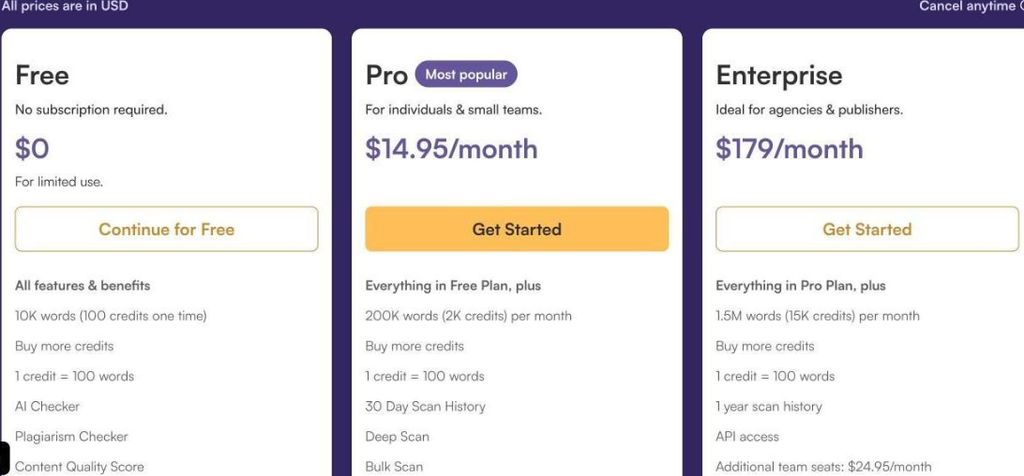
Monthly prices on 4 November 2026. Source: originality.ai/pricing
| Plan | Monthly | Annual (per month) | Credits | Adds |
|---|---|---|---|---|
| Free | $0 | $0 | 100 one time (about 10,000 words) | AI, plagiarism and other checkers |
| Pro | $14.95 | $12.95 | 2,000 / month (200,000 words) | Deep Scan, bulk scan, PDF reports, file uploads, 30-day history |
| Enterprise | $179 | $136.58 | 15,000 / month (1.5M words) | API access, 1-year history, priority support |
How Originality.ai credits work
- 1 credit = 100 words for an AI scan, rounded up. Our 197-word text cost 2 credits and the 302-word text cost 4.
- AI plus plagiarism = 2 credits per 100 words. Plagiarism is ticked by default on new scans, so untick it if you only want an AI check.
- 5.0 Max costs 10 times more: 10 credits per 100 words. In our tests, 302 words cost 40 credits on Max versus 4 on 5.0.
- Subscription credits renew monthly and are used first. Extra credits you buy separately expire after 2 years, according to the pricing page.
That makes Originality cheap for standard AI checks: Pro covers 200,000 words a month for $14.95. Winston’s Essential plan gave 100,000 words for $18 a month ($9 with a promo) when we checked on 30 October 2026.
Is Originality.ai free?
Yes, up to 100 credits. You can scan without an account, and you get 100 free credits, about 10,000 words of AI checks on model 5.0. That’s about 33 essays of 250 words, since each one costs 3 credits (credits round up). The pricing table also lists a “Basic” allowance of 60 credits (3 scans) a day. Originality says text pasted into the free detector “may be used for training”, while account holders can opt out. Don’t paste anything private on the free tier.
Our tests used 70 of the 100 free credits, 60 of them on the two 5.0 Max scans (plus 2 on a grammar check we ran by mistake).
How to use the Originality AI detector
- Go to originality.ai and paste at least 100 words into the box, or upload a .docx or .txt file.
- Click Scan. A results page opens in the app.
- For the next scan, click New Scan, tick AI Score and untick Plagiarism Score if you don’t need it.
- Pick Originality 5.0 (cheaper) or 5.0 Max, and check the credit counter under the text.
- Click Scan and read the headline percentage and label first, then the sentence highlights.
- Use Share Report or Export to save the result. Downloadable PDF reports are listed under the paid plans.
Who should use Originality.ai?
Originality.ai is best for people who check a lot of content, like publishers, SEO agencies and editors hiring freelance writers. For them, its low price per word, bulk scans and API add up.
Good fit:
- Content teams checking freelance articles before publishing
- SEO agencies auditing client sites for AI or plagiarised content. You can scan a single URL or, on paid plans, a whole site. Google doesn’t penalise AI content as such, only unhelpful content, so treat a high AI score as a quality flag
- Teachers who want a second opinion, with the Chrome extension’s writing replay as extra evidence
Not the best fit if:
- You need to point to exactly which sentences were AI. Winston’s highlights were cleaner in our tests.
- You want to use Max routinely. At 10 times the credits, it gets expensive fast.
Originality.ai alternatives
- Winston AI: cleaner sentence highlights in our tests, plus image detection and OCR. Read our Winston AI review.
- GPTZero: aimed at teachers and students, with a free allowance when you sign up. Originality is aimed at publishers and SEO teams, adds plagiarism and site scans, and is cheaper per word at volume. We haven’t run our 4 tests on GPTZero yet.
- Turnitin: only sold to schools, not to individuals. If your school uses it, that’s the score your teacher will see, not Originality’s.
Originality.ai pros and cons
Pros
- Labelled all four of our tests correctly, including AI text written to sound casual
- Free scans without an account, about 10,000 words
- Cheap per word on Pro: 200,000 words a month for $14.95
- Plagiarism, readability, grammar and fact-checking tools in the same scan
- Clear Original / Mixed / AI labels and a credit counter before every scan
Cons
- Sentence highlights on mixed text were blurry and partly wrong
- 5.0 Max costs about 10 times more credits, with no difference in our tests
- Plagiarism is ticked by default, which doubles the cost if you don’t notice
- Free-tier text may be used for training
- Accuracy claims are the company’s own
FAQ
What is the difference between Originality 5.0 and 5.0 Max?
Both are Originality.ai’s latest AI detection models, and the company claims 99%+ accuracy for each. In our tests, 5.0 Max gave the same results as 5.0 on human and mixed text but cost about 10 times more credits: 40 credits for 302 words instead of 4.
How many credits does Originality.ai use?
One credit covers 100 words for an AI scan, rounded up, so a 250-word essay costs 3 credits. Adding a plagiarism check doubles that to 2 credits per 100 words. 5.0 Max uses about 10 times more. Pro includes 2,000 credits (200,000 words) a month.
Can Originality.ai detect ChatGPT and Claude?
Yes. Originality.ai says its 5.0 models are accurate on the latest models, including GPT-6, Claude, Gemini, DeepSeek and Kimi. In our 4 November 2026 tests, both AI-written texts were labelled “AI” (98% and 87%), including one we told the AI to write in a casual, human-sounding style.
Does Originality.ai detect humanized AI text?
Partly tested. Asking an AI to “sound like a real person” did not fool Originality.ai: our casual AI text still scored 87% AI. Originality says it trains on adversarial data and tests against paraphrasing tools like Quillbot. We didn’t test paid AI humanizer tools, so we can’t confirm how it handles those.
Is Originality.ai legit?
Yes. Originality.ai is a real, paid AI detection and plagiarism tool from a company based in Collingwood, Ontario, Canada. In our 4 November 2026 tests it labelled all four texts correctly and showed the credit cost before every scan. Its “99%+” accuracy claim is the company’s own, so treat any single score as a signal, not proof.
Does Originality.ai store my text?
Originality.ai says text pasted into its free detector “may be used for training”, and account holders can opt out. Scans are kept in your history, for 30 days on Pro and 1 year on Enterprise. Don’t paste confidential client work or student details into the free, no-account scanner.
What is a good Originality.ai score?
For your own writing, the lower the AI percentage, the better. In our 4 November 2026 tests, results under about 10% AI were labelled “Original”, results over about 80% were labelled “AI”, and anything in between was “Mixed”. There is no official pass mark, so treat “Mixed” as a reason to review, not proof.
Can teachers use Originality.ai?
Yes. Originality.ai works with Google Classroom and Moodle, and its Chrome extension has a writing replay that plays back how a document was typed. Originality itself says AI scores alone shouldn’t decide academic discipline, and detectors flag non-native English writers more often (Liang et al., 2023). Use a result to start a conversation.
Can Originality.ai be wrong?
Yes. Every AI detector can flag human writing as AI or miss AI text, especially short, heavily edited or non-native English writing. Originality.ai says editing tools like Grammarly can raise AI scores, and that scores alone shouldn’t be used for academic discipline. If your human writing gets flagged, show the client your draft history or Originality’s writing replay.
Final verdict
Originality.ai got every overall result right in our tests, it’s cheap per word, and you can try it free without an account. Its weak spot is the sentence highlights, which blurred the line on our mixed text, and 5.0 Max cost ten times more for the same result. Use 5.0 for everyday checks, read the overall score first, and let a person make the final call

Keep exploring