

Prices last checked November 20, 2026, on each vendor’s own pricing or help pages. We built one free tool mentioned here (our AI Visibility Checker) and say so where it appears. It isn’t in the ranked list.
Ask ChatGPT “what’s the best CRM for a small team?” and it names three or four brands. If yours isn’t one of them, that buyer may never look you up. An AI visibility tracker shows you how often that happens. It runs the questions your buyers ask through ChatGPT, Gemini, Perplexity and Google’s AI answers, then records whether your brand comes up, how it’s described, and which websites the AI cites.
Quick verdict
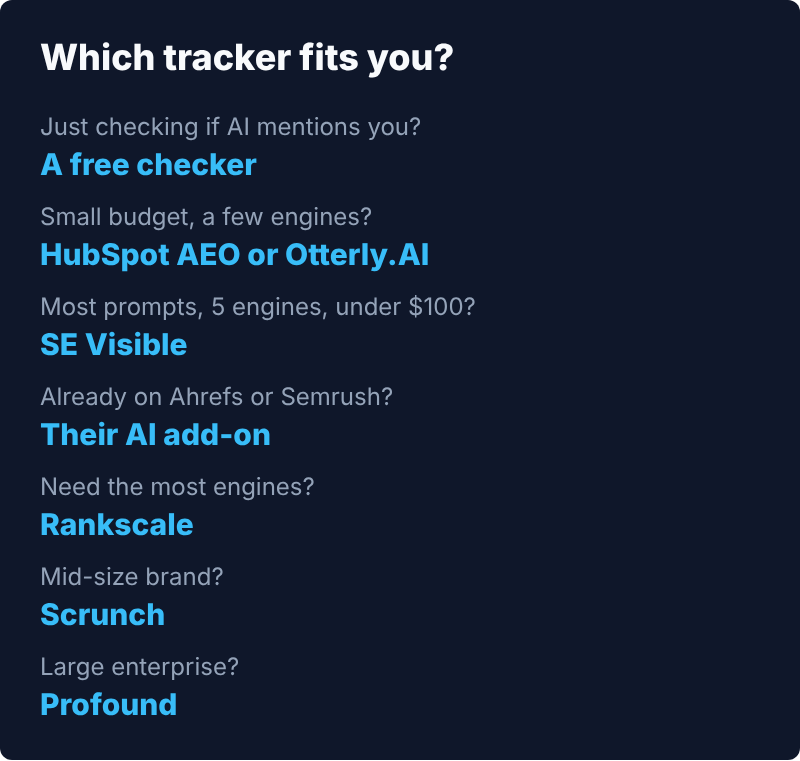
- Small business on a budget: HubSpot AEO ($50/month, 25 prompts on ChatGPT, Gemini and Perplexity) or Otterly.AI (€29/month, 16 prompts).
- Most prompts across several engines under $100: SE Visible ($89/month for 75 prompts on 5 engines, 14-day trial).
- Already pay for Ahrefs or Semrush: start with their AI add-on.
- Just want to know if AI mentions you at all: run a free check first. Our AI Visibility Checker or HubSpot’s AEO Grader both work.
What an AI visibility tracker does (and how LLM visibility tracking works)
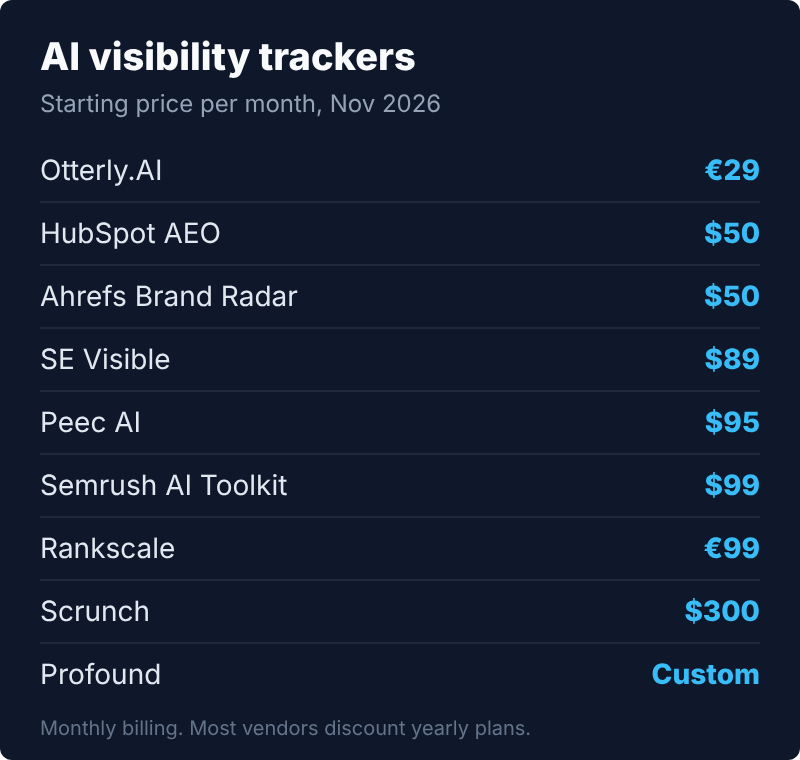
An AI visibility tracker is a tool that sends a fixed list of buyer questions to AI assistants like ChatGPT, Gemini and Perplexity on a schedule, then measures how often your brand is mentioned, how it’s described, and which sources the AI cites, compared with your competitors.
You give the tool your prompts. It runs them, usually every day, and turns the answers into four numbers you can follow over time: mentions, share of voice against competitors, sentiment, and citations. Some tools collect answers from the real chat apps, the way a user sees them. Others query the AI models through their APIs. API answers can differ from the app: they may not search the web the same way, so they can name different brands. Better tools say which method they use for each engine.
AI visibility trackers compared
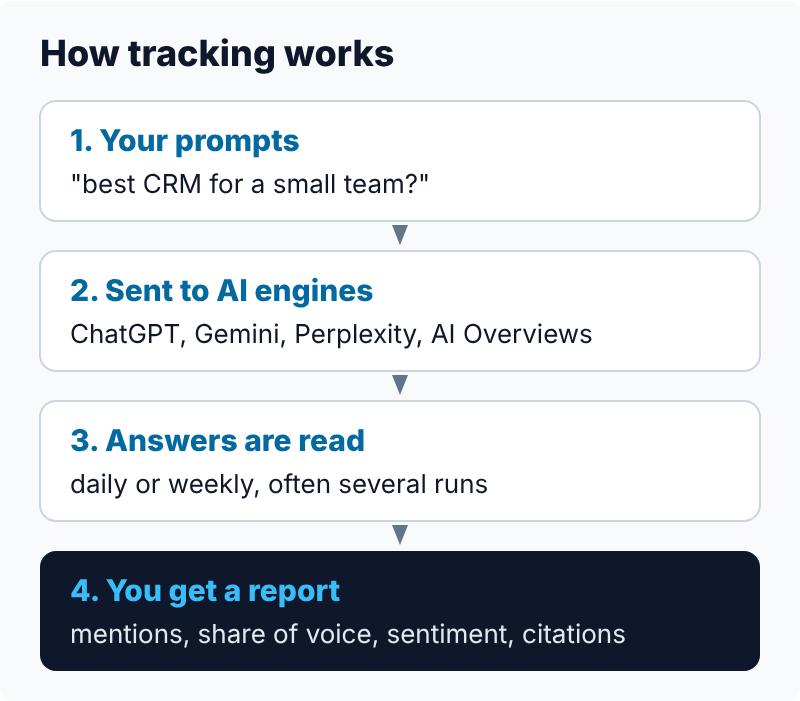
| Tool | Starts at | What you get at that price | Best for |
|---|---|---|---|
| Otterly.AI | €29/month | 16 prompts, 4 engines of your choice | Lowest entry price of the nine |
| HubSpot AEO | $50/month ($45 yearly) | 25 prompts on ChatGPT, Gemini, Perplexity | Small businesses, HubSpot users |
| Ahrefs Brand Radar | $50/month | 2,500 checks (about 80 prompts daily on 1 engine) | Many prompts on a few engines |
| SE Visible | $89/month ($71 yearly) | 75 prompts on 5 engines | Most multi-engine prompts under $100 |
| Peec AI | $95/month | 50 prompts, 3 engines of your choice | Marketing teams, several countries |
| Semrush AI Visibility Toolkit | $99/month | 25 prompts on ChatGPT and Google AI Mode | Teams already on Semrush |
| Rankscale | €99/month | 1,200 credits (up to 4,800 AI answers), 17+ engines | The widest engine list |
| Scrunch | $300/month ($250 yearly) | 350 prompts on 7 platforms | Mid-size brands |
| Profound | Custom | Custom, up to 10 engines | Large enterprises |
A note on units, because vendors count differently. Most charge per prompt (one question, tracked on a schedule). Ahrefs charges per check (one prompt on one engine, once), and Rankscale per credit (an app answer costs 0.25 credits, an API answer 1 to 4). Otterly and Rankscale price in euros. Roughly, at the cheapest monthly plan, that works out to:
- Scrunch: about $0.86 per prompt
- SE Visible: about $1.19 per prompt (about $0.95 billed yearly)
- Otterly.AI: about €1.81 per prompt
- Peec AI: about $1.90 per prompt
- HubSpot AEO: $2.00 per prompt
- Semrush: about $3.96 per prompt
- Ahrefs Brand Radar: about $0.63 per prompt, but on one engine only
Per prompt isn’t the whole story. A prompt tracked on 5 engines gives you five answers, while one tracked on 1 engine gives you one. Compare price per prompt and the number of engines together.
How to choose an AI visibility tracker
Most AI rank tracking tools look similar on their homepages. Four questions settle most decisions:
- Which engines do your buyers use? Developers often use ChatGPT and Claude. Local businesses care most about Google’s AI Overviews. Don’t pay for engines your buyers never open.
- How many prompts do you need? A small business can start with 15 to 25 prompts on 2 or 3 engines, then add more once it sees which ones move. A brand with several products usually needs 50 or more.
- App or API answers? App answers are closer to what users see. If a tool uses APIs for some engines, expect some differences. (If you want to check API costs yourself, our LLM token calculator estimates them.)
- Data only, or fixes too? Semrush and Scrunch add audits and recommendations. Most cheaper tools mostly report.
Before you pay: free ways to check your AI visibility
If you’ve never checked, start free. One snapshot tells you whether paid tracking is worth it.
- Our AI Visibility Checker (we built it). It gives you 5 to 10 buyer questions, you paste in the answers from each assistant, and it scores your mentions and share of voice against up to three competitors, and lists the domains the AIs cite. It works with answers from ChatGPT, Claude, Gemini, Grok, Copilot and AI Overviews, plus Perplexity. Free, no sign-up, and it runs in your browser. The catch is manual work: the chat apps don’t offer an API that returns what users see, so you paste most answers yourself. An optional Gemini mode runs each question automatically, three times. Run a free check.
- HubSpot AEO Grader: a free, one-time snapshot of your visibility across ChatGPT, Perplexity and Gemini, with a score and sample recommendations.
- AthenaHQ Essential: a free tier with 300 credits (one credit is one AI answer) across ChatGPT, Perplexity, AI Overviews, Gemini and Copilot.
- Your own analytics: in Google Analytics, look for referral traffic from chatgpt.com, perplexity.ai and gemini.google.com. It undercounts, because some AI clicks arrive without a referrer and land in “Direct”, but it costs nothing.
The 9 best AI visibility trackers
1. Otterly.AI: lowest entry price of the nine
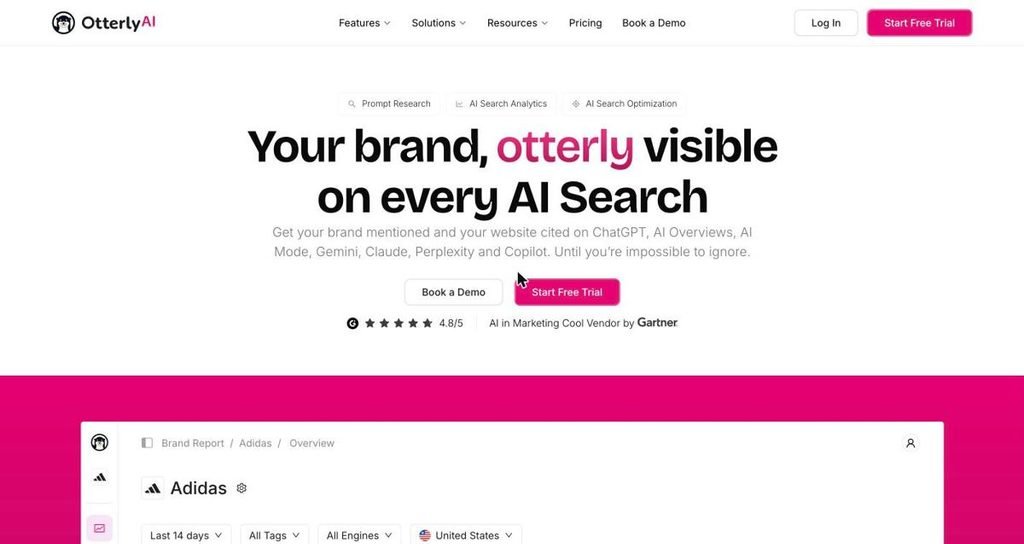
Otterly.AI starts at €29 a month for 16 prompts, tracked daily. Its engine list includes ChatGPT, Google AI Overviews, AI Mode, Gemini, Perplexity, Microsoft Copilot and Claude. Its plan cards say each plan tracks 4 of those 7, and a Claude answer uses 3 credits instead of 1. The €189 Standard plan raises the limit to 120 prompts.
Watch out for: 16 prompts covers a test, not a full product line. Grok and DeepSeek logos sit under “More engines coming soon”.
2. HubSpot AEO: best for small businesses
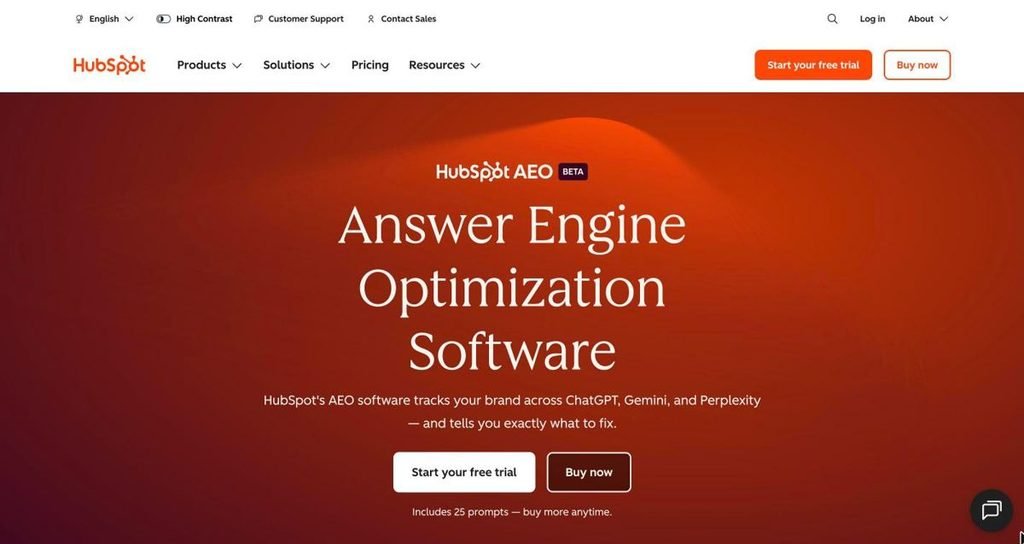
HubSpot AEO costs $50 a month ($45 billed yearly) for 25 prompts, tracked on ChatGPT, Gemini and Perplexity, and you can buy more prompts at any time. You can start tracking free with no card. It’s the simplest answer to “track my brand in ChatGPT and Gemini” if you don’t need Google’s AI Overviews.
Watch out for: three engines only, and no Google AI Overviews or Claude.
3. SE Visible (SE Ranking): most multi-engine prompts under $100
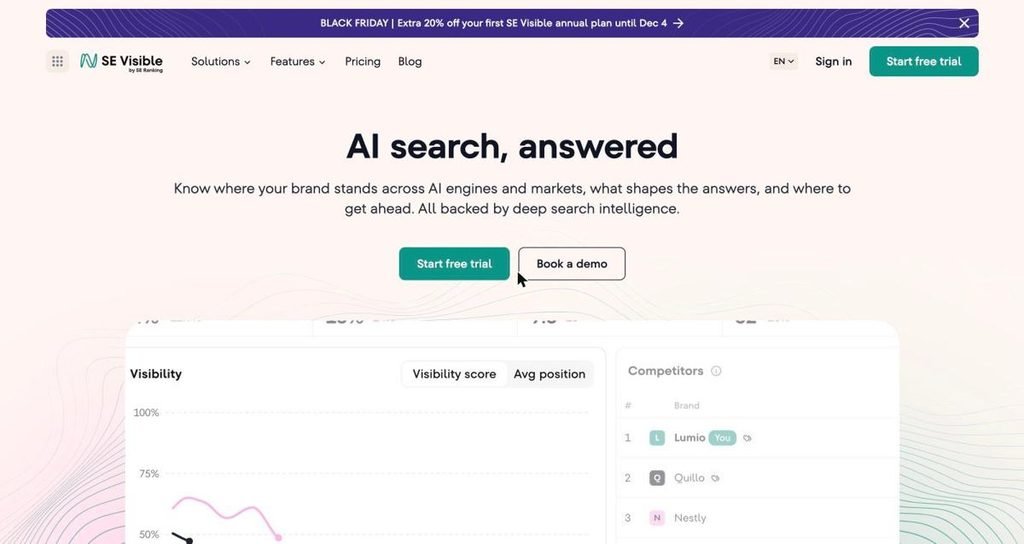
SE Visible is SE Ranking’s AI visibility tool. Basic is $89 a month for 75 prompts ($71 billed yearly), tracked daily on ChatGPT, AI Overviews, AI Mode, Gemini and Copilot, with unlimited seats. The Agency plan ($399, or $319 yearly) raises that to 1,000 prompts and adds Claude. It has a 14-day free trial, and when we checked, SE Ranking was offering an extra 20% off a first yearly plan until December 4, 2026.
Watch out for: Perplexity isn’t on its engine list.
4. Ahrefs Brand Radar: most checks per dollar
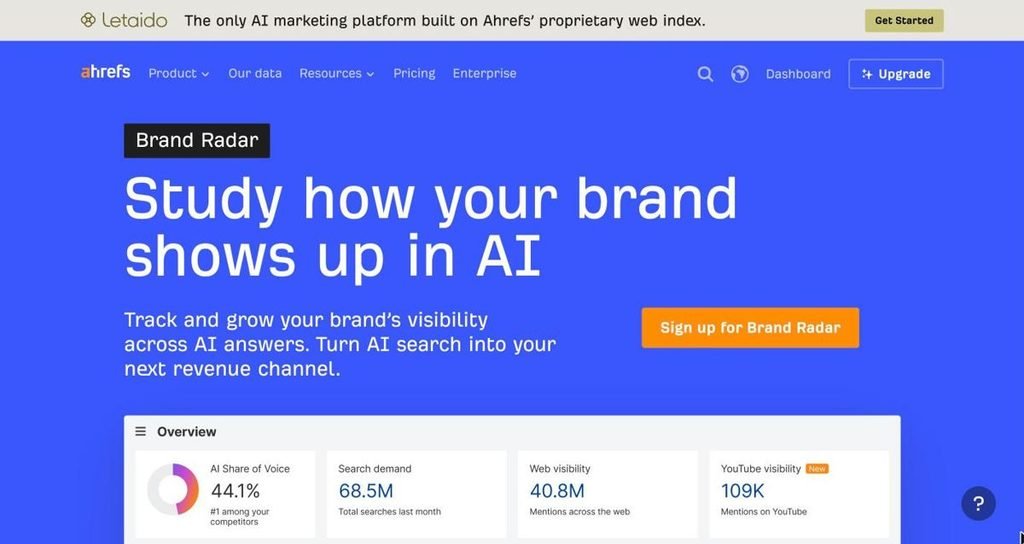
Brand Radar has two parts, and you can buy it on its own or alongside an Ahrefs plan. Custom prompt tracking is sold in packages of checks: Basic is $50 a month for 2,500 checks, which Ahrefs gives as roughly 80 prompts daily on one platform. It covers AI Overviews, AI Mode, ChatGPT, Perplexity, Gemini and Copilot, plus Claude, which uses 8 checks per update. The AI Visibility Index starts at $199 a month and shows how your brand appears across Ahrefs’ database of about 581 million search-based prompts, not only the ones you chose.
Watch out for: checks run out fast across several engines. 80 prompts on one engine is about 27 prompts on three.
5. Peec AI: pick-your-engines plans
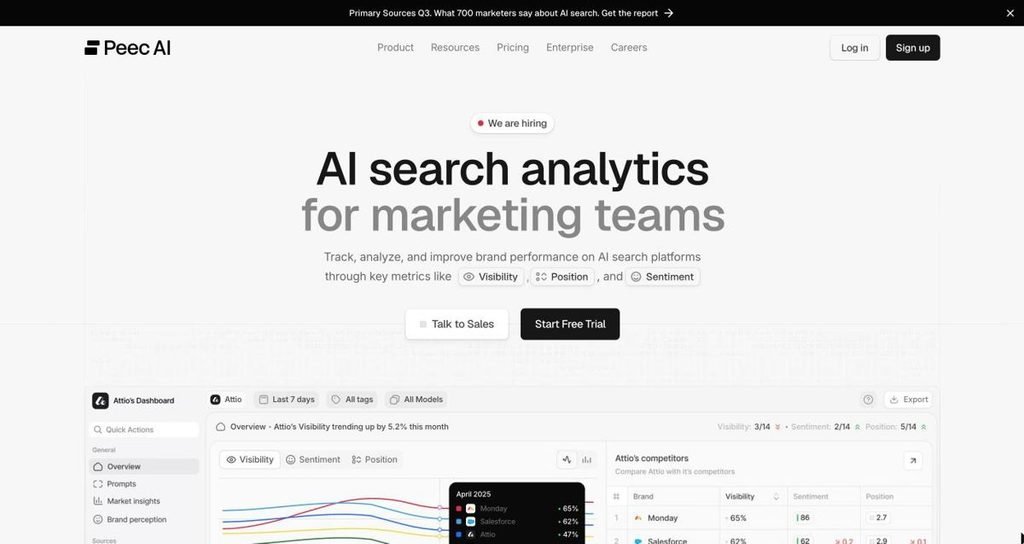
Peec AI starts at $95 a month for 50 prompts, tracked daily, with unlimited users. On the Starter, Pro and Advanced plans you choose 3 engines from 8, including ChatGPT, Perplexity, AI Overviews, AI Mode and Gemini. Each extra engine costs $30 to $140 a month depending on the plan, and Enterprise covers 26 models. Higher plans add more countries.
Watch out for: the 3-engine limit on standard plans.
6. Semrush AI Visibility Toolkit: for Semrush users
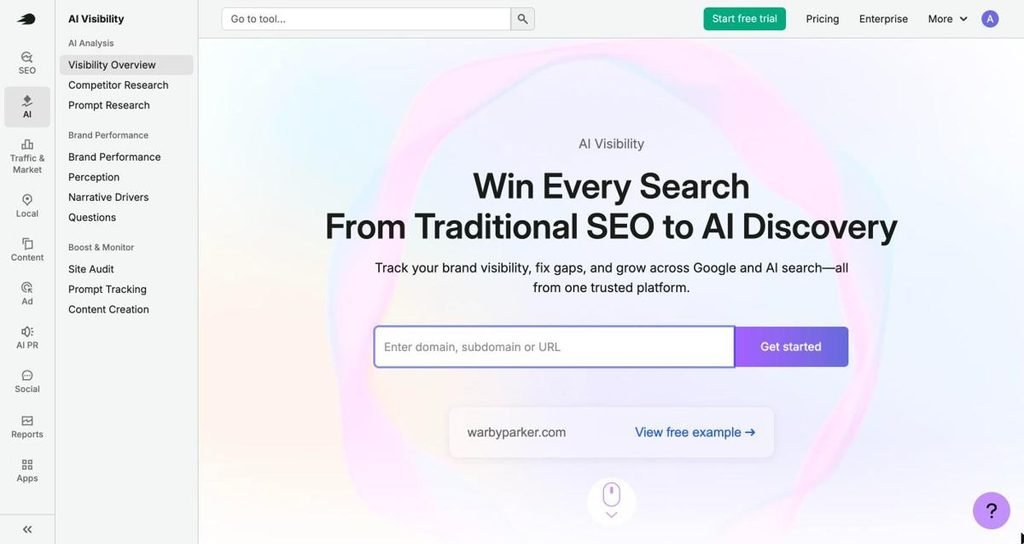
The AI Visibility Toolkit costs $99 a month for 25 prompts, with 50 more for $60 a month. Its prompt tracking covers ChatGPT and Google AI Mode. It also includes prompt research with volume and difficulty, competitor citation gaps, sentiment, and a site audit for anything blocking AI crawlers. Semrush’s bigger Semrush One bundles advertise wider engine coverage.
Watch out for: fewer tracked engines than most tools here, and no free trial.
7. Rankscale: widest engine list
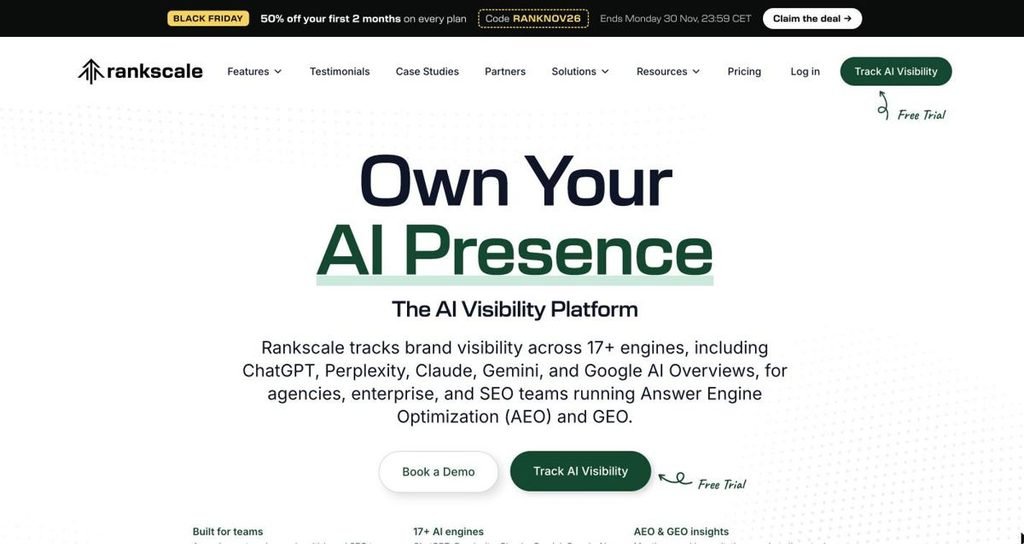
Rankscale charges in credits. Pro is €99 a month for 1,200 credits. An answer from a chat app costs 0.25 credits and an API answer 1 to 4, so that’s up to 4,800 app answers a month, roughly 40 prompts on 4 app engines every day. Every plan includes all 17+ engines. The apps it reads directly are ChatGPT, AI Mode, AI Overviews, Gemini and Bing AI Mode. Claude, Perplexity and the rest come through their APIs. Pro has a 7-day trial, and Rankscale’s homepage was offering 50% off the first two months with code RANKNOV26 until November 30, 2026.
Watch out for: API answers burn credits 4 to 16 times faster than app answers, more with web search on.
8. Scrunch: tracking plus site audits
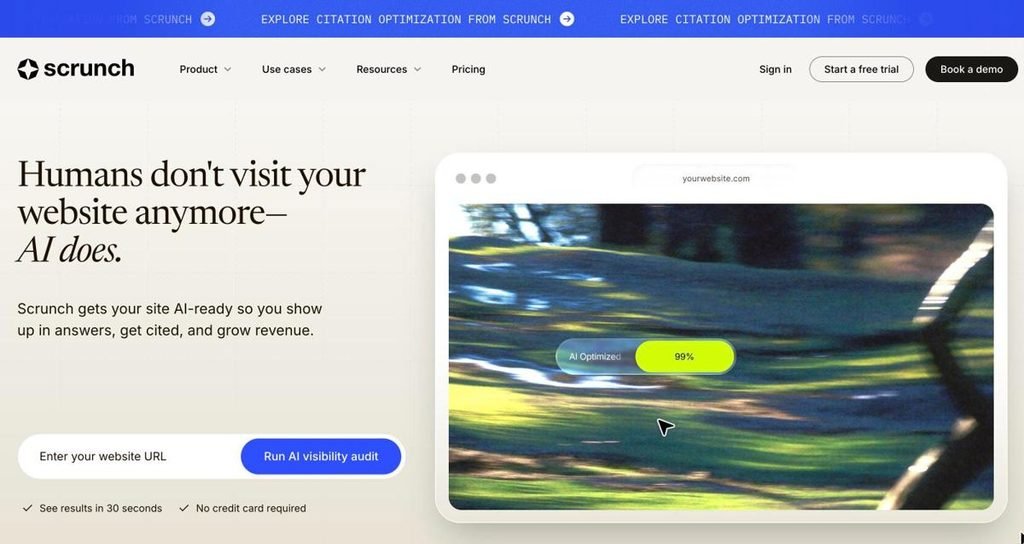
Scrunch starts at $300 a month ($250 billed yearly) for 350 custom prompts, across ChatGPT, Claude, Gemini, Perplexity, Google AI Mode, AI Overviews and Meta. It adds page audits, buyer personas and AI bot traffic monitoring, and has a 7-day free trial with no card. It also sells an “Agent Experience Platform” that serves an AI-friendly version of your site; the pricing page doesn’t say which plans include it.
Watch out for: the price is a big step up from the tools above.
9. Profound: enterprise only
Profound now sells only an Enterprise plan with custom pricing. It retired its cheaper Starter and Growth plans for brands in September 2026, so reviews that still quote those plans are out of date. It tracks up to 10 answer engines, including ChatGPT, Perplexity, Gemini, Claude, DeepSeek and Google’s AI Mode and AI Overviews, and adds AI traffic analytics, prompt volume data, SSO and dedicated support.
Also worth a look
| Tool | Starts at | Notes |
|---|---|---|
| ZipTie | From $25.65/month | Build-your-own plan across 7 engines including Gemini and Copilot. 7-day free trial, no card |
| AthenaHQ | Free, then $295/month | Free tier on 5 engines. Starter adds 11 models including Grok and Claude |
Best tracker for each AI engine (ChatGPT, Gemini, Perplexity, Claude, Grok)
If one platform matters most to your buyers, start there. Looking for the best Perplexity rank trackers, a Gemini visibility tracker or a free ChatGPT visibility checker? Here’s who covers each engine.
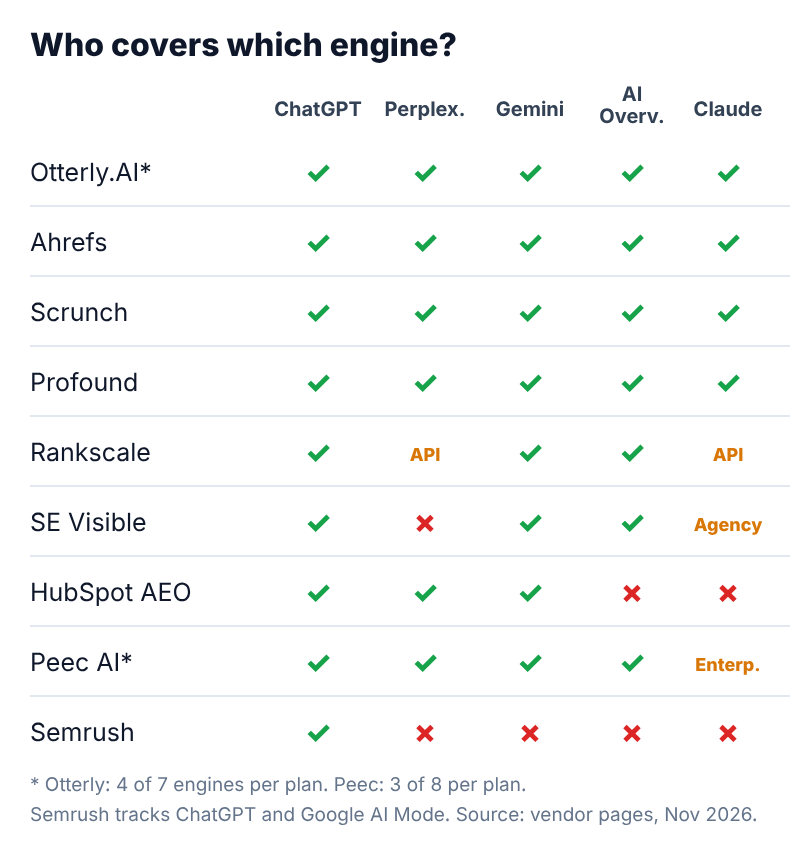
| AI engine | Paid trackers that list it |
|---|---|
| ChatGPT | All nine |
| Perplexity | Otterly, HubSpot AEO, Ahrefs, Peec AI, Scrunch, Profound, Rankscale (API) |
| Gemini | Otterly, HubSpot AEO, Ahrefs, SE Visible, Peec AI, Scrunch, Profound, Rankscale |
| Google AI Overviews | Otterly, Ahrefs, SE Visible, Peec AI, Scrunch, Profound, Rankscale |
| Claude | Otterly, Ahrefs, Scrunch, Profound, Rankscale (API), SE Visible (Agency), Peec AI (Enterprise) |
| Microsoft Copilot | Otterly, Ahrefs, SE Visible |
| Grok | AthenaHQ (Starter plan), Peec AI (Enterprise, API) |
Perplexity visibility tracker options
Perplexity always shows its sources, so it’s the easiest engine to learn from: you can see exactly which pages it trusts for your topic. Most trackers cover it, but two popular ones don’t. SE Visible leaves it out, and Semrush’s toolkit tracks ChatGPT and AI Mode instead. For Perplexity on a budget, HubSpot AEO ($50) and Otterly.AI (€29) both include it. Rankscale tracks it through Perplexity’s Sonar API rather than the app.
Gemini visibility tracker options
Gemini answers can differ from Google’s AI Overviews even though both come from Google, so track them separately if Google matters to you. HubSpot AEO, Otterly, SE Visible, Ahrefs and Peec AI all list Gemini, and SE Visible covers Gemini, AI Overviews and AI Mode together in its $89 plan, a good fit for brands that live on Google.
Claude rank tracking and Grok
Claude is covered by fewer cheap plans: Otterly includes it at 3 credits per answer, and SE Visible only on its Agency plan. For Grok, AthenaHQ’s $295 Starter plan is the cheapest paid option we found (Peec AI offers a Grok API on Enterprise). For a free Claude or Grok check, paste their answers into our free checker.
KPIs for AEO and GEO: what to measure
AEO (answer engine optimization) and GEO (generative engine optimization) are two names for getting your brand into AI answers. AEO grew out of featured snippets and voice search, GEO out of research on generative engine optimization from Princeton and other universities, but in practice teams use them interchangeably. Whatever you call it, these are the numbers to track.
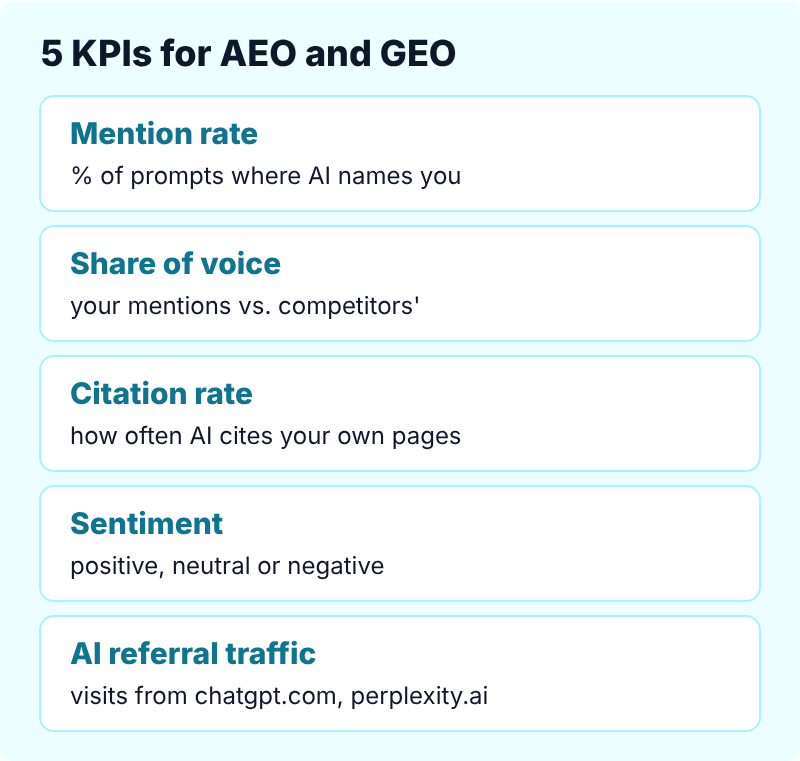
Judge trends over weeks, not single days. AI answers change from run to run, which is why some tools, such as our free checker’s Gemini mode, run each prompt several times. AI referral traffic doesn’t need a tracker at all. It’s in your analytics, though it undercounts.
What to do once you have the data
A tracker tells you where you stand. Moving the numbers is a separate job. If you’re missing from answers:
- Look at what the AI cites. Every good tracker shows the domains behind each answer. Those pages, often review sites, Reddit threads and “best X” roundups, are where you need to appear.
- Get listed and reviewed there. Ask happy customers for reviews on the sites the AI trusts, and pitch the roundup authors.
- Publish clear comparison and FAQ pages on your own site that answer your buyers’ questions directly. Google’s own guide to AI features and your website says normal SEO best practices still apply to AI Overviews and AI Mode.
- Don’t block AI crawlers. Check that your robots.txt doesn’t block bots like GPTBot or PerplexityBot unless you mean to.
- Re-check monthly and keep the same prompt list, so changes are real and not noise.
What AI visibility trackers can’t see
- Personal answers. Logged-in users get answers shaped by memory, location and past chats. Trackers see a clean, logged-out version.
- Every phrasing. Buyers word questions in endless ways. Your prompt list is a sample, so choose it carefully.
- App vs API differences. A tool that queries an API may not see what the consumer app shows.
- Clicks that become sales. Being mentioned isn’t the same as being chosen. Pair tracking with your analytics and sales data.
If you’re building in public or running a small product, our guides to vibe coding and the best vibe coding tools cover the rest of the stack.
Frequently asked questions
What is an AI visibility tracker?
A tool that sends your buyers’ questions to AI assistants like ChatGPT, Gemini and Perplexity on a schedule, and measures how often your brand is mentioned, how it’s described and which sources the AI cites. Other names for it include AI rank tracker and LLM visibility tracker.
What tools track brand mentions in ChatGPT and Gemini?
HubSpot AEO, Otterly.AI, Ahrefs Brand Radar, SE Visible, Peec AI, Rankscale, Scrunch and Profound all list both. HubSpot AEO is the cheapest dedicated option at $50 a month for 25 prompts. Semrush’s toolkit tracks ChatGPT and Google AI Mode rather than Gemini.
Is there a free ChatGPT visibility checker?
Yes. Our free AI Visibility Checker scores answers you paste in from ChatGPT and six other assistants, with no sign-up. HubSpot’s AEO Grader gives a free one-time snapshot across ChatGPT, Perplexity and Gemini, and AthenaHQ has a free tier with 300 AI answers.
How much do AI visibility tools cost?
For small teams, about €29 to $100 a month for 16 to 80 prompts. Mid-market tools like Scrunch run $250 to $500 a month, and enterprise platforms like Profound are custom-priced.
What is the cheapest AI visibility tracker?
Of the nine tools ranked here, Otterly.AI has the lowest entry price at €29 a month for 16 prompts (ZipTie’s build-your-own plans start at $25.65). For more prompts across several engines under $100, SE Visible gives 75 prompts on 5 engines for $89 a month, or $71 billed yearly.
Why do tools show different results for the same prompt?
AI answers vary between runs, locations and dates, and tools collect them differently. Some read the consumer apps, others call APIs, and they run prompts at different times. Compare trends within one tool rather than numbers across tools.
Are AI visibility tools the same as GEO tools?
Mostly. “AI visibility tracker”, “LLM tracker” and “GEO tool” describe the same core job. Some GEO tools go further and add content audits and recommendations, like Semrush and Scrunch.

Keep exploring
Leave a Reply