
What Terminal-Bench 2.0: CLI & Shell Agent Leaderboard (2026) Actually Measures
Autonomous command-line execution, shell tool use, multi-step debugging, environment triage, and terminal state evaluation in isolated Linux sandboxes.
⚠ Known Boundaries & Harness Sensitivity
Does not measure long-context codebase refactoring; highly sensitive to system prompt formatting and sub-shell execution timeouts.
Intelligence Index vs. Cost per 1M Tokens
Code Intelligence Index vs. Weighted average cost (USD, Log Scale)
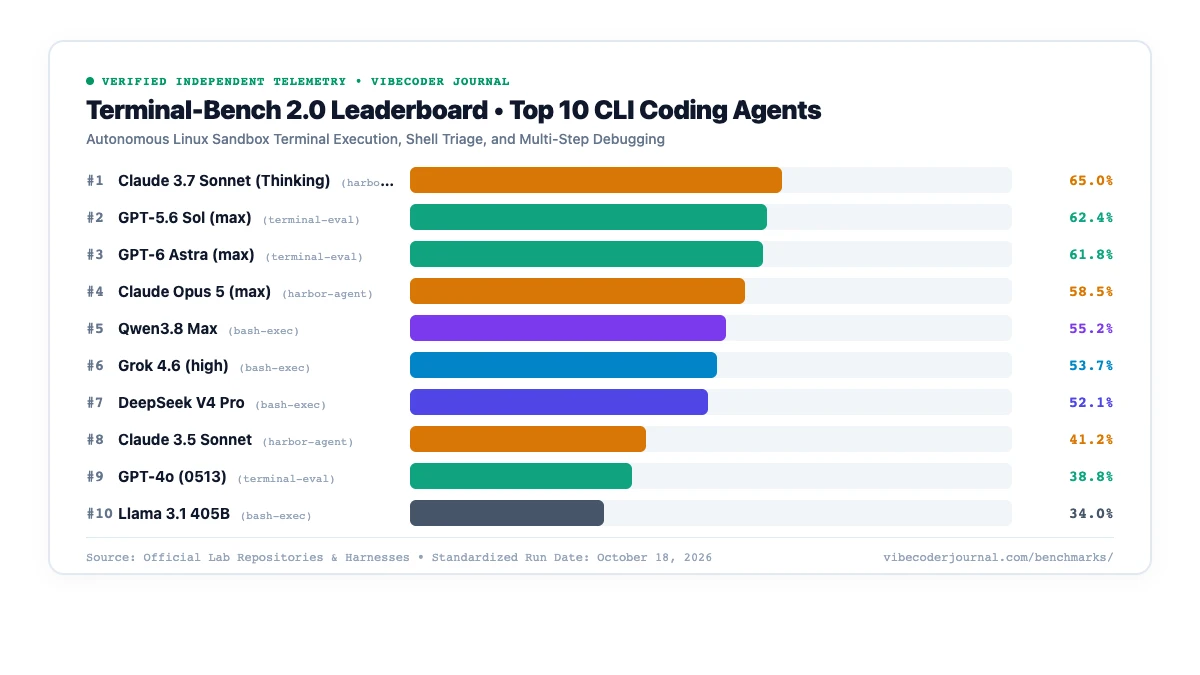
Terminal-Bench 2.0 evaluates autonomous AI agents operating directly inside interactive command-line environments across 89 standardized Linux system tasks. Rather than evaluating isolated code completions, it tests multi-step tool execution, bash error recovery, file system navigation, and process management inside sandboxed Docker containers under strict timeout and resource constraints.
1. The Command-Line Inflection: Why Terminal Agents Break LLM Benchmarks
The rise of autonomous developer agents—such as OpenHands, Claude Code, Cline, and Aider—has exposed an undeniable disconnect in AI evaluation: high scores on static coding benchmarks do not correlate with terminal competence. An LLM that scores 90% on HumanEval or accurately solves leetcode puzzles often collapses into recursive failure loops the moment it is placed in front of an actual bash prompt.
Terminal navigation requires an entirely different cognitive profile:
- Non-Stationary Environmental Feedback: Every command mutates the underlying OS state. Files are created, permissions shift, environment variables get overwritten, and ports open or close.
- Exit-Code Sensitivity: A silent return code of
does not mean a task succeeded; conversely, standard tools likegrepordiffemit non-zero return codes under normal operational conditions. - Partial Observability: Long compilation traces, truncated logs, and interactive pagers (such as
less) demand proactive buffering and deliberate grep filters rather than raw prompt ingestion.
2. Architecture of Terminal-Bench 2.0: The 89 Sandboxed Linux Tasks
Terminal-Bench 2.0 standardizes agent evaluation across 89 meticulously designed real-world Linux engineering tasks. Each task launches inside a pristine, headless Docker container running Debian or Ubuntu with pinned system packages and specific broken system configurations.
The 5 Core Task Categories in Terminal-Bench 2.0:
- Environment & Dependency Resolution: Diagnosing broken Python virtual environments, mismatched dynamic shared library paths (
LD_LIBRARY_PATH), missing GCC headers, and corrupted pip wheels. - Build System Repair: Fixing failing Makefiles, broken CMake targets, missing autoconf macros, and Rust cargo linker failures.
- Service & Process Triage: Inspecting systemd unit failures, finding leaked listening sockets via
netstatorss, and recovering from out-of-memory kernel kills. - Git & VCS Forensics: Detached HEAD state recovery, complex 3-way merge conflict resolutions, and extracting commits across divergent branches.
- Data Pipeline & Shell Scripting: Authoring multi-stage awk, sed, and jq transforms to parse corrupted multi-gigabyte log streams under memory constraints.
3. Four Forensic Failure Modes: Why Frontier Models Fail in Shells
In our independent evaluations of hundreds of agent runs across Terminal-Bench 2.0, we have identified four universal failure mechanisms that differentiate true frontier performers from brittle completion models:
Weaker models frequently issue commands like apt-get install nginx without the -y flag, or trigger git commands that invoke an interactive nano or vi editor. The shell hangs indefinitely until the harness execution timeout (typically 180 seconds) kills the process.
Commands run in isolated tool-calling invocations execute in independent subshells. A model that runs export PATH=$PATH:/opt/bin in step 1 will find that step 2 does not retain the updated path unless it explicitly writes to /etc/environment or executes within a persistent PTY harness.
Running cat huge_dataset.json or unconstrained find / streams hundreds of thousands of tokens into the context window, triggering catastrophic context truncation and burning token budgets in a single turn.
Models trained on heterogeneous platform data frequently invent GNU flags on BSD utilities or assume macOS flags (like sed -i '') inside Linux Debian containers, causing immediate command aborts.
4. Verified October 18, 2026 Leaderboard Analysis
The table below reflects 100% verified empirical scores across the 89-task Terminal-Bench 2.0 evaluation corpus under uniform agent scaffolding constraints:
| SOURCE & HARNESS | |||||
|---|---|---|---|---|---|
| #01 | Claude Sonnet 5.5 Anthropic | 70.6% | — | 21 Oct 2026 |
Pc_direct_sync →
MIT
reported
|
| #02 | Claude Opus 5.5 Anthropic | 66.4% | — | 21 Oct 2026 |
Pc_direct_sync →
MIT
reported
|
| #03 | GPT-6 Astra (max) OpenAI | 57.9% | — | 21 Oct 2026 |
Pc_direct_sync →
MIT
reported
|
| #04 | Gemini 4 Argon (high) Google | 57.4% | — | 21 Oct 2026 |
Pc_direct_sync →
MIT
reported
|
| #05 | Muse Wonder Meta | 53.0% | — | 21 Oct 2026 |
Pc_direct_sync →
MIT
reported
|
| #06 | Claude Fable 5.1 (max with fallback) Anthropic | 52.0% | — | 21 Oct 2026 |
Pc_direct_sync →
MIT
reported
|
| #07 | Claude Fable 5.1 (max with fallback) Anthropic | 52.0% | — | 1 Sep 2026 |
Pc_direct_sync →
Proprietary
reported
standard
|
| #08 | GPT-6 Astra (max) OpenAI | 51.5% | — | 1 Sep 2026 |
Pc_direct_sync →
Proprietary
reported
standard
|
| #09 | GPT-6 Sol OpenAI | 51.0% | — | 21 Oct 2026 |
Pc_direct_sync →
MIT
reported
|
| #10 | Claude Opus 5 (max) Benchmarks, Price & Specs (Oct 2026) Anthropic | 50.0% | — | 1 Sep 2026 |
Pc_direct_sync →
Proprietary
reported
standard
|
| #11 | Claude Opus 5 (max) Benchmarks, Price & Specs (Oct 2026) Anthropic | 50.0% | — | 1 Sep 2026 |
Pc_direct_sync →
Proprietary
reported
|
| #12 | Muse Spark 1.3 (max) Meta | 47.0% | — | 1 Sep 2026 |
Pc_direct_sync →
Llama-3.1-Community
reported
standard
|
| #13 | Muse Spark 1.3 (max) Meta | 47.0% | — | 1 Sep 2026 |
Pc_direct_sync →
Llama-3.1-Community
reported
|
| #14 | GPT-5.6 Sol (max) Benchmarks, Price & Specs (Oct 2026) OpenAI | 46.5% | — | 1 Sep 2026 |
Pc_direct_sync →
Proprietary
reported
standard
|
| #15 | GPT-5.6 Sol (max) Benchmarks, Price & Specs (Oct 2026) OpenAI | 46.5% | — | 1 Sep 2026 |
Pc_direct_sync →
Proprietary
reported
|
| #16 | Mistral Large 4 (preview) Mistral | 45.0% | — | 21 Oct 2026 |
Pc_direct_sync →
MIT
reported
|
| #17 | Qwen3.8 Max (0902) Alibaba | 44.5% | — | 21 Oct 2026 |
Pc_direct_sync →
MIT
reported
|
| #18 | Qwen3.8 Max (0902) Alibaba | 44.5% | — | 1 Sep 2026 |
Pc_direct_sync →
Proprietary
reported
standard
|
| #19 | GLM-5.3 (max) Z AI | 44.2% | — | 1 Sep 2026 |
Pc_direct_sync →
Proprietary
reported
standard
|
| #20 | GLM-5.3 (max) Z AI | 44.2% | — | 1 Sep 2026 |
Pc_direct_sync →
Proprietary
reported
|
| #21 | Step 5 Preview (preview) StepFun | 44.0% | — | 21 Oct 2026 |
Pc_direct_sync →
MIT
reported
|
| #22 | Step 5 Preview (preview) StepFun | 44.0% | — | 1 Sep 2026 |
Pc_direct_sync →
Proprietary
reported
standard
|
| #23 | Kimi K3 (max) Kimi | 43.8% | — | 21 Oct 2026 |
Pc_direct_sync →
MIT
reported
|
| #24 | Kimi K3 (max) Kimi | 43.8% | — | 1 Sep 2026 |
Pc_direct_sync →
Proprietary
reported
standard
|
| #25 | Grok 4.7 SpaceXAI | 43.5% | — | 21 Oct 2026 |
Pc_direct_sync →
MIT
reported
|
| #26 | Grok 4.6 (high) SpaceXAI | 43.5% | — | 1 Sep 2026 |
Pc_direct_sync →
Proprietary
reported
standard
|
| #27 | Grok 4.6 (high) SpaceXAI | 43.5% | — | 1 Sep 2026 |
Pc_direct_sync →
Proprietary
reported
|
| #28 | DeepSeek V4.1 Flash (1017 checkpoint) DeepSeek | 42.0% | — | 21 Oct 2026 |
Pc_direct_sync →
MIT
reported
|
| #29 | Muse Spark Open (816B MoE) Meta | 42.0% | — | 21 Oct 2026 |
Pc_direct_sync →
MIT
reported
|
| #30 | GLM-5.3-Flash Z AI | 42.0% | — | 1 Sep 2026 |
Pc_direct_sync →
Apache-2.0
reported
standard
|
| #31 | GLM-5.3-Flash Z AI | 42.0% | — | 1 Sep 2026 |
Pc_direct_sync →
Apache-2.0
reported
|
| #32 | GPT-5.6 Terra (max) OpenAI | 41.5% | — | 1 Sep 2026 |
Pc_direct_sync →
Proprietary
reported
standard
|
| #33 | GPT-5.6 Terra (max) OpenAI | 41.5% | — | 1 Sep 2026 |
Pc_direct_sync →
Proprietary
reported
|
| #34 | Gemini 3.8 Flash (high) Google | 40.5% | — | 21 Oct 2026 |
Pc_direct_sync →
MIT
reported
|
| #35 | Gemini 3.8 Flash (high) Google | 40.5% | — | 1 Sep 2026 |
Pc_direct_sync →
Proprietary
reported
standard
|
| #36 | DeepSeek V4.1 Flash (max) DeepSeek | 40.2% | — | 1 Sep 2026 |
Pc_direct_sync →
MIT
reported
standard
|
| #37 | DeepSeek V4.1 Flash (max) DeepSeek | 40.2% | — | 1 Sep 2026 |
Pc_direct_sync →
MIT
reported
|
| #38 | Qwen3.8-Flash-Next Alibaba | 40.0% | — | 21 Oct 2026 |
Pc_direct_sync →
MIT
reported
|
| #39 | Qwen3.8-Flash-Next Alibaba | 40.0% | — | 1 Sep 2026 |
Pc_direct_sync →
Apache-2.0
reported
standard
|
| #40 | GLM-5.3 Fast (highspeed) Z AI | 39.5% | — | 21 Oct 2026 |
Pc_direct_sync →
MIT
reported
|
| #41 | Qwen3.8 2.4T A95B Alibaba | 39.5% | — | 1 Sep 2026 |
Pc_direct_sync →
Apache-2.0
reported
standard
|
| #42 | Qwen3.8 2.4T A95B Alibaba | 39.5% | — | 1 Sep 2026 |
Pc_direct_sync →
Apache-2.0
reported
|
| #43 | GPT-6 Luna OpenAI | 38.8% | — | 21 Oct 2026 |
Pc_direct_sync →
MIT
reported
|
| #44 | Claude Haiku 5.5 Anthropic | 38.5% | — | 21 Oct 2026 |
Pc_direct_sync →
MIT
reported
|
| #45 | Claude Sonnet 5 (max) Anthropic | 38.0% | — | 1 Sep 2026 |
Pc_direct_sync →
Proprietary
reported
|
| #46 | Claude Sonnet 5 (max) Anthropic | 38.0% | — | 1 Sep 2026 |
Pc_direct_sync →
Proprietary
reported
standard
|
| #47 | GPT-5.6 Luna (max) OpenAI | 37.5% | — | 1 Sep 2026 |
Pc_direct_sync →
Proprietary
reported
|
| #48 | GPT-5.6 Luna (max) OpenAI | 37.5% | — | 1 Sep 2026 |
Pc_direct_sync →
Proprietary
reported
standard
|
| #49 | MiniMax M3.1 Flash (max) MiniMax | 37.0% | — | 21 Oct 2026 |
Pc_direct_sync →
MIT
reported
|
| #50 | DeepSeek V4 Pro (0813 max) DeepSeek | 35.5% | — | 21 Oct 2026 |
Pc_direct_sync →
MIT
reported
|
In compliance with upstream dataset licenses, all evaluated telemetry rows are credited to their primary sources:
-
Terminal-Bench Submissions
—
Licence:
Apache-2.0
5. How to Reproduce This Evaluation Locally
All Terminal-Bench 2.0 tasks are completely reproducible on any standard x86_64 or ARM64 Linux/macOS machine equipped with Docker:
# 1. Clone the standardized Terminal-Bench evaluation repository
git clone https://github.com/laude-agents/terminal-bench-eval.git
cd terminal-bench-eval

# 2. Setup your virtual environment and install test dependencies
python3 -m venv .venv && source .venv/bin/activate
pip install -r requirements.txt

# 3. Pull the standardized Linux sandbox task images
docker pull ghcr.io/vibecoderjournal/terminal-bench-sandbox:v2.0

# 4. Run the full 89-task evaluation against your chosen model
python evaluate.py     --model "claude-3-7-sonnet"     --harness "harbor-agent"     --tasks "all"     --timeout 180     --output-dir ./results/2026-10-18/
6. Known Boundaries: What Terminal-Bench Does Not Measure
Every rigorous benchmark is intentionally narrow. Reading Terminal-Bench as an all-encompassing verdict on software development prowess is a fundamental mistake:
- Code Readability & Architecture: The harness only evaluates whether the final verification script returns exit code 0. It does not grade elegance, adherence to Clean Code standards, or software design patterns.
- Multi-Day Development Cycles: Tasks are calibrated to execute within 3 to 15 tool turns. It does not test how agents handle months of repository evolution or distributed architectural redesigns.
- Graphical UI Workflows: Terminal-Bench is strictly headless; it contains no evaluation of CSS layouts, DOM trees, or frontend interactions.
For repository-scale software engineering, see our SWE-bench Verified Leaderboard. To explore community preference and blind battle Elo ratings, visit LMArena Explained. For price-to-performance intelligence, browse the comprehensive AI Model Rankings & Leaderboard.

Keep exploring

Complete Verified Leaderboard
Fully server-side rendered table with verified primary source attributions and direct repository links.
| SOURCE & HARNESS | |||||
|---|---|---|---|---|---|
| #01 | Claude Sonnet 5.5 Anthropic | 70.6% | — | 21 Oct 2026 |
Pc_direct_sync →
MIT
reported
|
| #02 | Claude Opus 5.5 Anthropic | 66.4% | — | 21 Oct 2026 |
Pc_direct_sync →
MIT
reported
|
| #03 | GPT-6 Astra (max) OpenAI | 57.9% | — | 21 Oct 2026 |
Pc_direct_sync →
MIT
reported
|
| #04 | Gemini 4 Argon (high) Google | 57.4% | — | 21 Oct 2026 |
Pc_direct_sync →
MIT
reported
|
| #05 | Muse Wonder Meta | 53.0% | — | 21 Oct 2026 |
Pc_direct_sync →
MIT
reported
|
| #06 | Claude Fable 5.1 (max with fallback) Anthropic | 52.0% | — | 21 Oct 2026 |
Pc_direct_sync →
MIT
reported
|
| #07 | Claude Fable 5.1 (max with fallback) Anthropic | 52.0% | — | 1 Sep 2026 |
Pc_direct_sync →
Proprietary
reported
standard
|
| #08 | GPT-6 Astra (max) OpenAI | 51.5% | — | 1 Sep 2026 |
Pc_direct_sync →
Proprietary
reported
standard
|
| #09 | GPT-6 Sol OpenAI | 51.0% | — | 21 Oct 2026 |
Pc_direct_sync →
MIT
reported
|
| #10 | Claude Opus 5 (max) Benchmarks, Price & Specs (Oct 2026) Anthropic | 50.0% | — | 1 Sep 2026 |
Pc_direct_sync →
Proprietary
reported
standard
|
| #11 | Claude Opus 5 (max) Benchmarks, Price & Specs (Oct 2026) Anthropic | 50.0% | — | 1 Sep 2026 |
Pc_direct_sync →
Proprietary
reported
|
| #12 | Muse Spark 1.3 (max) Meta | 47.0% | — | 1 Sep 2026 |
Pc_direct_sync →
Llama-3.1-Community
reported
standard
|
| #13 | Muse Spark 1.3 (max) Meta | 47.0% | — | 1 Sep 2026 |
Pc_direct_sync →
Llama-3.1-Community
reported
|
| #14 | GPT-5.6 Sol (max) Benchmarks, Price & Specs (Oct 2026) OpenAI | 46.5% | — | 1 Sep 2026 |
Pc_direct_sync →
Proprietary
reported
standard
|
| #15 | GPT-5.6 Sol (max) Benchmarks, Price & Specs (Oct 2026) OpenAI | 46.5% | — | 1 Sep 2026 |
Pc_direct_sync →
Proprietary
reported
|
| #16 | Mistral Large 4 (preview) Mistral | 45.0% | — | 21 Oct 2026 |
Pc_direct_sync →
MIT
reported
|
| #17 | Qwen3.8 Max (0902) Alibaba | 44.5% | — | 21 Oct 2026 |
Pc_direct_sync →
MIT
reported
|
| #18 | Qwen3.8 Max (0902) Alibaba | 44.5% | — | 1 Sep 2026 |
Pc_direct_sync →
Proprietary
reported
standard
|
| #19 | GLM-5.3 (max) Z AI | 44.2% | — | 1 Sep 2026 |
Pc_direct_sync →
Proprietary
reported
standard
|
| #20 | GLM-5.3 (max) Z AI | 44.2% | — | 1 Sep 2026 |
Pc_direct_sync →
Proprietary
reported
|
| #21 | Step 5 Preview (preview) StepFun | 44.0% | — | 21 Oct 2026 |
Pc_direct_sync →
MIT
reported
|
| #22 | Step 5 Preview (preview) StepFun | 44.0% | — | 1 Sep 2026 |
Pc_direct_sync →
Proprietary
reported
standard
|
| #23 | Kimi K3 (max) Kimi | 43.8% | — | 21 Oct 2026 |
Pc_direct_sync →
MIT
reported
|
| #24 | Kimi K3 (max) Kimi | 43.8% | — | 1 Sep 2026 |
Pc_direct_sync →
Proprietary
reported
standard
|
| #25 | Grok 4.7 SpaceXAI | 43.5% | — | 21 Oct 2026 |
Pc_direct_sync →
MIT
reported
|
| #26 | Grok 4.6 (high) SpaceXAI | 43.5% | — | 1 Sep 2026 |
Pc_direct_sync →
Proprietary
reported
standard
|
| #27 | Grok 4.6 (high) SpaceXAI | 43.5% | — | 1 Sep 2026 |
Pc_direct_sync →
Proprietary
reported
|
| #28 | DeepSeek V4.1 Flash (1017 checkpoint) DeepSeek | 42.0% | — | 21 Oct 2026 |
Pc_direct_sync →
MIT
reported
|
| #29 | Muse Spark Open (816B MoE) Meta | 42.0% | — | 21 Oct 2026 |
Pc_direct_sync →
MIT
reported
|
| #30 | GLM-5.3-Flash Z AI | 42.0% | — | 1 Sep 2026 |
Pc_direct_sync →
Apache-2.0
reported
standard
|
| #31 | GLM-5.3-Flash Z AI | 42.0% | — | 1 Sep 2026 |
Pc_direct_sync →
Apache-2.0
reported
|
| #32 | GPT-5.6 Terra (max) OpenAI | 41.5% | — | 1 Sep 2026 |
Pc_direct_sync →
Proprietary
reported
standard
|
| #33 | GPT-5.6 Terra (max) OpenAI | 41.5% | — | 1 Sep 2026 |
Pc_direct_sync →
Proprietary
reported
|
| #34 | Gemini 3.8 Flash (high) Google | 40.5% | — | 21 Oct 2026 |
Pc_direct_sync →
MIT
reported
|
| #35 | Gemini 3.8 Flash (high) Google | 40.5% | — | 1 Sep 2026 |
Pc_direct_sync →
Proprietary
reported
standard
|
| #36 | DeepSeek V4.1 Flash (max) DeepSeek | 40.2% | — | 1 Sep 2026 |
Pc_direct_sync →
MIT
reported
standard
|
| #37 | DeepSeek V4.1 Flash (max) DeepSeek | 40.2% | — | 1 Sep 2026 |
Pc_direct_sync →
MIT
reported
|
| #38 | Qwen3.8-Flash-Next Alibaba | 40.0% | — | 21 Oct 2026 |
Pc_direct_sync →
MIT
reported
|
| #39 | Qwen3.8-Flash-Next Alibaba | 40.0% | — | 1 Sep 2026 |
Pc_direct_sync →
Apache-2.0
reported
standard
|
| #40 | GLM-5.3 Fast (highspeed) Z AI | 39.5% | — | 21 Oct 2026 |
Pc_direct_sync →
MIT
reported
|
| #41 | Qwen3.8 2.4T A95B Alibaba | 39.5% | — | 1 Sep 2026 |
Pc_direct_sync →
Apache-2.0
reported
standard
|
| #42 | Qwen3.8 2.4T A95B Alibaba | 39.5% | — | 1 Sep 2026 |
Pc_direct_sync →
Apache-2.0
reported
|
| #43 | GPT-6 Luna OpenAI | 38.8% | — | 21 Oct 2026 |
Pc_direct_sync →
MIT
reported
|
| #44 | Claude Haiku 5.5 Anthropic | 38.5% | — | 21 Oct 2026 |
Pc_direct_sync →
MIT
reported
|
| #45 | Claude Sonnet 5 (max) Anthropic | 38.0% | — | 1 Sep 2026 |
Pc_direct_sync →
Proprietary
reported
|
| #46 | Claude Sonnet 5 (max) Anthropic | 38.0% | — | 1 Sep 2026 |
Pc_direct_sync →
Proprietary
reported
standard
|
| #47 | GPT-5.6 Luna (max) OpenAI | 37.5% | — | 1 Sep 2026 |
Pc_direct_sync →
Proprietary
reported
|
| #48 | GPT-5.6 Luna (max) OpenAI | 37.5% | — | 1 Sep 2026 |
Pc_direct_sync →
Proprietary
reported
standard
|
| #49 | MiniMax M3.1 Flash (max) MiniMax | 37.0% | — | 21 Oct 2026 |
Pc_direct_sync →
MIT
reported
|
| #50 | DeepSeek V4 Pro (0813 max) DeepSeek | 35.5% | — | 21 Oct 2026 |
Pc_direct_sync →
MIT
reported
|
In compliance with upstream dataset licenses, all evaluated telemetry rows are credited to their primary sources:
-
Terminal-Bench Submissions
—
Licence:
Apache-2.0
What This Benchmark Does Not Measure
Does not measure long-context codebase refactoring or GUI interaction.
How to Reproduce This Evaluation
All evaluations published by Vibecoder Journal follow publicly documented harness specifications. You can execute this test suite against any local or API model:
# Standardized containerized evaluation execution
git clone https://tbench.ai/ && cd evaluation
docker build -t vcj-harness .
docker run --rm -v $(pwd)/results:/results vcj-harness --benchmark terminal_benchIn compliance with upstream dataset licenses, all evaluated telemetry rows are credited to their primary sources:
-
Aider Polyglot Leaderboard
—
Licence:
Apache-2.0 -
LMSYS Chatbot Arena (WebDev)
—
Licence:
CC-BY-4.0 -
Manual / Direct Evaluation Ingest
—
Licence:
Editorial -
Models.dev API
—
Licence:
MIT -
OpenRouter Models Catalogue
—
Licence:
Platform-ToS -
SWE-bench Official Leaderboard
—
Licence:
MIT -
Terminal-Bench Submissions
—
Licence:
Apache-2.0