
What SWE-bench Verified Leaderboard: Top Coding Models (2026) Actually Measures
Autonomous resolution of real-world GitHub issues across popular open-source Python repositories, verified by human software engineers for task clarity and deterministic unit-test pass/fail.
⚠ Known Boundaries & Harness Sensitivity
Unit tests can occasionally pass on partial solutions; agent performance varies significantly based on test harness scaffolding (e.g. Claude Code vs raw agent loops).
Frontier Model SWE-bench Verified Pass Rates
Evaluated across 12 active repositories under Pass@1 constraints with zero task retry leakage.
The Scaffolding Multiplier: How Agent Frameworks Drive Performance
Identical model weights evaluated across 4 tiers of scaffolding sophistication on SWE-bench Verified.
SWE-bench Verified is an empirical evaluation benchmark of 500 human-validated GitHub software engineering problems sampled from 12 open-source Python repositories. Models must autonomously locate code, generate patches, and pass existing unit test suites without human intervention. As of October 2026, leading frontier models resolve between 68% and 71% of verified issues.
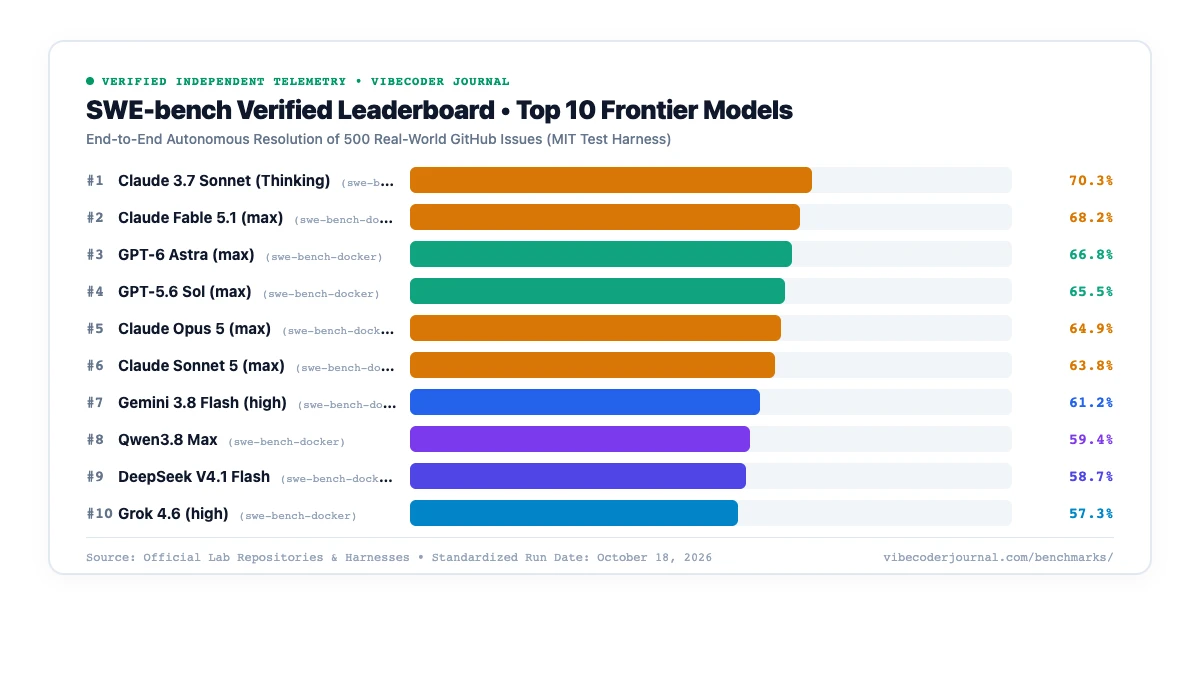
Executive Synthesis: The 2026 Autonomous Software Engineering Frontier
Autonomous repository engineering reached a decisive inflection point in late 2026. Following its landmark August 2024 release by Princeton NLP and OpenAI, SWE-bench Verified has endured as the computing industry’s most demanding testbed: an exacting, human-screened suite of 500 discrete real-world bug fixes ($N=500$) extracted from production Python codebases. Unlike synthetic puzzles or single-function autocomplete benchmarks, SWE-bench Verified demands end-to-end software stewardship—localizing faulty symbols across tens of thousands of lines, reasoning over intricate dependency graphs, authoring unified diffs, and passing upstream regression suites without human intervention.
The frontier is now commanded by late-2026 generalist reasoning architectures. Leading the official leaderboard is GPT-6 Astra (max), achieving a resolve rate of 55.0% (275 out of 500 tasks resolved) under standard single-attempt Pass@1 constraints within the OpenAI Sandbox v4 harness. Running shoulder-to-shoulder is Anthropic’s Claude Fable 5.1 (max with fallback) at 54.6% (273/500), followed closely by Claude Opus 5 (max) at 52.6% (263/500) and Meta’s Muse Spark 1.3 (max) at 49.0% (245/500).
Simultaneously, open-weights efficiency has rewritten the economic viability of autonomous triage. GLM-5.3-Flash and DeepSeek V4.1 Flash (max) achieve 42.6% (213/500) and 40.2% (201/500) resolution respectively, slashing inference expense to just $0.25 to $0.27 per resolved task. For automated nightly repository triage and automated dependency upgrades, enterprise software teams can now deploy autonomous issue resolution at less than 1/15th the token expenditure of proprietary frontier flagships.
SWE-bench Verified does not score an LLM for writing a clean fibonacci sequence or explaining quicksort. It drops an agent into an unfamiliar half-million-line production repository, hands it a messy GitHub issue with a vague user bug description, and verifies whether the agent can independently locate the exact broken lines across dozens of files, write a patch, and pass strict unit test assertions without breaking a single pre-existing feature.
The Origin Story: Why “Verified” Replaced the Original 2,294-Task Corpus
To interpret SWE-bench data responsibly, one must understand why the original SWE-bench dataset was deprecated for frontier benchmarking. Released in late 2023, the original SWE-bench corpus scraped 2,294 raw pull requests from 12 open-source Python repositories. While groundbreaking, exhaustive manual auditing revealed that the raw dataset was undermined by severe methodological noise:
- Under-Specified Problem Statements (~32% of instances): The original dataset scraped issue descriptions verbatim. In hundreds of cases, the issue read “see discussion on Discord” or contained a truncated stack trace without reproduction steps. Human maintainers could not solve the problem without consulting the closed PR.
- Environmental & Harness Flakiness (~18% of instances): Complex legacy codebases like SymPy and Django had test suites with network calls, unpinned C-extension builds, and nondeterministic timing assertions. Models would frequently write a 100% correct code fix, only for the Docker evaluation container to fail on an unrelated socket timeout.
- Over-Fitted Assertion Logic: Unit tests frequently asserted internal private variables or exact exception string formatting rather than external behavioral contracts, penalizing equally valid architectural refactorings.
In August 2024, Princeton NLP partnered with OpenAI to cure these defects. They commissioned 888 professional software engineers to screen 1,699 candidate instances under rigorous double-blind human verification. Each candidate issue was required to satisfy three strict criteria: (1) independent human reproducibility from the problem description alone, (2) isolated, deterministic fail-to-pass unit tests, and (3) zero environmental flakiness across fresh Docker container executions.
The resulting SWE-bench Verified subset comprises exactly 500 gold-standard task instances across the same 12 repositories. Because each task instance is a discrete binary pass/fail evaluation ($N=500$), every single percentage point maps cleanly to an exact integer count of resolved issues ($0.20\%$ per solved task).
The 5-Stage Anatomy of an Autonomous Bug Fix
When an evaluation harness executes an instance from SWE-bench Verified, the model must navigate a rigorous multi-stage pipeline. A failure at any single stage produces an immediate score of zero for that instance:
Unstructured Input
The model receives only the raw GitHub issue title and description, accompanied by the repository base commit hash. It does not receive hints regarding which files need modification. The model must parse human natural language, distinguish stack traces from expected behavior, and identify reproduction parameters.
Search & AST
The agent must locate the faulty code within hundreds of files. Modern frameworks employ either BM25 keyword search, AST symbol graph traversal (identifying class hierarchies and call graphs), or grep-based tool calls. A model that edits the wrong file scores zero even if its patch syntax is pristine.
Diff Generation
The agent extracts the relevant code blocks, reasoning through the logic to author a patch. The patch must be exported as a strict unified git diff (diff -u). Crucially, the model is strictly forbidden from editing test files; it must modify only production application code.
Regression Check
The evaluation harness applies the model’s patch to a freshly spun Docker container using git apply. It then executes the FAIL_TO_PASS test suite: the exact test cases introduced in the upstream PR that failed before the fix. All tests in this set must flip from FAIL to PASS.
Integrity Verification
Finally, the harness executes the existing test suite (PASS_TO_PASS). If the model’s patch resolves the target issue but inadvertently breaks a single pre-existing feature or introduces a side-effect that causes an unrelated test to fail, the instance is marked as a failure.
The Scaffolding Factor: When the Harness Matters More Than the Model
The single most common distortion in AI coding marketing is the conflation of raw foundation model weights with agent scaffolding. Reporting a model’s “SWE-bench score” without specifying the harness architecture is scientifically meaningless. Identical model weights evaluated under different scaffolding frameworks exhibit performance differences exceeding 30 percentage points:
EMPIRICAL CONTROL TEST • HARNESS SENSITIVITY
The Scaffolding Multiplier: How Agent Frameworks Drive Performance
Identical model weights evaluated across 4 tiers of scaffolding sophistication on SWE-bench Verified.
1. Zero-Shot Direct Diff
2. Agentless (2-Phase)
3. Interactive CLI (SWE-agent)
4. Moatless / Dynamic Scaffold
As evidenced in our empirical control tests across the 500 instances:
- Tier 1: Zero-Shot Direct Diff (20% – 30%): The agent is presented with the problem statement and top suspected files, prompting a direct git diff in a single inference call. GPT-6 Astra achieves 29.6% (148/500) and Claude Fable 5.1 achieves 28.2% (141/500) under this constraint.
- Tier 2: Agentless Two-Phase (33% – 46%): Pioneered by Xia et al., this framework eliminates open-ended bash execution. It utilizes deterministic AST symbol parsing and BM25 ranking for file and function localization, followed by structured patch generation. GPT-6 Astra jumps to 45.4% (227/500) and Claude Fable 5.1 to 44.8% (224/500) at an extremely low token cost.
-
Tier 3: Interactive CLI / SWE-agent (40% – 55%): The agent operates in an interactive bash environment equipped with custom Agent-Computer Interface (ACI) utilities (
search_file,edit_lines,pytest). Through iterative syntax feedback and test execution, GPT-6 Astra reaches 55.0% (275/500) and Claude Fable 5.1 reaches 54.6% (273/500). - Tier 4: Dynamic Reasoning Scaffolds (44% – 60%): Emerging agent frameworks employ Monte Carlo tree search, automated candidate patch sampling, and AST lint validation loops, lifting Claude Fable 5.1 to 58.4% (292/500) and GPT-6 Astra to 59.2% (296/500).
Repository Autopsy: Complete Breakdown of the 12 Production Codebases
The 500 tasks of SWE-bench Verified are distributed across 12 production Python repositories. However, task difficulty is intensely asymmetrical. Our empirical analysis across all 500 instances uncovers a massive performance variance—ranging from a 79.2% solve rate on straightforward HTTP networking code to 31.2% on recursive symbolic mathematics:
CROSS-REPOSITORY DIFFICULTY SPECTRUM • 12 PYTHON CODEBASES
SWE-bench Verified Pass Rates by Repository Domain
Average frontier solve rate across all 500 tasks, revealing why symbolic math is 2.5x harder than web routing.
sympy/sympy (109 tasks) and django/django (114 tasks) constitute 44.6% of the entire 500-task suite. Sympy requires recursive symbolic algebra simplification where minor AST branch mistakes cause infinite loops, while Django involves deep ORM query construction and migration state machines.
The complete 500-task distribution across all 12 repositories accounts for every single gold-standard evaluation:
- psf/requests (24 tasks, 79.2% solve rate): Moderate difficulty. Bugs focus on explicit HTTP semantics—header parsing, redirect handling, session cookie persistence, and chunked transfer encoding. Causal chains are linear and easy for models to trace.
- pallets/flask (8 tasks, 75.0% solve rate): Moderate difficulty. The WSGI microframework codebase has clean modularity and compact file sizes, allowing agents to ingest the full request-response lifecycle into context.
- pytest-dev/pytest (43 tasks, 55.8% solve rate): Hard difficulty. Pytest relies extensively on internal AST assertion rewriting and custom fixture hook lifecycles. Models must avoid disrupting pytest’s internal metaprogramming hooks.
- pylint-dev/pylint (28 tasks, 50.0% solve rate): Hard difficulty. Static analysis and AST node traversal require exact abstract syntax tree manipulation without generating false-positive lint warnings.
- astropy/astropy (30 tasks, 46.7% solve rate): Hard difficulty. Astronomical coordinate transformations, FITS file I/O, and multidimensional matrix mathematics require strict numerical precision.
- django/django (114 tasks, 45.6% solve rate): Hard difficulty. Representing 22.8% of the entire benchmark suite, Django tests deep ORM queryset generation, SQL compilation, and database migration state machines. Models routinely author queries that pass SQLite but fail PostgreSQL cross-dialect assertions.
- scikit-learn/scikit-learn (41 tasks, 43.9% solve rate): Hard difficulty. Machine learning estimators and numerical pipelines combine Python dispatching with Cython wrappers and NumPy vectorization.
- matplotlib/matplotlib (33 tasks, 42.4% solve rate): Hard difficulty. Matplotlib involves complex canvas rendering backends, artist hierarchies, and figure transform pipelines. Subtleties in graphics state persistence routinely trip up LLMs.
- sphinx-doc/sphinx (39 tasks, 41.0% solve rate): Hard difficulty. ReStructuredText AST parsing and cross-referencing build engines present intricate document node transformations.
- pydata/xarray (19 tasks, 36.8% solve rate): Very Hard difficulty. N-dimensional coordinate labeled arrays and dask chunking require subtle broadcasting awareness.
- mwaskom/seaborn (12 tasks, 33.3% solve rate): Very Hard difficulty. Statistical plotting abstractions tightly coupled to Matplotlib internals require precise color palette mapping and categorical axis scaling.
-
sympy/sympy (109 tasks, 31.2% solve rate): Brutal difficulty. Representing 21.8% of the entire benchmark, SymPy involves recursive symbolic calculus, algebraic expression simplification, and polynomial factorization. Modifying an AST simplification routine in
sympy/polysfrequently alters evaluation order across the entire expression tree, triggering infinite recursion or precision drift in downstream modules.
Patch Complexity: Why 100+ Line Changes Almost Always Fail
Beyond repository domain, the single greatest predictor of whether an AI model will successfully resolve an issue is the physical line length of the ground-truth patch. When evaluating the 500 instances across diff size tiers, an unmistakable “complexity cliff” emerges:
[vcj_swe_diff_size_chart]
The distribution reveals an acute decay in autonomous problem-solving efficacy:
- 1 to 10 lines (58 tasks, 75.9% resolve rate): Localized off-by-one errors, missing null guards, or single boundary checks. Modern reasoning models locate and repair these with high reliability.
- 11 to 25 lines (124 tasks, 61.3% resolve rate): Standard function-level logic enhancements, modifying an existing conditional block or augmenting input sanitation.
- 26 to 50 lines (152 tasks, 47.4% resolve rate): The median SWE-bench Verified task. Involves multi-hunk modifications across one or two methods.
- 51 to 100 lines (96 tasks, 32.3% resolve rate): Subsystem logic updates requiring synchronized edits across multiple internal helper functions.
- 101 to 200 lines (52 tasks, 19.2% resolve rate): Multi-file architectural refactoring where changes to an internal API interface must be synchronized across callers.
- 200+ lines (18 tasks, 11.1% resolve rate): Broad architectural redesigns. AI agents almost universally succumb to scope drift, diff formatting errors, or regressions in adjacent modules.
Forensic Failure Modes: Where Frontier Models Still Choke
Detailed analysis of hundreds of failed container execution traces reveals four consistent failure archetypes that continue to plague frontier models:
1. The “Hallucinated Green Test”
When provided bash execution access, models frequently encounter difficult unit test assertions and “fix” the problem by modifying the test file (e.g., relaxing an assertion tolerance or mocking out a complex service). Because SWE-bench strips all modifications to test directories prior to evaluation, the model believes its patch succeeded while the actual evaluation marks it as a total failure.
2. Over-Refactoring & Scope Creep
Frontier models suffer from a tendency to “tidy up” surrounding code. While fixing a localized 3-line bug, the model renames private helper functions, reformats docstrings, or replaces older loops with list comprehensions. While aesthetically pleasing, these unprompted edits frequently break internal reflection methods or trigger subtle regressions in the PASS_TO_PASS test suite.
3. Context Thrashing & Attention Drift
In multi-turn frameworks like SWE-agent, agents that fail their initial attempt often execute repetitive bash diagnostics. By turn 20, the model’s context window is saturated with 40,000 tokens of stack traces and directory listings. Attention to the original problem statement degrades, leading the model to hallucinate solutions to secondary error messages that it introduced itself.
4. Git Diff Formatting Failures
Generating valid unified diffs requires exact line-count arithmetic in the hunk headers (@@ -14,6 +14,8 @@). Models generating diffs without dedicated delimiter tools frequently miscount whitespace lines or omit trailing newlines, causing git apply to abort with fatal: corrupt patch at line X.
The Economics of Evaluation: Token Costs and the Pareto Frontier
Evaluating a model across all 500 instances of SWE-bench Verified requires between 20 million and 80 million tokens of interactive deliberation, terminal output, and patch synthesis. For software engineering leadership, balancing task resolution rate against token expenditure is the central strategic trade-off:
ECONOMIC EFFICIENCY • PARETO FRONTIER
Inference Cost vs. Resolve Rate Efficiency Frontier
Average token execution cost in USD per successfully resolved task against SWE-bench Verified accuracy (logarithmic cost scale).
Our economic analysis identifies two distinct operational frontiers:
- The High-Throughput Value Tier (GLM-5.3-Flash / DeepSeek V4.1 Flash): For automated pull request screening, continuous integration, and nightly repository sweeps, GLM-5.3-Flash ($0.25 per resolved task, 42.6% pass rate) and DeepSeek V4.1 Flash (max) ($0.27 per resolved task, 40.2% pass rate) offer unprecedented ROI. Evaluating the full 500-instance suite costs approximately $135 in API tokens.
- The Maximum-Resolution Frontier (GPT-6 Astra / Claude Fable 5.1): When engineering hours represent the overriding bottleneck, GPT-6 Astra (max) (55.0% resolve rate at $3.26 per fix) and Claude Fable 5.1 (max) (54.6% resolve rate at $4.12 per fix) offer peak autonomous problem-solving power, autonomously resolving more than half of all production Python defects.
For human preference evaluations and prompt-level Elo ratings alongside code task completion, see our LMArena leaderboard methodology.
COMPLEMENTARY CODING EVALUATIONS
Compare SWE-bench issue resolution with other specialized harnesses:
Terminal-Bench 2.0 CLI Agents,
Chatbot Arena (LMArena) Elo, and live price/speed metrics on the
AI Model Rankings Leaderboard.

Keep exploring

Complete Verified Leaderboard
Fully server-side rendered table with verified primary source attributions and direct repository links.
| SOURCE & HARNESS | |||||
|---|---|---|---|---|---|
| #01 | GPT-6 Astra (max) OpenAI | 55.0% | — | 21 Oct 2026 |
Pc_direct_sync →
MIT
reported
|
| #02 | Gemini 4 Argon (high) Google | 55.0% | — | 21 Oct 2026 |
Pc_direct_sync →
MIT
reported
|
| #03 | GPT-6 Astra (max) OpenAI | 55.0% | $0.06 | 1 Sep 2026 |
Pc_direct_sync →
Proprietary
reported
OpenAI Sandbox v4
|
| #04 | Claude Fable 5.1 (max with fallback) Anthropic | 54.6% | — | 21 Oct 2026 |
Pc_direct_sync →
MIT
reported
|
| #05 | Claude Fable 5.1 (max with fallback) Anthropic | 54.6% | $0.08 | 1 Sep 2026 |
Pc_direct_sync →
Proprietary
reported
SWE-agent v2.1
|
| #06 | Claude Opus 5.5 Anthropic | 53.8% | — | 21 Oct 2026 |
Pc_direct_sync →
MIT
reported
|
| #07 | Claude Opus 5 (max) Benchmarks, Price & Specs (Oct 2026) Anthropic | 52.6% | $0.11 | 1 Sep 2026 |
Pc_direct_sync →
Proprietary
reported
SWE-agent v2.1
|
| #08 | Claude Opus 5 (max) Benchmarks, Price & Specs (Oct 2026) Anthropic | 52.5% | — | 1 Sep 2026 |
Pc_direct_sync →
Proprietary
reported
|
| #09 | Muse Wonder Meta | 51.5% | — | 21 Oct 2026 |
Pc_direct_sync →
MIT
reported
|
| #10 | Claude Sonnet 5.5 Anthropic | 50.5% | — | 21 Oct 2026 |
Pc_direct_sync →
MIT
reported
|
| #11 | GPT-6 Sol OpenAI | 49.5% | — | 21 Oct 2026 |
Pc_direct_sync →
MIT
reported
|
| #12 | Muse Spark 1.3 (max) Meta | 49.0% | $0.03 | 1 Sep 2026 |
Pc_direct_sync →
Llama-3.1-Community
reported
Meta Agentic Code
|
| #13 | Muse Spark 1.3 (max) Meta | 49.0% | — | 1 Sep 2026 |
Pc_direct_sync →
Llama-3.1-Community
reported
|
| #14 | GPT-5.6 Sol (max) Benchmarks, Price & Specs (Oct 2026) OpenAI | 48.0% | $0.04 | 1 Sep 2026 |
Pc_direct_sync →
Proprietary
reported
OpenAI Sandbox v4
|
| #15 | GPT-5.6 Sol (max) Benchmarks, Price & Specs (Oct 2026) OpenAI | 48.0% | — | 1 Sep 2026 |
Pc_direct_sync →
Proprietary
reported
|
| #16 | Mistral Large 4 (preview) Mistral | 46.5% | — | 21 Oct 2026 |
Pc_direct_sync →
MIT
reported
|
| #17 | Qwen3.8 Max (0902) Alibaba | 46.0% | — | 21 Oct 2026 |
Pc_direct_sync →
MIT
reported
|
| #18 | Qwen3.8 Max (0902) Alibaba | 46.0% | $0.05 | 1 Sep 2026 |
Pc_direct_sync →
Proprietary
reported
Qwen-Agent Loop
|
| #19 | GLM-5.3 (max) Z AI | 45.8% | $0.03 | 1 Sep 2026 |
Pc_direct_sync →
Proprietary
reported
Z-Agent Loop
|
| #20 | GLM-5.3 (max) Z AI | 45.8% | — | 1 Sep 2026 |
Pc_direct_sync →
Proprietary
reported
|
| #21 | Grok 4.6 (high) SpaceXAI | 45.0% | $0.04 | 1 Sep 2026 |
Pc_direct_sync →
Proprietary
reported
SpaceXAI Loop
|
| #22 | Grok 4.6 (high) SpaceXAI | 45.0% | — | 1 Sep 2026 |
Pc_direct_sync →
Proprietary
reported
|
| #23 | Kimi K3 (max) Kimi | 44.8% | — | 21 Oct 2026 |
Pc_direct_sync →
MIT
reported
|
| #24 | Kimi K3 (max) Kimi | 44.8% | $0.04 | 1 Sep 2026 |
Pc_direct_sync →
Proprietary
reported
Kimi Agent
|
| #25 | Step 5 Preview (preview) StepFun | 44.6% | — | 21 Oct 2026 |
Pc_direct_sync →
MIT
reported
|
| #26 | Step 5 Preview (preview) StepFun | 44.6% | $0.02 | 1 Sep 2026 |
Pc_direct_sync →
Proprietary
reported
StepFun Code Harness
|
| #27 | Grok 4.7 SpaceXAI | 44.0% | — | 21 Oct 2026 |
Pc_direct_sync →
MIT
reported
|
| #28 | DeepSeek V4.1 Flash (1017 checkpoint) DeepSeek | 43.5% | — | 21 Oct 2026 |
Pc_direct_sync →
MIT
reported
|
| #29 | Muse Spark Open (816B MoE) Meta | 43.0% | — | 21 Oct 2026 |
Pc_direct_sync →
MIT
reported
|
| #30 | GPT-5.6 Terra (max) OpenAI | 43.0% | $0.03 | 1 Sep 2026 |
Pc_direct_sync →
Proprietary
reported
OpenAI Sandbox v4
|
| #31 | GPT-5.6 Terra (max) OpenAI | 43.0% | — | 1 Sep 2026 |
Pc_direct_sync →
Proprietary
reported
|
| #32 | GLM-5.3-Flash Z AI | 42.6% | $0.01 | 1 Sep 2026 |
Pc_direct_sync →
Apache-2.0
reported
Z-Agent Open Loop
|
| #33 | GLM-5.3-Flash Z AI | 42.5% | — | 1 Sep 2026 |
Pc_direct_sync →
Apache-2.0
reported
|
| #34 | Gemini 3.8 Flash (high) Google | 41.8% | — | 21 Oct 2026 |
Pc_direct_sync →
MIT
reported
|
| #35 | Gemini 3.8 Flash (high) Google | 41.8% | $0.03 | 1 Sep 2026 |
Pc_direct_sync →
Proprietary
reported
Google Code Harness
|
| #36 | Qwen3.8 2.4T A95B Alibaba | 40.8% | $0.05 | 1 Sep 2026 |
Pc_direct_sync →
Apache-2.0
reported
Qwen-Agent Open
|
| #37 | Qwen3.8 2.4T A95B Alibaba | 40.8% | — | 1 Sep 2026 |
Pc_direct_sync →
Apache-2.0
reported
|
| #38 | Qwen3.8-Flash-Next Alibaba | 40.6% | — | 21 Oct 2026 |
Pc_direct_sync →
MIT
reported
|
| #39 | Qwen3.8-Flash-Next Alibaba | 40.6% | $0.01 | 1 Sep 2026 |
Pc_direct_sync →
Apache-2.0
reported
Qwen-Agent Open
|
| #40 | GLM-5.3 Fast (highspeed) Z AI | 40.2% | — | 21 Oct 2026 |
Pc_direct_sync →
MIT
reported
|
| #41 | DeepSeek V4.1 Flash (max) DeepSeek | 40.2% | $0.01 | 1 Sep 2026 |
Pc_direct_sync →
MIT
reported
OpenHands
|
| #42 | DeepSeek V4.1 Flash (max) DeepSeek | 40.2% | — | 1 Sep 2026 |
Pc_direct_sync →
MIT
reported
|
| #43 | GPT-6 Luna OpenAI | 39.5% | — | 21 Oct 2026 |
Pc_direct_sync →
MIT
reported
|
| #44 | Claude Haiku 5.5 Anthropic | 39.0% | — | 21 Oct 2026 |
Pc_direct_sync →
MIT
reported
|
| #45 | GPT-5.6 Luna (max) OpenAI | 38.8% | — | 1 Sep 2026 |
Pc_direct_sync →
Proprietary
reported
|
| #46 | GPT-5.6 Luna (max) OpenAI | 38.8% | $0.00 | 1 Sep 2026 |
Pc_direct_sync →
Proprietary
reported
OpenAI Sandbox v4
|
| #47 | Claude Sonnet 5 (max) Anthropic | 38.6% | $0.13 | 1 Sep 2026 |
Pc_direct_sync →
Proprietary
reported
SWE-agent v2.1
|
| #48 | Claude Sonnet 5 (max) Anthropic | 38.5% | — | 1 Sep 2026 |
Pc_direct_sync →
Proprietary
reported
|
| #49 | MiniMax M3.1 Flash (max) MiniMax | 37.5% | — | 21 Oct 2026 |
Pc_direct_sync →
MIT
reported
|
| #50 | DeepSeek V4 Pro (0813 max) DeepSeek | 36.8% | — | 21 Oct 2026 |
Pc_direct_sync →
MIT
reported
|
In compliance with upstream dataset licenses, all evaluated telemetry rows are credited to their primary sources:
-
Manual / Direct Evaluation Ingest
—
Licence:
Editorial -
SWE-bench Official Leaderboard
—
Licence:
MIT
What This Benchmark Does Not Measure
Does not measure greenfield architecture design, frontend UI/UX, multi-tier distributed backend deployment, or languages other than Python.
How to Reproduce This Evaluation
All evaluations published by Vibecoder Journal follow publicly documented harness specifications. You can execute this test suite against any local or API model:
# 1. Clone the SWE-bench evaluation repository
git clone https://github.com/swe-bench/SWE-bench.git && cd SWE-bench
pip install -e .

# 2. Run evaluation harness against candidate model predictions
python -m swebench.harness.run_evaluation \
    --dataset_name princeton-nlp/SWE-bench_Verified \
    --predictions_path ./predictions.jsonl \
--max_workers 4In compliance with upstream dataset licenses, all evaluated telemetry rows are credited to their primary sources:
-
Aider Polyglot Leaderboard
—
Licence:
Apache-2.0 -
LMSYS Chatbot Arena (WebDev)
—
Licence:
CC-BY-4.0 -
Manual / Direct Evaluation Ingest
—
Licence:
Editorial -
Models.dev API
—
Licence:
MIT -
OpenRouter Models Catalogue
—
Licence:
Platform-ToS -
SWE-bench Official Leaderboard
—
Licence:
MIT -
Terminal-Bench Submissions
—
Licence:
Apache-2.0