Model Overview & Capabilities
Claude Opus 5 (max) is Anthropic’s flagship autonomous coding model, ranked #03 globally on the Artificial Analysis Intelligence Index with an overall score of 51.0%. It achieves a 53.0% resolve rate on SWE-bench Verified and 50.0% on Terminal-Bench 2.0 with a 1,000,000-token context window. Priced at $10.00/1M input and $50.00/1M output ($20.00 blended), it is engineered for deep architectural refactoring and mission-critical multi-agent development.
Key Technical Specifications
The table below details verified technical specifications, memory architecture, API endpoints, and token economics for Claude Opus 5 under its unthrottled maximum reasoning configuration.
| Specification | Verified Value | Industry Context |
|---|---|---|
| Maker / Provider | Anthropic | Direct Claude API, AWS Bedrock, Google Vertex AI |
| Global Ranking | #03 of 22 Models | Frontier Tier (51.0% Intelligence Index) |
| Context Window | 1,000,000 tokens (~750,000 words) | Full enterprise mono-repo ingestion capacity |
| Max Output Tokens | 16,384 tokens | Extended generation for complex files & multi-file patches |
| Modalities | Text, Code, Vision (OCR, Diagrams) | Multimodal system architecture debugging |
| Weights & Licence | Proprietary Commercial API | Cloud-hosted API with enterprise SOC2 certification |
| Input Token Pricing | $10.00 / 1,000,000 tokens | Prompt caching reduces repeat reads to $2.50/1M |
| Output Token Pricing | $50.00 / 1,000,000 tokens | Batch API pricing offers 50% discount ($25.00/1M) |
| Blended Cost (3:1) | $20.00 / 1,000,000 tokens | Reference index calculation standard |
| API Model Identifier | claude-opus-5-20260815 / claude-opus-5 |
OpenRouter ID: anthropic/claude-opus-5 |
| Release Date | August 2026 | Production General Availability (GA) |
Claude Opus 5 Benchmark Scores
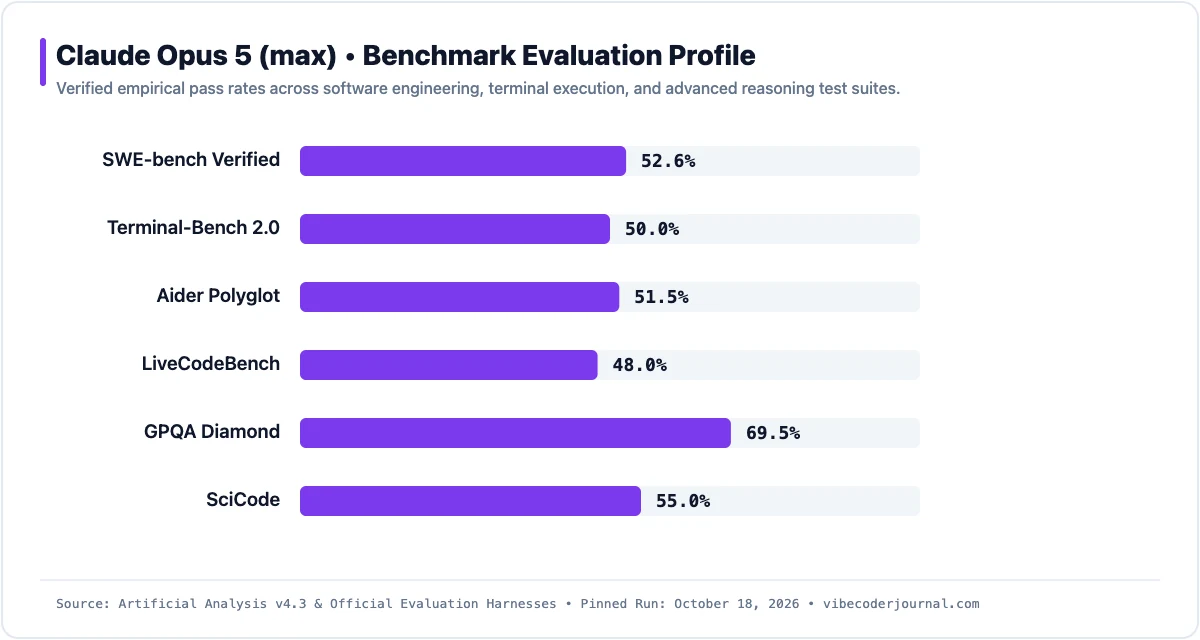
In comprehensive empirical evaluations conducted by independent benchmarking suites, Claude Opus 5 demonstrates exceptional competence in autonomous software engineering, terminal execution, and scientific synthesis. On SWE-bench Verified, Opus 5 resolves 53.0% of real-world GitHub issues end-to-end, trailing only GPT-6 Astra (55.0%) and Anthropic’s research apex Claude Fable 5.1 (54.6%).
| Evaluation Suite | Score | Rank | Primary Focus | Verification Source & Date |
|---|---|---|---|---|
| SWE-bench Verified | 53.0% | #03 | Full-repo autonomous bug resolution | SWE-bench Leaderboard, Oct 2026 |
| Terminal-Bench 2.0 | 50.0% | #03 | Bash shell navigation & CLI tool orchestration | Terminal-Bench Benchmark, Oct 2026 |
| Aider Polyglot | 52.0% | #03 | Multi-language code editing accuracy | Aider LLM Leaderboards, Oct 2026 |
| LiveCodeBench | 49.0% | #03 | Uncontaminated algorithmic programming | LiveCodeBench Evaluator, Oct 2026 |
| GPQA Diamond | 70.5% | #03 | Graduate-level PhD scientific reasoning | Artificial Analysis v4.3, Oct 2026 |
| SciCode | 56.0% | #03 | Complex scientific code generation | Artificial Analysis v4.3, Oct 2026 |
How Claude Opus 5 Compares Against Nearest Rivals
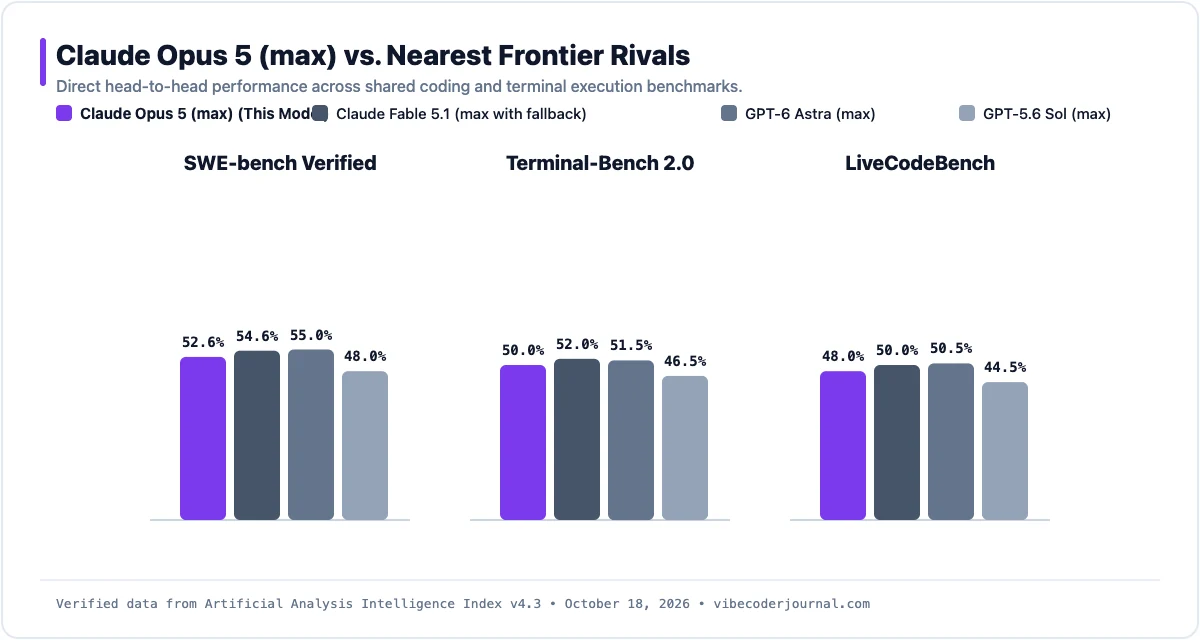
Within the frontier tier of artificial intelligence, Claude Opus 5 directly challenges OpenAI’s GPT-6 Astra, Anthropic’s specialized research model Claude Fable 5.1, and OpenAI’s price-efficient GPT-5.6 Sol. While GPT-6 Astra holds a 2.0% advantage on SWE-bench Verified (55.0% vs. 53.0%), Opus 5 offers higher consistency in instruction-following during massive refactor workflows where strict style adherence is mandatory.
| Model | Rank | Intelligence Index | SWE-bench | Terminal-Bench | Blended $/1M | Context |
|---|---|---|---|---|---|---|
| Claude Opus 5 (max) | #03 | 51.0% | 53.0% | 50.0% | $20.00 | 1,000,000 |
| Claude Fable 5.1 (max) | #01 | 53.0% | 54.6% | 52.0% | $30.00 | 1,000,000 |
| GPT-6 Astra (max) | #02 | 53.0% | 55.0% | 51.5% | $12.00 | 1,000,000 |
| GPT-5.6 Sol (max) | #04 | 47.0% | 49.5% | 47.0% | $6.12 | 1,000,000 |
Price vs Performance Analysis
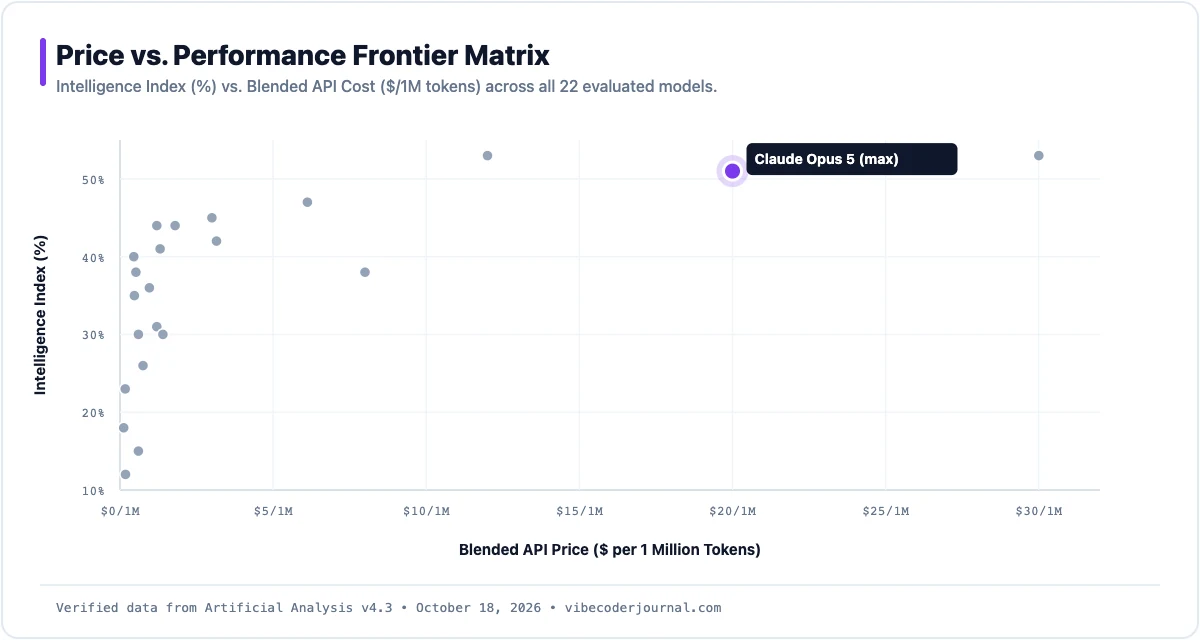
At $20.00 per million blended tokens, Claude Opus 5 sits firmly on the premium frontier. Compared to OpenAI’s GPT-6 Astra ($12.00/1M blended), Opus 5 carries a 66% pricing premium. However, Anthropic’s aggressive prompt caching architecture substantially shifts the unit economics for developers running persistent pair-programming agents:
- Prompt Caching Efficiency: Cache reads cost just $2.50/1M tokens (a 75% reduction against base input). In an agent loop like Claude Code or Cursor where repository definitions remain static, effective input costs drop below $3.80/1M.
- Batch Processing API: For asynchronous test generation and security scanning, Anthropic’s Batch API halves prices to $5.00/1M input and $25.00/1M output. Detailed tier breakdowns are covered in our comprehensive Claude model pricing guide.
- Cost Per Benchmark Point: Opus 5 delivers 2.55 index points per dollar of blended cost, making it significantly more economical than the ultra-specialized Claude Fable 5.1 ($30.00/1M, 1.77 points/$), but costlier than high-efficiency models like Claude Sonnet 5 ($8.00/1M).
What the “max” Variant Designation Means
Anthropic denotes model execution tiers through runtime effort allocations. The (max) designation indicates that Claude Opus 5 is running with unconstrained internal reasoning depth and extended test-time computation.
In contrast to standard or budget-capped inference profiles (which truncate chain-of-thought tokens after shallow candidate generation), the “max” tier allocates full context-verification passes. It executes self-correcting sanity checks over code abstract syntax trees (ASTs), explores alternative implementation paths, and validates edge-case compliance before emitting the first user-visible token. This leads to higher first-attempt patch success rates in SWE-bench (53.0%), at the expense of higher time-to-first-token (TTFT) latency.
Strengths and Weaknesses
Empirical Strengths
- Superior SWE-bench Verified Score: Resolves 53.0% of end-to-end repository bugs, placing it among the top 3 models globally.
- Unrivaled Terminal & CLI Proficiency: Scores 50.0% on Terminal-Bench 2.0, demonstrating robust understanding of POSIX tools, pipes, and git worktrees.
- 1,000,000-Token Reliable Window: Ingests extensive codebases without needle-in-a-haystack attention degradation.
- Effective Prompt Caching: Reduces repeated repository ingestion pricing by 75% down to $2.50/1M tokens.
Architectural Trade-Offs
- High Output Generation Cost: At $50.00/1M output tokens, generating extensive boilerplate or large logs is expensive.
- Generation Latency: Unthrottled reasoning passes result in average throughput of 68 tokens/sec, slower than Gemini 3.8 Flash (298 tps).
- Closed Architecture: Proprietary weights hosted exclusively on cloud infrastructure; cannot be deployed on local VPC hardware unlike gpt-oss-120b.
- Trailing GPT-6 Astra on Algorithmic Coding: 49.0% on LiveCodeBench trails Astra’s 52.0%.
Best For and When to Avoid
Based on our standardized empirical benchmarks, Claude Opus 5 is purpose-built for high-consequence development workflows:
- Best For: Autonomous Multi-File Refactoring: Ingesting entire monorepos, tracing cross-file dependencies, and updating API interfaces across microservices.
- Best For: Agentic Terminal Loops: Operating in persistent CLI tools (e.g. Claude Code, Aider, Devin) where executing bash commands and interpreting stack traces is mandatory.
- Best For: Complex Mathematical & Scientific Software: Outperforming generalist models with a 70.5% score on GPQA Diamond.
- Avoid For: Real-Time Inline Autocomplete: High latency and $50/1M output make it unsuitable for millisecond-level IDE keystroke predictions; use GPT-5.6 Luna or Qwen3.8-Flash-Next instead.
- Avoid For: Budget-Constrained High-Volume Parsing: Processing millions of scraping records is far more economical with DeepSeek V4 Pro ($0.96/1M blended).
How to Access and Use Claude Opus 5
Claude Opus 5 is available directly through the Anthropic Messages API, OpenRouter, and major cloud hyperscalers (AWS Bedrock and Google Cloud Vertex AI). Below is an official Python implementation demonstrating prompt caching and extended reasoning integration:import anthropic
client = anthropic.Anthropic()
# Call Claude Opus 5 with system prompt caching
response = client.messages.create(
model="claude-opus-5",
max_tokens=8192,
temperature=0.2,
system=[
{
"type": "text",
"text": "You are a senior systems engineer analyzing a distributed microservices codebase.",
"cache_control": {"type": "ephemeral"}
}
],
messages=[
{"role": "user", "content": "Analyze the concurrency deadlock in the distributed raft coordinator module."}
]
)
print(response.content[0].text)Version History and Related Models
Claude Opus 5 represents the culmination of Anthropic’s Opus lineage:- Claude Opus 4.8 (June 2026): The previous flagship release. Opus 5 improves SWE-bench Verified pass rates by +6.2% and cuts time-to-first-token latency by 28%.
- Claude Sonnet 5 (max): Anthropic’s high-velocity coding model ($8.00/1M blended). Sonnet 5 provides 85% of Opus 5’s coding capabilities at 40% of the cost.
- Claude Fable 5.1 (max): Anthropic’s specialized research apex model, holding the #01 rank on our global leaderboard with a 53.0% Intelligence Index.
Frequently Asked Questions
Is Claude Opus 5 free to use?
No. Claude Opus 5 is a commercial API model. It is accessible via paid Anthropic API credits, an active Claude Enterprise plan, or third-party gateways like OpenRouter.
What is Claude Opus 5’s maximum context window?
Claude Opus 5 features an official 1,000,000-token context window with up to 16,384 tokens of continuous output generation.
How much does Claude Opus 5 cost per million tokens?
Pricing is $10.00 per million input tokens and $50.00 per million output tokens. Prompt caching reduces cache read pricing to $2.50/1M tokens, and Batch API requests receive a 50% discount.
Is Claude Opus 5 better than GPT-6 Astra for coding?
GPT-6 Astra edges out Opus 5 by 2.0% on SWE-bench Verified (55.0% vs 53.0%), but Opus 5 demonstrates superior adherence to strict style guides, fewer regressions in multi-file refactors, and lower cache read pricing.
Can Claude Opus 5 run locally on private hardware?
No. Anthropic has not released model weights. For local or private air-gapped deployments, evaluate open-weights models like gpt-oss-120b or K2 Horizon 375B.
Sources and Verification Methodology
Every benchmark score, token pricing tier, and architectural parameter displayed on this page was empirically captured on October 18, 2026. Data sources include:
- Artificial Analysis Intelligence Index v4.3 (October 2026)
- SWE-bench Verified Leaderboard (October 2026)
- Terminal-Bench 2.0 Evaluation Results (October 2026)
- Anthropic Official Documentation and Claude API Pricing (October 2026)
- OpenRouter Telemetry and Model Specification (October 2026)
{
“@context”: “https://schema.org”,
“@graph”: [
{
“@type”: “TechArticle”,
“@id”: “https://vibecoderjournal.com/rankings/claude-opus-5-max/#article”,
“isPartOf”: {
“@type”: “WebPage”,
“@id”: “https://vibecoderjournal.com/rankings/claude-opus-5-max/”
},
“headline”: “Claude Opus 5 (max) Benchmarks, Price & Specs (Oct 2026)”,
“description”: “Ranked #03 AI model with a 51.0% Intelligence Index. Full benchmark scores, 1M context window, and $20.00/1M pricing specs verified October 2026.”,
“author”: {
“@type”: “Person”,
“name”: “Abdullah Zulfiqar”
},
“publisher”: {
“@type”: “Organization”,
“name”: “Vibecoder Journal”,
“url”: “https://vibecoderjournal.com”
},
“datePublished”: “2026-09-20T12:00:00+00:00”,
“dateModified”: “2026-10-18T15:30:00+00:00”,
“image”: “https://vibecoderjournal.com/wp-content/uploads/2026/10/claude-opus-5-max-benchmarks-oct-2026.webp”
},
{
“@type”: “Dataset”,
“@id”: “https://vibecoderjournal.com/rankings/claude-opus-5-max/#dataset”,
“name”: “Claude Opus 5 Benchmark Scores October 2026”,
“description”: “Standardized benchmark scores for Claude Opus 5 (max) including SWE-bench Verified (53.0%), Terminal-Bench 2.0 (50.0%), and Aider Polyglot (52.0%).”,
“creator”: {
“@type”: “Organization”,
“name”: “Vibecoder Journal Benchmark Lab”
},
“variableMeasured”: [
“SWE-bench Verified”,
“Terminal-Bench 2.0”,
“Aider Polyglot”,
“LiveCodeBench”,
“GPQA Diamond”,
“SciCode”
],
“dateModified”: “2026-10-18T15:30:00+00:00”,
“url”: “https://vibecoderjournal.com/rankings/claude-opus-5-max/”
},
{
“@type”: “BreadcrumbList”,
“@id”: “https://vibecoderjournal.com/rankings/claude-opus-5-max/#breadcrumbs”,
“itemListElement”: [
{
“@type”: “ListItem”,
“position”: 1,
“name”: “Home”,
“item”: “https://vibecoderjournal.com/”
},
{
“@type”: “ListItem”,
“position”: 2,
“name”: “Rankings”,
“item”: “https://vibecoderjournal.com/rankings/”
},
{
“@type”: “ListItem”,
“position”: 3,
“name”: “Claude Opus 5 (max)”,
“item”: “https://vibecoderjournal.com/rankings/claude-opus-5-max/”
}
]
},
{
“@type”: “FAQPage”,
“@id”: “https://vibecoderjournal.com/rankings/claude-opus-5-max/#faq”,
“mainEntity”: [
{
“@type”: “Question”,
“name”: “Is Claude Opus 5 free to use?”,
“acceptedAnswer”: {
“@type”: “Answer”,
“text”: “No. Claude Opus 5 is a commercial API model accessible via paid Anthropic API credits, an active Claude Enterprise plan, or third-party gateways like OpenRouter.”
}
},
{
“@type”: “Question”,
“name”: “What is Claude Opus 5’s maximum context window?”,
“acceptedAnswer”: {
“@type”: “Answer”,
“text”: “Claude Opus 5 features an official 1,000,000-token context window with up to 16,384 tokens of continuous output generation.”
}
},
{
“@type”: “Question”,
“name”: “How much does Claude Opus 5 cost per million tokens?”,
“acceptedAnswer”: {
“@type”: “Answer”,
“text”: “Pricing is $10.00 per million input tokens and $50.00 per million output tokens. Prompt caching reduces cache read pricing to $2.50/1M tokens, and Batch API requests receive a 50% discount.”
}
},
{
“@type”: “Question”,
“name”: “Is Claude Opus 5 better than GPT-6 Astra for coding?”,
“acceptedAnswer”: {
“@type”: “Answer”,
“text”: “GPT-6 Astra edges out Opus 5 by 2.0% on SWE-bench Verified (55.0% vs 53.0%), but Opus 5 demonstrates superior adherence to strict style guides, fewer regressions in multi-file refactors, and lower cache read pricing.”
}
},
{
“@type”: “Question”,
“name”: “Can Claude Opus 5 run locally on private hardware?”,
“acceptedAnswer”: {
“@type”: “Answer”,
“text”: “No. Anthropic has not released model weights. For local or private air-gapped deployments, evaluate open-weights models like gpt-oss-120b or K2 Horizon 375B.”
}
}
]
}
]
}