
By Abdullah Zulfiqar · Data checked 27 October 2026 · 8 min read
Kimi K2.5 vs Qwen 3.5: which is better? On paper they’re almost tied. Kimi K2.5 is slightly ahead on SWE-bench Verified (76.8 vs 76.4) and LiveCodeBench (85.0 vs 83.6). Qwen 3.5 wins on agent and tool-calling tests like TAU2-Bench (86.7 vs 77.0) and BFCL-V4 (72.9 vs 68.3). Qwen 3.5 is a little cheaper on the API and far easier to run yourself, because it comes in sizes from 0.8B up to 397B. Kimi K2.5 only comes as a 1-trillion-parameter model.
Verdict: Pick Qwen 3.5 for agents, tool calling, local use and the Apache 2.0 license. Pick Kimi K2.5 if you want the slightly stronger raw coder, very strong document and OCR handling, or Moonshot’s Agent Swarm mode. For most vibe coders using an API, the difference in code quality is too small to notice. Price and tooling should decide it.
How to read these numbers: every benchmark here is self-reported by Moonshot or Alibaba on their official Hugging Face model cards. We didn’t re-run them. The head-to-head figures come from the Qwen 3.5 model card, which lists Kimi K2.5 next to Qwen 3.5. Where Moonshot’s own card reports the same test, the Kimi numbers match. Prices are OpenRouter’s lowest listed provider price on 27 October 2026.
| Kimi K2.5 | Qwen 3.5 (flagship) | |
|---|---|---|
| Maker | Moonshot AI | Alibaba (Qwen team) |
| Released | 27 Jan 2026 (OpenRouter listing) | 16 Feb 2026 (OpenRouter listing) |
| Size | 1T total, 32B active (MoE) | 397B total, 17B active (MoE) |
| Context | 256K | 262K native, up to ~1M with YaRN |
| Input | Text, image, video (video via official API, experimental) | Text, image, video |
| License | Modified MIT | Apache 2.0 |
| API price (in / out, per 1M tokens) | $0.49 / $2.50 | $0.39 / $2.34 |
| Smaller versions | None | 0.8B, 2B, 4B, 9B, 27B, 35B-A3B, 122B-A10B |
Kimi K2.5 vs Qwen 3.5 at a glance
Both are open-weight Mixture-of-Experts (MoE) models from Chinese labs, released about three weeks apart in early 2026. Both are built for the same jobs: agentic coding, tool use and multimodal input.
The big difference is size. Kimi K2.5 is a 1-trillion-parameter model that activates 32B parameters per token. Qwen 3.5’s flagship (Qwen3.5-397B-A17B) is less than half the total size and activates just 17B per token. That’s a big part of why Qwen is cheaper to serve and easier to run.
Both companies have shipped newer models since. Moonshot has moved on to the Kimi K3 series, and our model rankings track the newest Qwen releases. K2.5 and Qwen 3.5 are still widely used, though, especially through cheap API providers and for self-hosting.
Benchmarks: coding, agents and reasoning
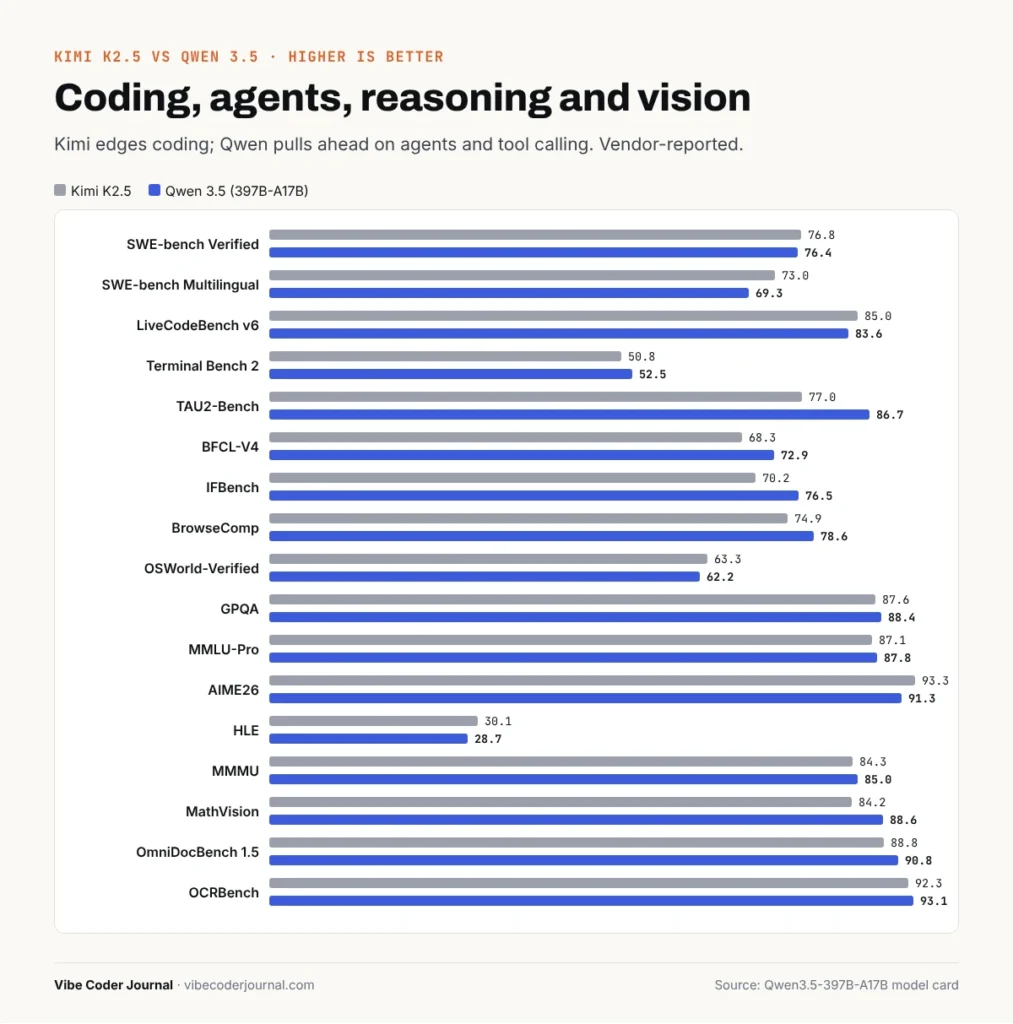 Head-to-head scores from the Qwen3.5-397B-A17B model card (vendor-reported). Higher is better.
Coding
| Benchmark | Kimi K2.5 | Qwen 3.5 | Winner |
|---|---|---|---|
| SWE-bench Verified | 76.8 | 76.4 | Kimi (by 0.4) |
| SWE-bench Multilingual | 73.0 | 69.3 | Kimi |
| LiveCodeBench v6 | 85.0 | 83.6 | Kimi |
| Terminal Bench 2 | 50.8 | 52.5 | Qwen |
Kimi K2.5 has a small edge on coding. It wins three of the four coding tests, and its clearest lead is on SWE-bench Multilingual, real GitHub fixes in languages other than Python. On SWE-bench Verified, the most cited coding test, the gap is 0.4 points, which is essentially a tie. Qwen 3.5 wins Terminal Bench 2, which tests working in a real terminal.
Agents and tool calling
| Benchmark | Kimi K2.5 | Qwen 3.5 | Winner |
|---|---|---|---|
| TAU2-Bench | 77.0 | 86.7 | Qwen |
| BFCL-V4 (function calling) | 68.3 | 72.9 | Qwen |
| IFBench (instruction following) | 70.2 | 76.5 | Qwen |
| BrowseComp (discard-all context strategy) | 74.9 | 78.6 | Qwen |
| OSWorld-Verified (computer use) | 63.3 | 62.2 | Kimi |
This is where Qwen 3.5 pulls ahead. TAU2-Bench measures how well a model handles multi-step tasks with tools and a simulated user, and Qwen leads by almost 10 points. It also follows instructions more reliably on IFBench. If you’re building agents, or using a coding tool that makes lots of tool calls, Qwen 3.5 has the stronger case.
A note on BrowseComp: the Qwen card reports Qwen 3.5 at 69.0 with a simple context strategy and 78.6 with the “discard-all” strategy Kimi K2.5 also uses. We compare like with like.
Kimi K2.5 does have one agent trick Qwen doesn’t: Agent Swarm. It splits a big task into parallel sub-tasks run by sub-agents it creates on the fly. Moonshot reports BrowseComp rising to 78.4 with it on.
Reasoning, knowledge and vision
| Benchmark | Kimi K2.5 | Qwen 3.5 |
|---|---|---|
| GPQA | 87.6 | 88.4 |
| MMLU-Pro | 87.1 | 87.8 |
| AIME26 (math) | 93.3 | 91.3 |
| HLE (Humanity’s Last Exam) | 30.1 | 28.7 |
| MMMU (multimodal) | 84.3 | 85.0 |
| MathVision | 84.2 | 88.6 |
| OmniDocBench 1.5 (documents) | 88.8 | 90.8 |
| OCRBench | 92.3 | 93.1 |
General knowledge and reasoning are a wash, with differences of about one point either way. Kimi is slightly better at hard math (AIME26) and the very hard HLE set. Qwen is better at visual math and document reading in this table. Kimi K2.5 is still very strong on documents and OCR in its own card, ahead of GPT-5.2 and Claude 4.5 Opus on OCRBench.
Price: Qwen 3.5 is a bit cheaper
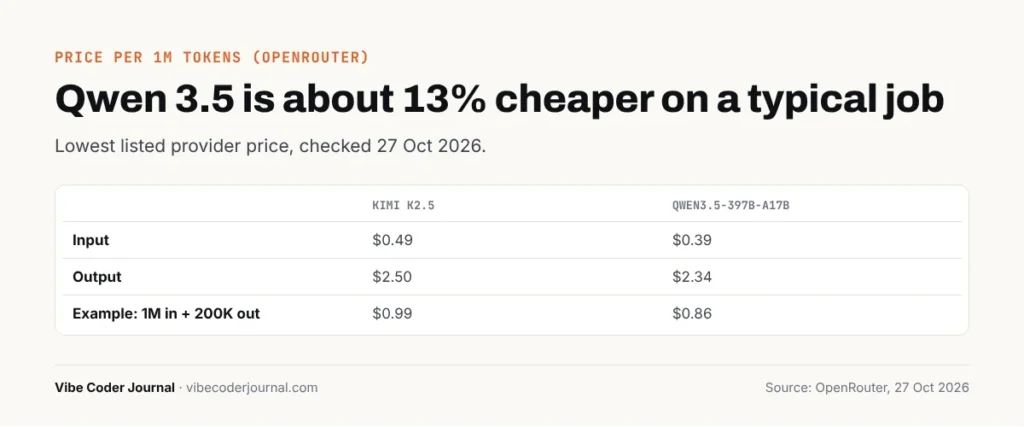 Lowest listed provider price on OpenRouter, checked 27 Oct 2026.
| Price per 1M tokens (OpenRouter) | Kimi K2.5 | Qwen3.5-397B-A17B |
|---|---|---|
| Input | $0.49 | $0.39 |
| Output | $2.50 | $2.34 |
| Example: 1M in + 200K out | $0.99 | $0.86 |
Qwen 3.5 is about 13% cheaper on a typical coding job that reads a lot and writes less. Both are a fraction of the price of closed frontier models. Kimi K2.5 providers also list cached input from about $0.10 to $0.21 per 1M tokens, which helps with long agent sessions that re-read the same context.
Prices vary by provider. OpenRouter lists several for each model, including Amazon Bedrock for Kimi K2.5 and Alibaba Cloud for Qwen 3.5. Check the live page before you commit. For cheaper or free options, see our best free OpenRouter models tracker.
Running them locally: not even close
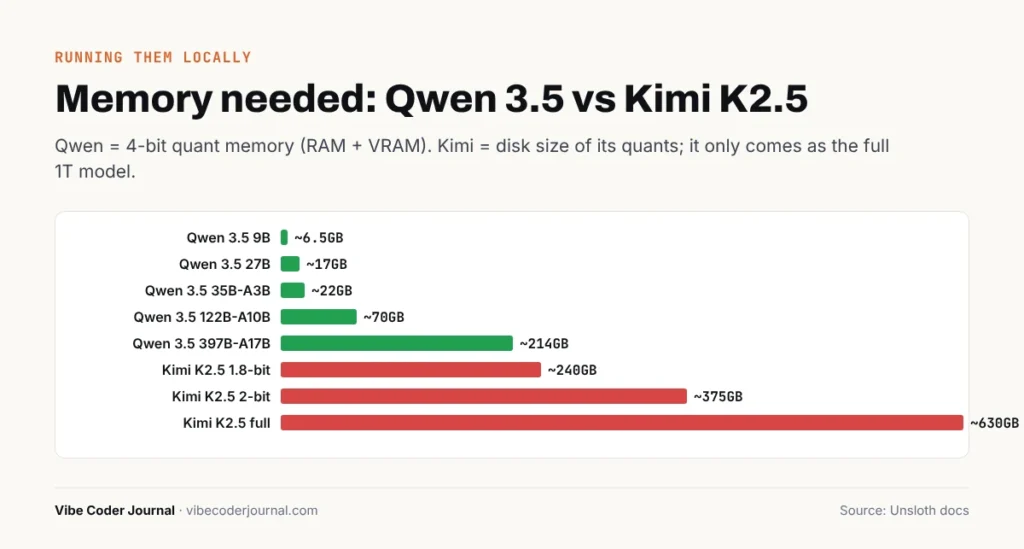 Qwen = 4-bit quant memory. Kimi = disk size of its smallest quants. Source: Unsloth docs.
If you want to run the model on your own hardware, Qwen 3.5 wins easily.
Kimi K2.5 only comes as the full 1T model. Using Unsloth’s numbers: – the smallest 1.8-bit quant is about 240GB on disk – the recommended 2-bit quant is 375GB – the full model is about 630GB and needs at least 4× H200 GPUs
Unsloth says a single 24GB GPU can run the 1.8-bit quant if you offload the MoE layers to system RAM. You get about 10 tokens/s with around 256GB of RAM, and speed can drop below 2 tokens/s if memory is short.
Qwen 3.5 is a whole family:
| Qwen 3.5 model | Memory at 4-bit (RAM + VRAM) |
|---|---|
| 9B | ~6.5GB |
| 27B | ~17GB |
| 35B-A3B | ~22GB |
| 122B-A10B | ~70GB |
| 397B-A17B (flagship) | ~214GB |
Unsloth says the 27B and 35B-A3B models work with about 22GB of memory, so a 24GB GPU or a 32GB Mac is enough. Unsloth says the flagship can hit 25+ tokens/s on a single 24GB GPU with 256GB of system RAM using MoE offloading.
Our what fits in 32GB and run LLMs locally guides cover setup with Ollama and llama.cpp.
License
- Qwen 3.5: Apache 2.0, one of the most permissive licenses there is. You can use it commercially, modify it and ship it with very few conditions.
- Kimi K2.5: a Modified MIT License for both code and weights. It’s also permissive, but “modified” means extra terms. Read the license file on Hugging Face before using it in a large commercial product.
If licensing matters to your company, Qwen 3.5 is the simpler choice.
Which should you choose?
Choose Qwen 3.5 if: – you’re building agents or tools that make lots of function calls (it leads TAU2-Bench by 9.7 points) – you want to run it locally on a normal GPU or Mac (use the 27B or 35B-A3B version) – you want the lowest API price – you need the plain Apache 2.0 license – you work in many languages (Qwen says it supports 201 languages and dialects)
Choose Kimi K2.5 if: – you want the slightly stronger coder, especially for non-Python repos (it leads SWE-bench Multilingual 73.0 vs 69.3) – you do heavy math or very hard reasoning (AIME26, HLE) – you want Agent Swarm for big research or search tasks – you’re happy using it through an API and never self-hosting
For vibe coding with Claude Code-style tools: both work through OpenAI-compatible APIs. Qwen 3.5’s stronger tool calling and lower price make it our default pick between the two. If you’d rather keep using Claude Code with these models, see our Claude Code OpenRouter config tool.
For how both compare with Claude, GPT and Gemini, check our AI model rankings and the SWE-bench Verified leaderboard. If you’re upgrading from an older Qwen, read Qwen 2.5 vs Qwen 3.5.
Frequently asked questions
Is Kimi K2.5 better than Qwen 3.5?
For pure coding, Kimi K2.5 is very slightly ahead (76.8 vs 76.4 on SWE-bench Verified, 85.0 vs 83.6 on LiveCodeBench). For agents and tool calling, Qwen 3.5 is clearly better (86.7 vs 77.0 on TAU2-Bench). Qwen 3.5 is also cheaper and much easier to run locally, so for most people it’s the better all-round choice.
Which is better for coding, Kimi K2.5 or Qwen 3.5?
Kimi K2.5, by a small margin. It wins SWE-bench Verified, SWE-bench Multilingual and LiveCodeBench in the vendor-reported results. Qwen 3.5 wins Terminal Bench 2. In everyday use the gap is small, so tool calling, speed and price often matter more.
Is Qwen 3.5 cheaper than Kimi K2.5?
Yes. On OpenRouter on 27 October 2026, Qwen3.5-397B-A17B started at $0.39 input and $2.34 output per million tokens, versus $0.49 and $2.50 for Kimi K2.5. On a job with 1M input and 200K output tokens, that’s about $0.86 vs $0.99.
Can I run Kimi K2.5 locally?
Only with a lot of memory. Kimi K2.5 has 1 trillion parameters. Its smallest quant is about 240GB, and Unsloth recommends RAM plus VRAM roughly matching the file size for decent speed. Most people use it through an API. Qwen 3.5’s 27B or 35B-A3B versions need only about 17 to 22GB at 4-bit.
What is the context window of Kimi K2.5 and Qwen 3.5?
Kimi K2.5 supports 256K tokens. Qwen3.5-397B-A17B supports 262,144 tokens natively and can be extended to about 1 million tokens with YaRN scaling, according to its model card.
Are Kimi K2.5 and Qwen 3.5 open source?
Both are open-weight models on Hugging Face. Qwen 3.5 uses the Apache 2.0 license. Kimi K2.5 uses a Modified MIT License that covers both code and weights. Both allow commercial use, but read Kimi’s extra terms before a large deployment.
Do Kimi K2.5 and Qwen 3.5 understand images?
Yes. Both are natively multimodal and accept images and video. Kimi K2.5 uses a 400M-parameter MoonViT vision encoder, and its model card notes that video chat is experimental and only on the official API. Qwen 3.5’s flagship model card shows image and video input with text output.
Sources
Checked 27 October 2026:
- Kimi K2.5 model card (Moonshot AI), Hugging Face: https://huggingface.co/moonshotai/Kimi-K2.5
- Qwen3.5-397B-A17B model card (Qwen), Hugging Face: https://huggingface.co/Qwen/Qwen3.5-397B-A17B
- OpenRouter, Kimi K2.5: https://openrouter.ai/moonshotai/kimi-k2.5
- OpenRouter, Qwen3.5 397B A17B: https://openrouter.ai/qwen/qwen3.5-397b-a17b

Keep exploring