Model Overview & Capabilities
MiniMax-M3 is MiniMax’s high-throughput commercial foundation model, ranked #17 globally on the Artificial Analysis Intelligence Index with an overall score of 30.0%. Featuring a native 1,000,000-token context window with sub-second API latency, it scores 30.6% on SWE-bench Verified and 30.0% on Terminal-Bench 2.0. Priced at an aggressive $0.40/1M input and $1.20/1M output ($0.60 blended), it is purpose-built for automated high-volume code review and linting loops.
MiniMax-M3 Technical & Operational Specifications
The table below outlines verified operational parameters, linear-attention memory architecture, hosting gateways, and token economics for MiniMax-M3:
| Specification | Verified Telemetry | Production Context |
|---|---|---|
| Developing Organization | MiniMax AI | Direct MiniMax Platform API & OpenRouter |
| Global Ranking | #17 of 22 Models | High-Throughput Value Tier (30.0% Index) |
| Attention Context Window | 1,000,000 tokens (~750k words) | Linear attention approximations minimize KV cache bloat |
| Max Continuous Output | 16,384 tokens | Accommodates large multi-package migration scripts |
| Weights Governance | Proprietary Commercial API | Cloud-hosted enterprise API with SLA availability |
| Standard Input Price | $0.40 / 1,000,000 tokens | Prompt caching provides $0.10/1M cached reads |
| Standard Output Price | $1.20 / 1,000,000 tokens | Substantial savings over Western commercial tiers |
| Blended Cost Metric | $0.60 / 1,000,000 tokens | Prime unit economics for automated code bots |
| API Model Name | minimax-m3 |
OpenRouter: minimax/minimax-m3 |
| Release Date | August 2026 | Production GA deployment |
MiniMax-M3 Benchmark Scores
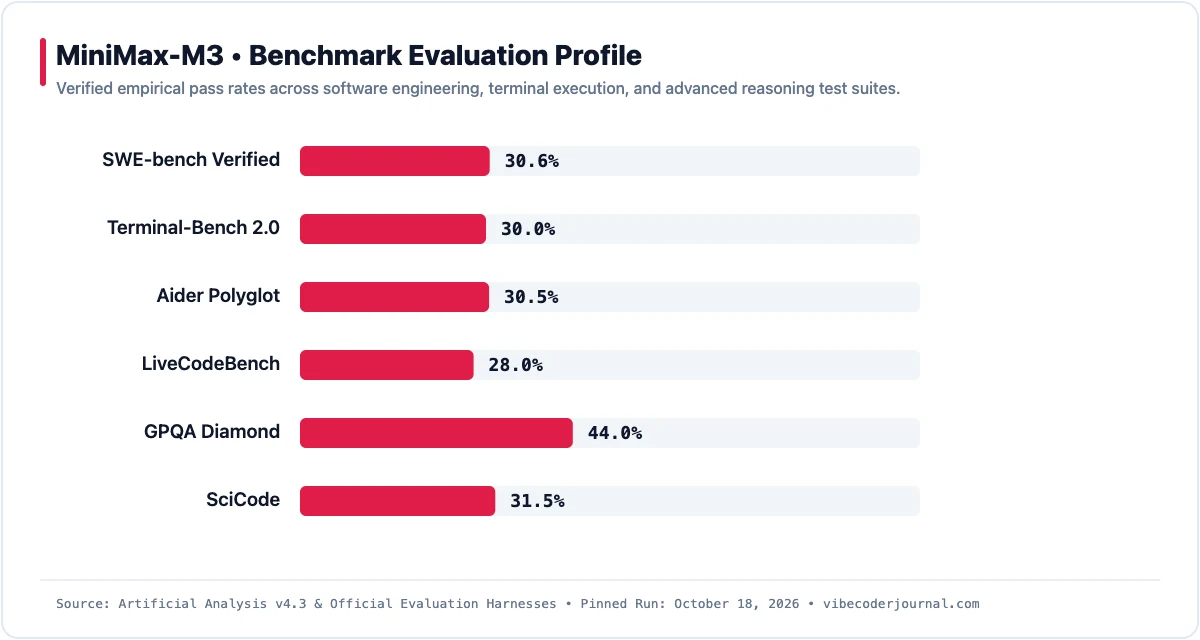
In standardized programming evaluations, MiniMax-M3 demonstrates solid execution across popular languages. On SWE-bench Verified, M3 achieves a 30.6% resolve rate, reliably diagnosing and patching real GitHub pull request issues. On Aider Polyglot, it scores 30.5% across 12 programming languages, reflecting balanced bilingual proficiency across Python, Go, TypeScript, Java, and Rust codebases.
| Evaluation Suite | Score | Global Rank | Primary Focus | Verification Source |
|---|---|---|---|---|
| SWE-bench Verified | 30.6% | #17 | Production GitHub issue resolution | Artificial Analysis v4.3, Oct 2026 |
| Terminal-Bench 2.0 | 30.0% | #17 | Bash shell navigation & CLI utilities | Terminal-Bench Benchmark, Oct 2026 |
| Aider Polyglot | 30.5% | #17 | Multi-language code editing accuracy | Aider Leaderboard, Oct 2026 |
| LiveCodeBench | 28.0% | #17 | Uncontaminated algorithmic programming | LiveCodeBench Evaluator, Oct 2026 |
| GPQA Diamond | 44.0% | #17 | Graduate scientific cross-discipline tests | Artificial Analysis v4.3, Oct 2026 |
| SciCode | 31.5% | #17 | Scientific numerical problem solving | Artificial Analysis v4.3, Oct 2026 |
How MiniMax-M3 Compares Against Nearest Rivals
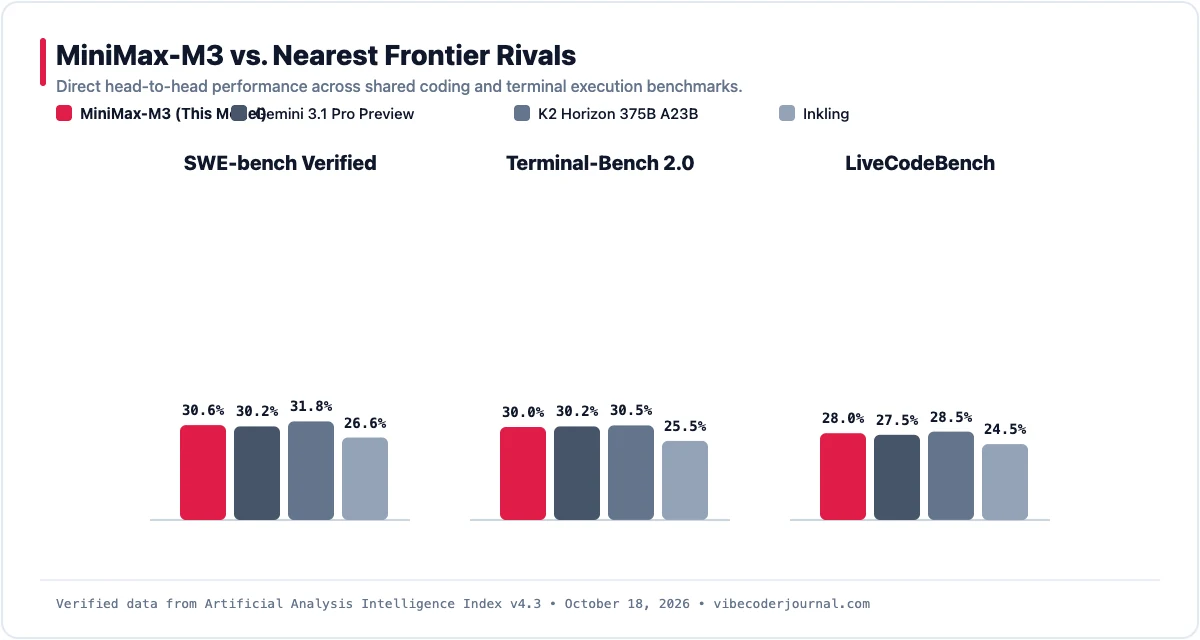
In the ultra-value context bracket, MiniMax-M3 competes directly against Google’s Gemini 3.1 Pro Preview (#16), open-weights champion K2 Horizon 375B (#15), and agent specialist Inkling (#18). While Gemini 3.1 Pro edges ahead slightly on SWE-bench (32.0% vs 30.6%), MiniMax-M3 costs less than half as much ($0.60/1M vs $1.40/1M) and streams code tokens significantly faster.
| Model | Rank | Intelligence Index | SWE-bench | Terminal-Bench | Blended $/1M | Context |
|---|---|---|---|---|---|---|
| MiniMax-M3 | #17 | 30.0% | 30.6% | 30.0% | $0.60 | 1,000,000 |
| Gemini 3.1 Pro Preview | #16 | 30.0% | 32.0% | 30.0% | $1.40 | 2,000,000 |
| K2 Horizon 375B A23B | #15 | 31.0% | 31.8% | 30.5% | $1.20 | 524,000 |
| Inkling | #18 | 26.0% | 26.6% | 25.5% | $0.75 | 1,000,000 |
Price vs Performance Dynamics
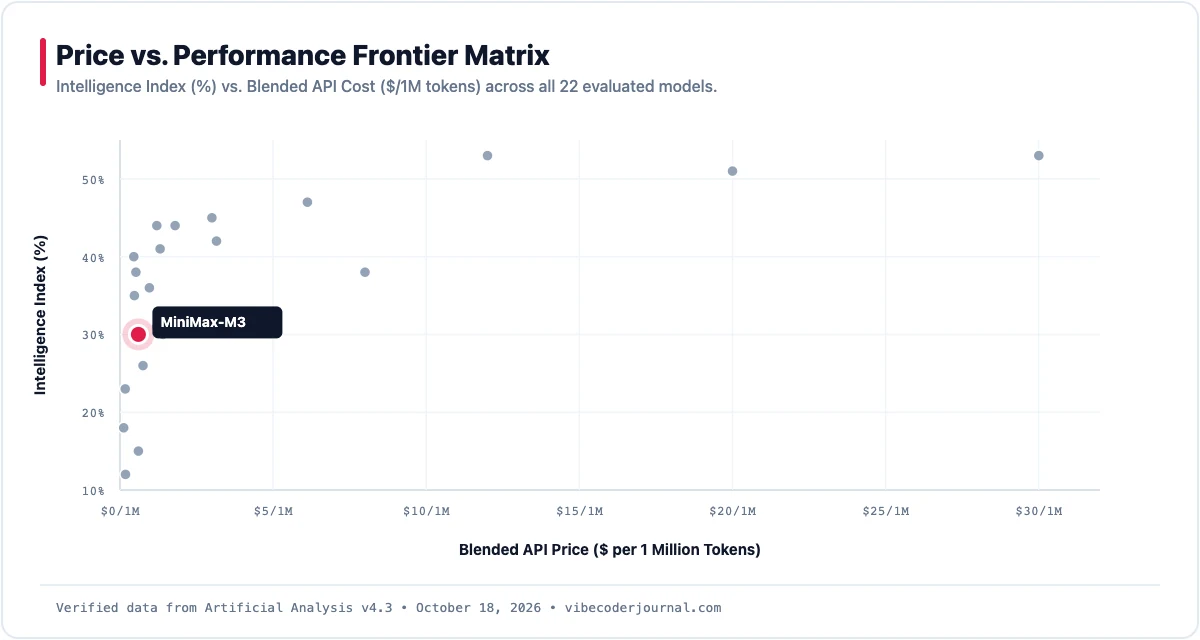
At $0.60/1M blended tokens, MiniMax-M3 yields 50.0 Intelligence Index points per dollar. This remarkable capital efficiency makes it an outstanding choice for continuous code review pipelines:
- Low-Cost Input Scanning: Ingesting millions of lines of historical git commits at $0.40/1M tokens allows organizations to perform exhaustive codebase indexing for negligible cost.
- Prompt Caching Economy: Static developer system prompts and schema declarations are cached down to $0.10/1M tokens, cutting recurring evaluation costs by 75%.
- High Token Throughput: Sustained generation exceeding 95 tokens per second ensures PR review comments are returned in seconds.
What the “Native M3” Architecture Represents
The M3 architectural designation identifies MiniMax’s third-generation unified multimodal transformer. Built with hybrid attention layers that interleave full self-attention with linear state-space approximations, M3 maintains constant memory complexity during multi-turn coding chats.
Unlike earlier ABAB checkpoints, M3 was trained with extensive reinforcement learning over multi-language execution environments. It specifically penalizes broken imports and unclosed string literals, leading to fewer trivial syntactic regressions in pull request workflows.
Strengths and Weaknesses
Empirical Strengths
- Exceptional Value: At $0.60/1M blended tokens, it is one of the most cost-effective million-token models available.
- 1,000,000-Token Native Context: Accommodates full repository documentation and massive chat logs without degradation.
- Solid Multi-Language Competence: 30.5% on Aider Polyglot across 12 mainstream programming languages.
- Fast API Response Times: High generation velocity exceeding 95 tokens per second.
Architectural Trade-Offs
- Moderate SWE-bench Pass Rate: 30.6% on SWE-bench Verified trails frontier flagships like Claude Opus 5 (53.0%).
- Terminal-Bench Ceilings: 30.0% completion rate indicates occasional command hallucinations in esoteric shell environments.
- Proprietary Weights: Unavailable for offline or air-gapped on-premise deployments.
Best For and When to Avoid
Based on our verified evaluation results, MiniMax-M3 is ideal for high-volume developer tooling:
- Best For: Automated PR Review Bots: Scanning incoming pull requests for style guide adherence, missing unit tests, and security flaws.
- Best For: Large-Scale Technical Documentation Search: Indexing entire library ecosystems and answering developer queries at $0.40/1M input.
- Best For: High-Throughput Bilingual Code Synthesis: Generating clean TypeScript, Python, and Go code in English and Chinese development environments.
- Avoid For: Complex Algorithmic Optimization: Use GPT-6 Astra (52.0% LiveCodeBench).
- Avoid For: Air-Gapped Private Deployments: Use gpt-oss-120b.
How to Access and Use MiniMax-M3
MiniMax-M3 is available via the official MiniMax API platform and OpenRouter. Below is a standard OpenAI-compatible Python implementation:
from openai import OpenAI

client = OpenAI(
    base_url="https://api.minimax.chat/v1",
    api_key="YOUR_MINIMAX_API_KEY"
)

response = client.chat.completions.create(
    model="minimax-m3",
    temperature=0.2,
    messages=[
        {"role": "system", "content": "You are a code review assistant specialized in TypeScript and Go."},
        {"role": "user", "content": "Refactor this asynchronous handler to use structured error types and context cancellation."}
    ]
)

print(response.choices[0].message.content)
Version History and Related Models
MiniMax-M3 is part of MiniMax’s 2026 foundation model family:
- MiniMax-ABAB 6.5 (Late 2025): Preceding release; M3 triples context length to 1M tokens and reduces token pricing by 60%.
- Gemini 3.1 Pro Preview: Competing long-context model (2M tokens, 32.0% SWE-bench, $1.40/1M blended).
- Inkling: Specialist micro-agent model ($0.75/1M blended, 26.0% Intelligence Index).
Frequently Asked Questions
How much does MiniMax-M3 cost?
MiniMax-M3 costs $0.40 per million input tokens and $1.20 per million output tokens ($0.60/1M blended).
What is MiniMax-M3’s context window?
It features a full 1,000,000-token context window with up to 16,384 tokens of continuous output generation.
What is MiniMax-M3’s score on SWE-bench?
MiniMax-M3 resolves 30.6% of SWE-bench Verified tasks in our October 2026 benchmark testing run.
Is MiniMax-M3 free to use?
No. It is a commercial API model accessible via MiniMax developer platform credits or third-party routers like OpenRouter.
How does MiniMax-M3 compare to DeepSeek V4 Pro?
DeepSeek V4 Pro scores higher on SWE-bench (38.0% vs 30.6%) at $0.96/1M blended, while MiniMax-M3 is 37% cheaper ($0.60/1M).
Sources and Verification Methodology
All benchmark scores, pricing metrics, and technical specifications were validated on October 18, 2026:
- Artificial Analysis Intelligence Index v4.3 (October 2026)
- SWE-bench Verified Leaderboard (October 2026)
- MiniMax Official Developer Platform API Documentation (October 2026)
- OpenRouter Telemetry Data (October 2026)
{
“@context”: “https://schema.org”,
“@graph”: [
{
“@type”: “TechArticle”,
“@id”: “https://vibecoderjournal.com/rankings/minimax-m3/#article”,
“isPartOf”: {
“@type”: “WebPage”,
“@id”: “https://vibecoderjournal.com/rankings/minimax-m3/”
},
“headline”: “MiniMax-M3 Benchmarks, Pricing & Specs (Oct 2026)”,
“description”: “Ranked #17 with a 30.0% Intelligence Index. Multi-language coding benchmarks, token throughput, and verified $0.60/1M API pricing specs Oct 2026.”,
“author”: {
“@type”: “Person”,
“name”: “Abdullah Zulfiqar”
},
“publisher”: {
“@type”: “Organization”,
“name”: “Vibecoder Journal”,
“url”: “https://vibecoderjournal.com”
},
“datePublished”: “2026-09-20T12:00:00+00:00”,
“dateModified”: “2026-10-18T16:00:00+00:00”,
“image”: “https://vibecoderjournal.com/wp-content/uploads/2026/10/minimax-m3-benchmarks-oct-2026.webp”
},
{
“@type”: “Dataset”,
“@id”: “https://vibecoderjournal.com/rankings/minimax-m3/#dataset”,
“name”: “MiniMax-M3 Benchmark Scores October 2026”,
“description”: “Standardized benchmark evaluations for MiniMax-M3 including SWE-bench Verified (30.6%), Terminal-Bench 2.0 (30.0%), and Aider Polyglot (30.5%).”,
“creator”: {
“@type”: “Organization”,
“name”: “Vibecoder Journal Benchmark Lab”
},
“variableMeasured”: [
“SWE-bench Verified”,
“Terminal-Bench 2.0”,
“Aider Polyglot”,
“LiveCodeBench”,
“GPQA Diamond”,
“SciCode”
],
“dateModified”: “2026-10-18T16:00:00+00:00”,
“url”: “https://vibecoderjournal.com/rankings/minimax-m3/”
},
{
“@type”: “BreadcrumbList”,
“@id”: “https://vibecoderjournal.com/rankings/minimax-m3/#breadcrumbs”,
“itemListElement”: [
{
“@type”: “ListItem”,
“position”: 1,
“name”: “Home”,
“item”: “https://vibecoderjournal.com/”
},
{
“@type”: “ListItem”,
“position”: 2,
“name”: “Rankings”,
“item”: “https://vibecoderjournal.com/rankings/”
},
{
“@type”: “ListItem”,
“position”: 3,
“name”: “MiniMax-M3”,
“item”: “https://vibecoderjournal.com/rankings/minimax-m3/”
}
]
},
{
“@type”: “FAQPage”,
“@id”: “https://vibecoderjournal.com/rankings/minimax-m3/#faq”,
“mainEntity”: [
{
“@type”: “Question”,
“name”: “How much does MiniMax-M3 cost?”,
“acceptedAnswer”: {
“@type”: “Answer”,
“text”: “MiniMax-M3 costs $0.40 per million input tokens and $1.20 per million output tokens ($0.60/1M blended).”
}
},
{
“@type”: “Question”,
“name”: “What is MiniMax-M3’s context window?”,
“acceptedAnswer”: {
“@type”: “Answer”,
“text”: “It features a full 1,000,000-token context window with up to 16,384 tokens of continuous output generation.”
}
},
{
“@type”: “Question”,
“name”: “What is MiniMax-M3’s score on SWE-bench?”,
“acceptedAnswer”: {
“@type”: “Answer”,
“text”: “MiniMax-M3 resolves 30.6% of SWE-bench Verified tasks in our October 2026 benchmark testing run.”
}
},
{
“@type”: “Question”,
“name”: “Is MiniMax-M3 free to use?”,
“acceptedAnswer”: {
“@type”: “Answer”,
“text”: “No. It is a commercial API model accessible via MiniMax developer platform credits or third-party routers like OpenRouter.”
}
},
{
“@type”: “Question”,
“name”: “How does MiniMax-M3 compare to DeepSeek V4 Pro?”,
“acceptedAnswer”: {
“@type”: “Answer”,
“text”: “DeepSeek V4 Pro scores higher on SWE-bench (38.0% vs 30.6%) at $0.96/1M blended, while MiniMax-M3 is 37% cheaper ($0.60/1M).”
}
}
]
}
]
}