
- The short answer
- Grok is cheaper than OpenAI only in one specific situation: flagship against flagship,
- short context, no batching. Grok 4.6 outputs at $6 per million tokens against GPT-6
- Astra's $50.
- Change any one of those three variables and it flips. OpenAI's gpt-5.6-luna is cheaper
- than every Grok model. OpenAI discounts batch work 50% while Grok 4.6 gets nothing.
- And between 200k and 272k tokens of context, OpenAI is cheaper outright.
- The other difference is structural: since February 2026, xAI is a division of SpaceX,
- listed on Nasdaq. OpenAI is still private.
Every figure below was read from docs.x.ai and developers.openai.com on 17 September 2026, then run through our own cost model. No vendor benchmark claims are repeated as fact.
What each company actually sells
Start with the catalogues, because they reveal two opposite bets.
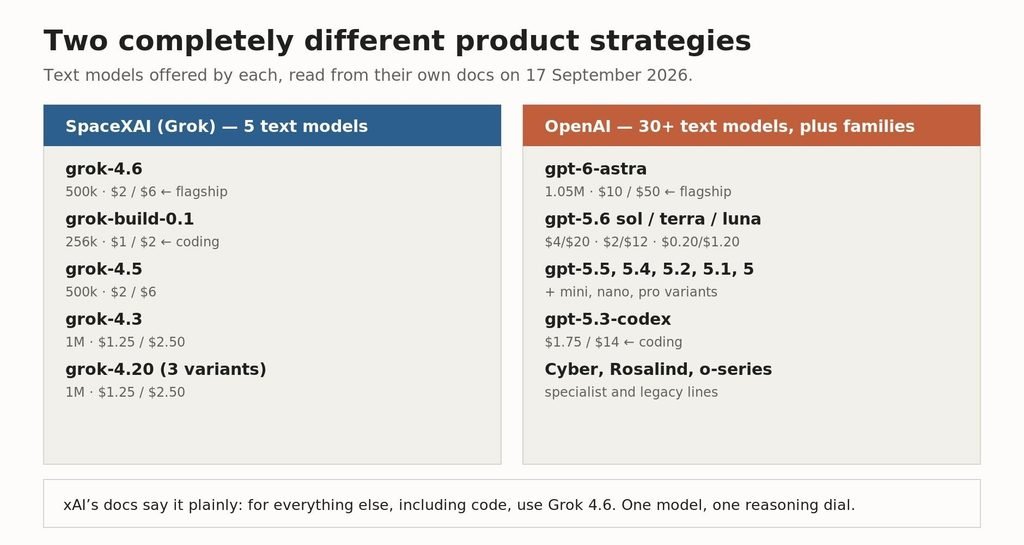
Five text models against thirty-odd. The strategies could hardly be further apart.
xAI’s own documentation is refreshingly blunt about this. Asked which model to choose, it answers that for everything else, including code, you should use Grok 4.6, calling it the most intelligent and fastest model the company has built. There is one flagship, one coding model, and a reasoning_effort dial. That is the product.
OpenAI sells the opposite: a graded ladder from gpt-5.6-luna at twenty cents per million input tokens up to GPT-6 Astra at ten dollars, plus separate lines for coding, cybersecurity, life sciences, search, images, video, realtime audio and embeddings. Picking correctly is part of the job.
Neither approach is better in the abstract. But it does mean any headline comparison of “xAI versus OpenAI pricing” is comparing a single price against a range, and most articles quietly pick whichever end of OpenAI’s range makes their argument.
Which is cheaper, xAI or OpenAI?
Output tokens dominate real bills, because reasoning tokens are billed as output and modern models generate a great many of them. So start there.
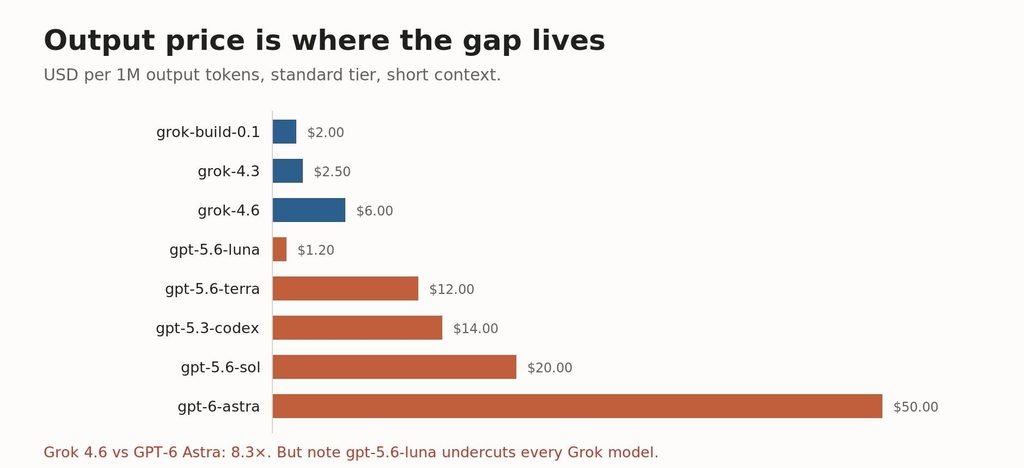
Output pricing per million tokens. Blue is SpaceXAI, orange is OpenAI.
The flagship gap is real and large: $6 against $50, a factor of 8.3. If your mental model is “Grok is much cheaper,” this chart is where that comes from, and it is correct as far as it goes.
But look at the fourth bar. gpt-5.6-luna outputs at $1.20 per million — cheaper than grok-build-0.1, xAI’s own budget coding model, and a fifth the price of Grok 4.6. OpenAI has a cheap tier; xAI does not really have one. That single fact undoes most of the comparisons published on this subject.
The same jobs, priced both ways
Headline rates are not costs. Here are three realistic workloads run through both price lists, including prompt caching, which both vendors offer and which changes the answer substantially.
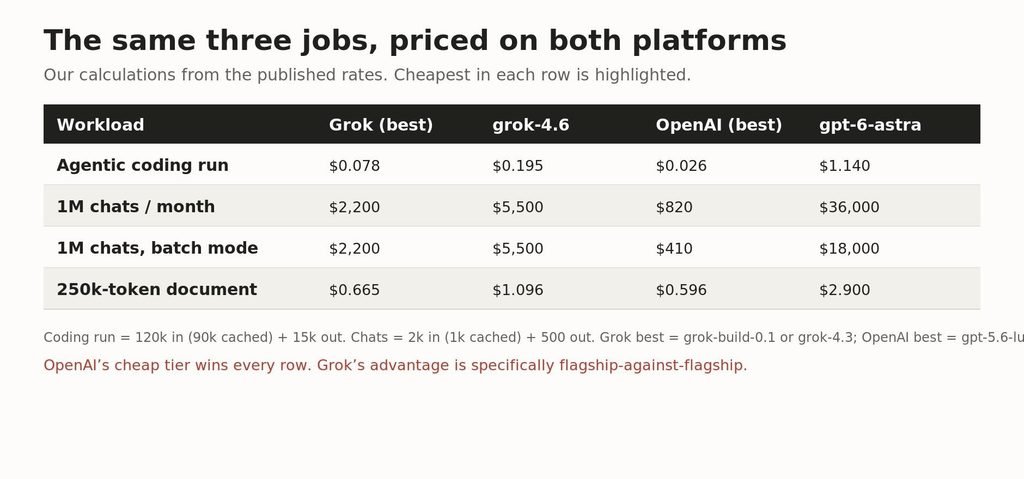
Our calculations from the published rates. The cheapest option in every row is an OpenAI model.
The agentic coding run assumes 120,000 input tokens of which 90,000 are cache hits, plus 15,000 output tokens — roughly one substantial task in a coding agent. The chat scenario assumes a million requests a month at 2,000 in and 500 out.
Two results are worth sitting with. First, at a million chats a month, gpt-5.6-luna costs $820 and Grok 4.6 costs $5,500. Second, the same job in batch mode costs $410 on OpenAI and still $5,500 on Grok — because Grok 4.6 has no batch discount at all.
The batch asymmetry
This deserves its own paragraph because it is easy to miss. OpenAI applies a flat 50% discount to batch and flex processing across essentially its whole range, flagship included. xAI’s batch discount is 20%, and it applies to exactly four models — grok-4.3 and the three grok-4.20 variants. Grok 4.6 and grok-build-0.1 are excluded.
If your workload is asynchronous — evaluations, bulk classification, document processing, anything that tolerates a 24-hour turnaround — this one line item can reverse the entire comparison.
The long-context trap on both platforms
Both vendors reprice long requests, and both do it in a way that is genuinely easy to get wrong in a budget.
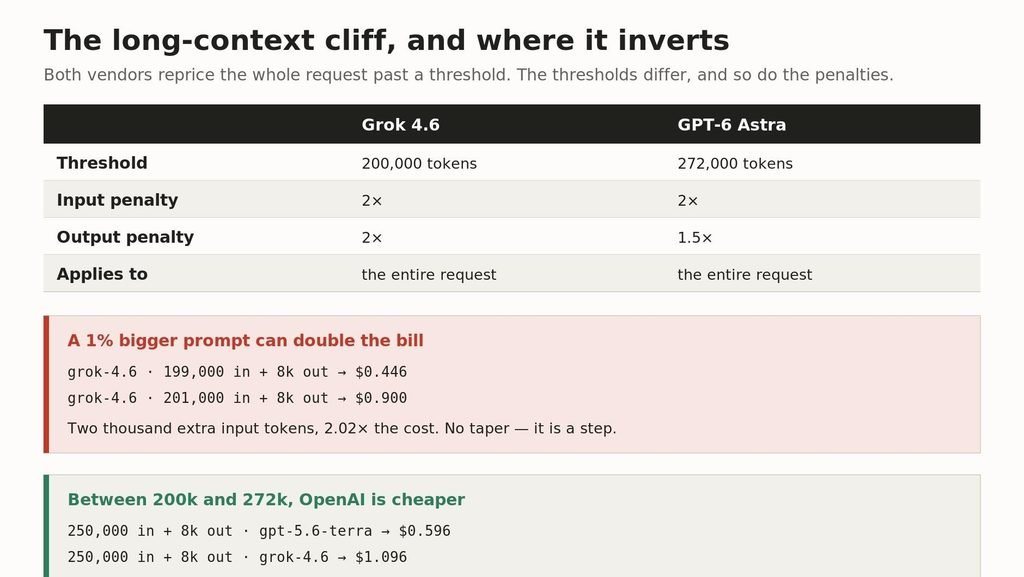
Neither vendor charges the higher rate only on the excess tokens. It applies to the whole request.
The crucial word in both sets of documentation is that the higher rate applies to the full request. This is not a marginal tier like an income tax bracket. Cross the threshold by one token and every token in that request reprices.
For Grok 4.6 the threshold is 200,000 tokens and both input and output double. We modelled the same job either side of the line: 199,000 input tokens with 8,000 of output costs $0.446, and 201,000 input tokens costs $0.900. A prompt 1% larger produces a bill 2.02 times bigger.
GPT-6 Astra’s threshold sits at 272,000 tokens, and its penalty is 2× on input but only 1.5× on output. The practical consequence is a band between 200,000 and 272,000 tokens where OpenAI is simply cheaper: at 250,000 input tokens, gpt-5.6-terra costs $0.596 and Grok 4.6 costs $1.096.
If you process long documents, that band is worth knowing about, and it is the opposite of what the headline rates imply.
The fees that do not appear in headline pricing
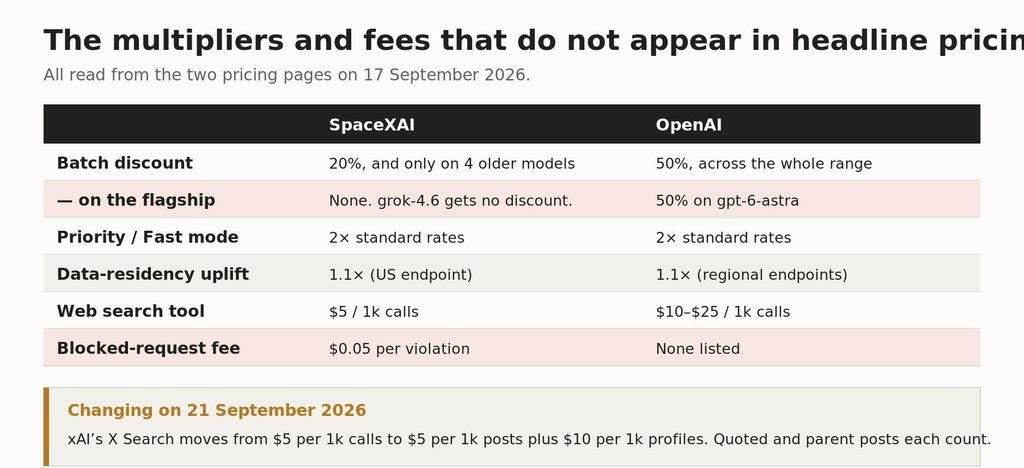
Multipliers and per-call fees from both pricing pages.
Some of this is a striking convergence. Both charge exactly 2× for priority or fast processing. Both charge exactly a 1.1× uplift for regional data residency. Two companies with very different cultures landed on identical multipliers, independently.
Two line items have no counterpart on the other side. xAI charges a $0.05 usage-guidelines violation fee for requests blocked before generation — you pay for refusals. OpenAI lists nothing equivalent. And xAI’s web search tool is $5 per thousand calls against OpenAI’s $10 to $25, a real advantage for search-heavy agents.
| Changing in four days xAI’s X Search pricing changes on 21 September 2026. It moves from $5 per 1,000 calls to $5 per 1,000 posts fetched plus $10 per 1,000 user profiles fetched.The documentation is explicit that every post returned counts, including parent and quoted posts. A single call that walks a long thread could return dozens of billable posts where it previously counted as one.Anyone with an X Search workload in production should re-model it this week rather than next month. |
What about benchmarks?
This is where most comparisons of these two companies go wrong, so it is worth being explicit about what we are not doing.
Both vendors publish benchmark results. Those results are not comparable to each other, for a reason that has nothing to do with honesty. Both flagship models expose a configurable reasoning budget — GPT-6 Astra accepts low, medium, high, xhigh and max; Grok 4.6 exposes a configurable reasoning effort. A score is a function of that setting, and the setting also determines the cost. A vendor reporting its best number at maximum effort is telling the truth about a configuration you may not be able to afford to run.
Add differing evaluation harnesses, differing tool access during the run, and differing prompt scaffolds, and a published number from one company cannot be placed in a table next to one from the other without a footnote longer than the table.
So we are not publishing a leaderboard here. What we can tell you factually: GPT-6 Astra has a 1,050,000-token context window with a 128,000-token maximum output and an April 2026 knowledge cutoff. Grok 4.6 has a 500,000-token window and a February 2026 cutoff, and xAI’s documentation warns that Grok has no knowledge of current events unless you explicitly enable its search tools. We take the same approach in our comparison of Claude Code and GitHub Copilot, where the benchmark comparability problem is even worse.
Consumer plans: Grok costs more than ChatGPT
An inversion that surprises people, given the API picture.
| Plan | SpaceXAI | OpenAI |
|---|---|---|
| Free tier | $0 | $0 |
| Entry paid | $30 / mo | ~$20 / mo |
| Higher tier | $100 / mo | $100 / mo |
| Naming | SuperGrok | Plus / Business |
SuperGrok is $30 a month. ChatGPT’s comparable paid tier sits around $20, and a ChatGPT Business standard seat is $20 a month billed annually. At the top, SuperGrok Plus and a ChatGPT Business premium seat both land at $100.
So the company that is dramatically cheaper per API token is the more expensive one at the consumer counter. Worth remembering if you have read that “Grok is the cheap option” and were planning to act on it as a subscriber rather than a developer.
The difference nobody prices in
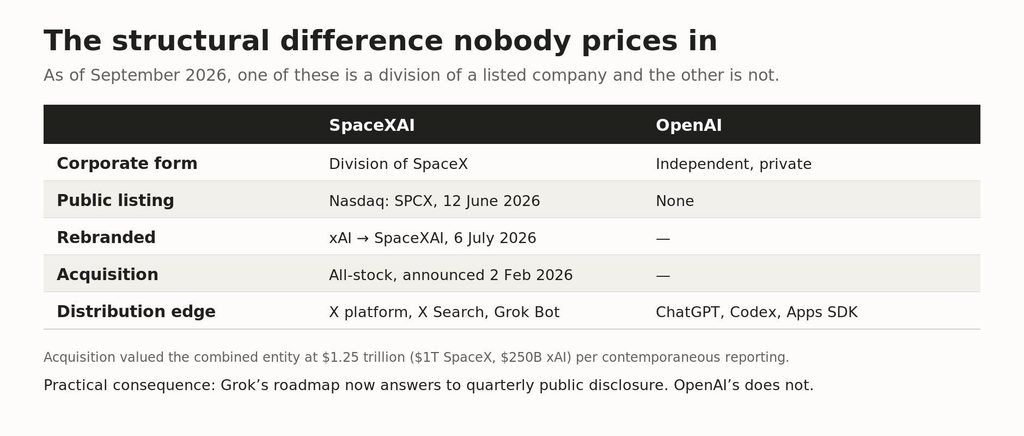
One of these companies has quarterly reporting obligations. The other does not.
On 2 February 2026, SpaceX announced it had acquired xAI. The company was rebranded SpaceXAI on 6 July 2026, and its documentation and copyright notices now carry that name. SpaceX listed on Nasdaq under SPCX on 12 June 2026. Contemporaneous reporting put the all-stock deal at a combined $1.25 trillion, with xAI valued at $250 billion.
For anyone choosing a vendor, this is not trivia. Grok’s roadmap now sits inside a public company with quarterly disclosure and shareholder pressure. Pricing changes like the X Search repricing above become decisions with a reported revenue line attached to them. OpenAI, still private, answers to a different set of constituencies.
It also explains the distribution asymmetry. xAI’s structural advantage is the X platform — X Search is a data source no competitor can replicate, and it is the one genuinely differentiated thing in the Grok API. OpenAI’s is ChatGPT’s user base and the developer surface around Codex and the Apps SDK.
So which should you use?
Reduced to decision rules, from the numbers above rather than from vibes:
- Choose Grok 4.6 when you need frontier-tier output at volume, your prompts stay under 200,000 tokens, and you cannot batch. The 8.3× output saving against GPT-6 Astra is the strongest case either company has.
- Choose Grok if you need X data. X Search has no equivalent — but re-price it after 21 September.
- Choose gpt-5.6-luna for anything high-volume and undemanding. Nothing in the Grok catalogue competes at $0.20 in and $1.20 out.
- Choose OpenAI for batch workloads, for prompts between 200k and 272k tokens, and when you want to tune cost by dropping down a model tier rather than dialling reasoning effort.
- Choose grok-build-0.1 over gpt-5.3-codex for cost-sensitive coding: $1 / $2 against $1.75 / $14. That output gap is seven-fold and coding agents emit a lot of output.
And a third option worth keeping in view: for a large share of everyday work, neither. Running models locally costs nothing per token, and what actually fits in 32GB is more than most people assume. If you want to try OpenAI’s coding agent first, our Codex CLI install guide takes about five minutes.
Frequently asked questions
Is xAI cheaper than OpenAI?
Only at the flagship tier with short prompts and no batching. Grok 4.6 outputs at $6 per million against GPT-6 Astra’s $50. But OpenAI’s gpt-5.6-luna, at $1.20 per million output, undercuts every model xAI sells.
Which has the bigger context window?
OpenAI. GPT-6 Astra has a 1,050,000-token window against Grok 4.6’s 500,000. Grok 4.3 also offers 1M at a lower price than Grok 4.6.
Does Grok get a batch discount?
Not on the flagship. xAI’s 20% batch discount applies only to grok-4.3 and the three grok-4.20 variants. OpenAI discounts batch 50% across its range.
Is xAI owned by SpaceX?
Yes. SpaceX announced the acquisition on 2 February 2026 and the company was rebranded SpaceXAI on 6 July 2026. SpaceX listed on Nasdaq as SPCX on 12 June 2026.
What is SuperGrok and how much does it cost?
SuperGrok is xAI’s consumer subscription at $30 a month, including Grok 4.6, Grok Bot and image and video generation. SuperGrok Plus is $100 a month.
Why can’t you just compare the benchmark scores?
Both flagships expose configurable reasoning effort, so any score is a function of a setting that also determines cost. Combined with different harnesses and tool access, the published numbers are not directly comparable.
Which is better for coding?
On price, grok-build-0.1 at $1 in and $2 out is far cheaper than gpt-5.3-codex at $1.75 and $14. On capability, we do not have comparable evidence, for the reasons set out above.
Does Grok know about current events?
Not by default. xAI’s documentation states Grok has no knowledge beyond its training data unless you enable the Web Search or X Search tools. Its knowledge cutoff is 1 February 2026.
Primary sources, fetched 17 September 2026: docs.x.ai/developers/models · docs.x.ai/developers/pricing (last updated 14 Sep 2026) · x.ai/pricing · x.ai/news/xai-joins-spacex · developers.openai.com/api/docs/pricing · developers.openai.com/api/docs/models/gpt-6-astra · openai.com/business/pricing. Cost scenarios are our own calculations from these published rates.