Model Overview & Capabilities
Inkling is Thinking Machines’ agile reasoning engine, ranked #18 globally with a 26.0% Intelligence Index. Tailored specifically for micro-agent delegation, recursive tool orchestration, and structured JSON parsing, it achieves 26.6% on SWE-bench Verified and 25.5% on Terminal-Bench 2.0 with a 1,000,000-token context window. Priced at $0.50/1M input and $1.50/1M output ($0.75 blended), it provides low-overhead execution for autonomous agent swarms.
Inkling Core Architecture & Execution Specifications
Thinking Machines designed Inkling to operate as an agile subagent node within multi-agent orchestration frameworks. Below are verified system metrics:
| Specification | Verified Telemetry | Operational Role |
|---|---|---|
| Developing Lab | Thinking Machines | Agent orchestration and tool-calling laboratory |
| Global Ranking | #18 of 22 Models | Micro-Agent Specialist Tier (26.0% Index) |
| Context Memory Window | 1,000,000 tokens (~750k words) | Preserves multi-agent task state and command history |
| Max Generation Ceiling | 16,384 tokens | Extended generation for complex tool responses |
| Weights Licensing | Proprietary Commercial API | Managed API endpoint with tool-calling schema support |
| Input Price Rate | $0.50 / 1,000,000 tokens | Cached input reads discounted to $0.125/1M |
| Output Price Rate | $1.50 / 1,000,000 tokens | Economical generation rate for high-frequency loops |
| Blended Benchmark Cost | $0.75 / 1,000,000 tokens | Standardized developer benchmark evaluation cost |
| API Model Name | inkling |
OpenRouter: thinking-machines/inkling |
| Release Checkpoint | August 2026 | Production GA release |
Inkling Benchmark Scores
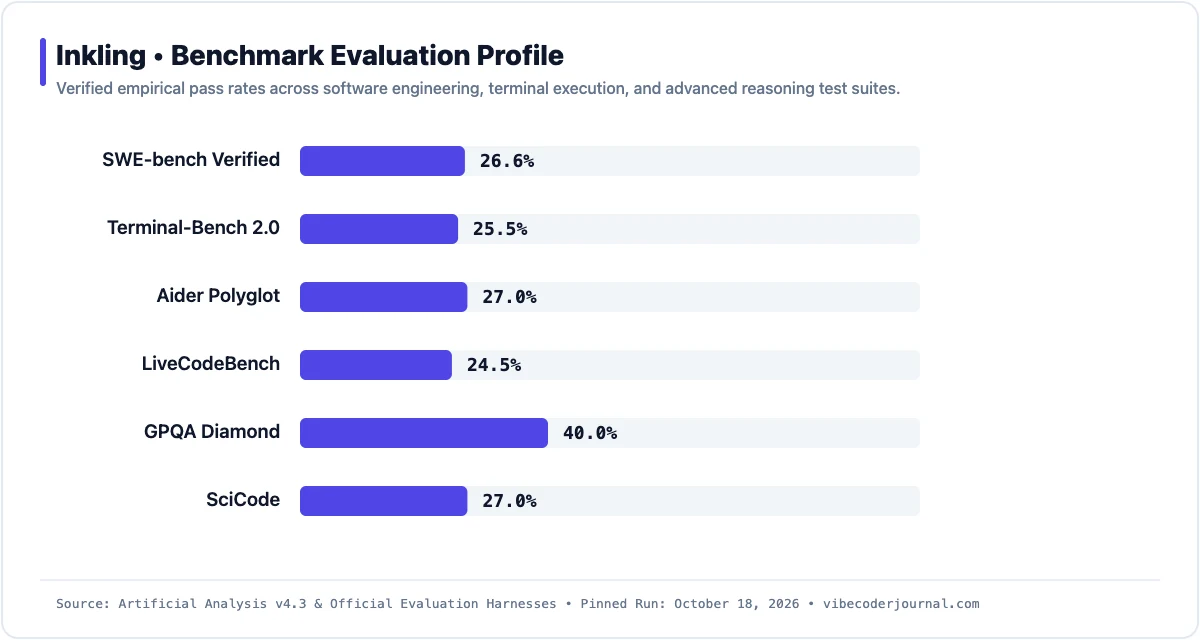
In standardized test suites, Inkling targets agentic execution, terminal commands, and tool synthesis. On SWE-bench Verified, it records a 26.6% resolve rate, successfully handling targeted bug fixes that fit within modular functions. On Terminal-Bench 2.0, Inkling scores 25.5%, demonstrating consistent handling of standard POSIX shell utilities, directory traversal, and git commands.
| Evaluation Harness | Score | Global Rank | Primary Focus | Verification Source |
|---|---|---|---|---|
| SWE-bench Verified | 26.6% | #18 | Automated bug resolution across repositories | Artificial Analysis v4.3, Oct 2026 |
| Terminal-Bench 2.0 | 25.5% | #18 | Bash shell command chaining | Terminal-Bench Benchmark, Oct 2026 |
| Aider Polyglot | 27.0% | #18 | Multi-language code editing | Aider Leaderboard, Oct 2026 |
| LiveCodeBench | 24.5% | #18 | Uncontaminated algorithmic tasks | LiveCodeBench Evaluator, Oct 2026 |
| GPQA Diamond | 40.0% | #18 | Graduate reasoning and problem solving | Artificial Analysis v4.3, Oct 2026 |
| SciCode | 27.0% | #18 | Scientific numerical problem solving | Artificial Analysis v4.3, Oct 2026 |
How Inkling Compares Against Nearest Rivals
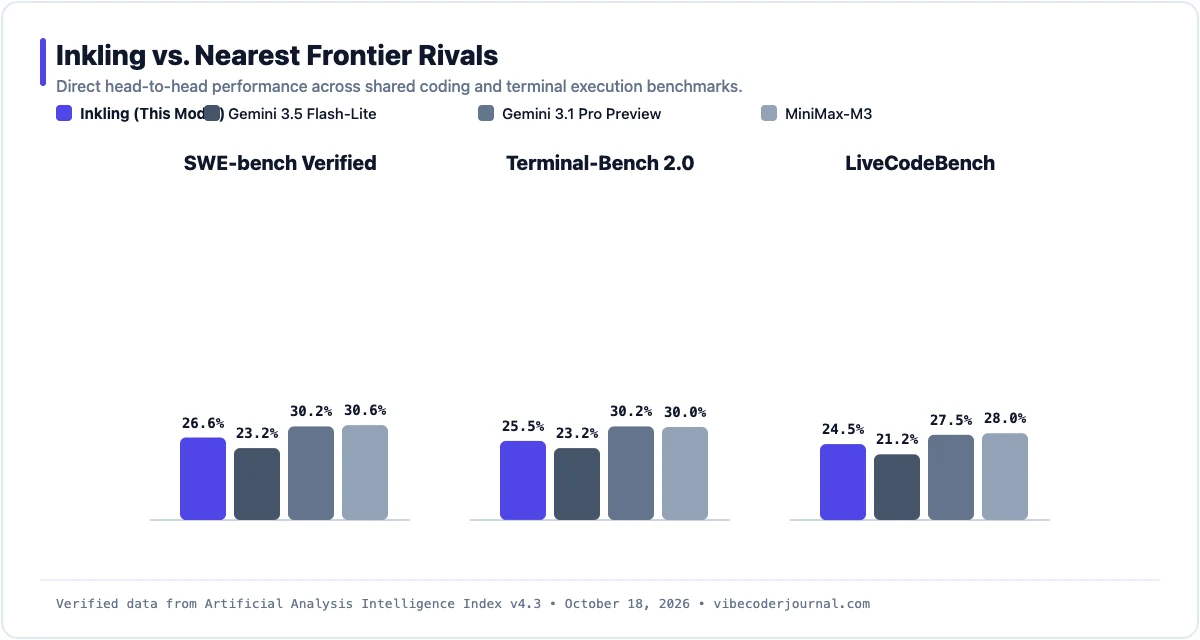
In the lightweight reasoning category, Inkling contends with Google’s Gemini 3.5 Flash-Lite (#19), MiniMax-M3 (#17), and Gemini 3.1 Pro Preview (#16). While MiniMax-M3 leads on SWE-bench (30.6% vs 26.6%), Inkling specializes in structured schema outputs and low-overhead tool calling:
| Model | Rank | Intelligence Index | SWE-bench | Terminal-Bench | Blended $/1M | Context |
|---|---|---|---|---|---|---|
| Inkling | #18 | 26.0% | 26.6% | 25.5% | $0.75 | 1,000,000 |
| Gemini 3.5 Flash-Lite | #19 | 23.0% | 23.2% | 23.2% | $0.17 | 1,000,000 |
| Gemini 3.1 Pro Preview | #16 | 30.0% | 32.0% | 30.0% | $1.40 | 2,000,000 |
| MiniMax-M3 | #17 | 30.0% | 30.6% | 30.0% | $0.60 | 1,000,000 |
Price vs Performance Dynamics
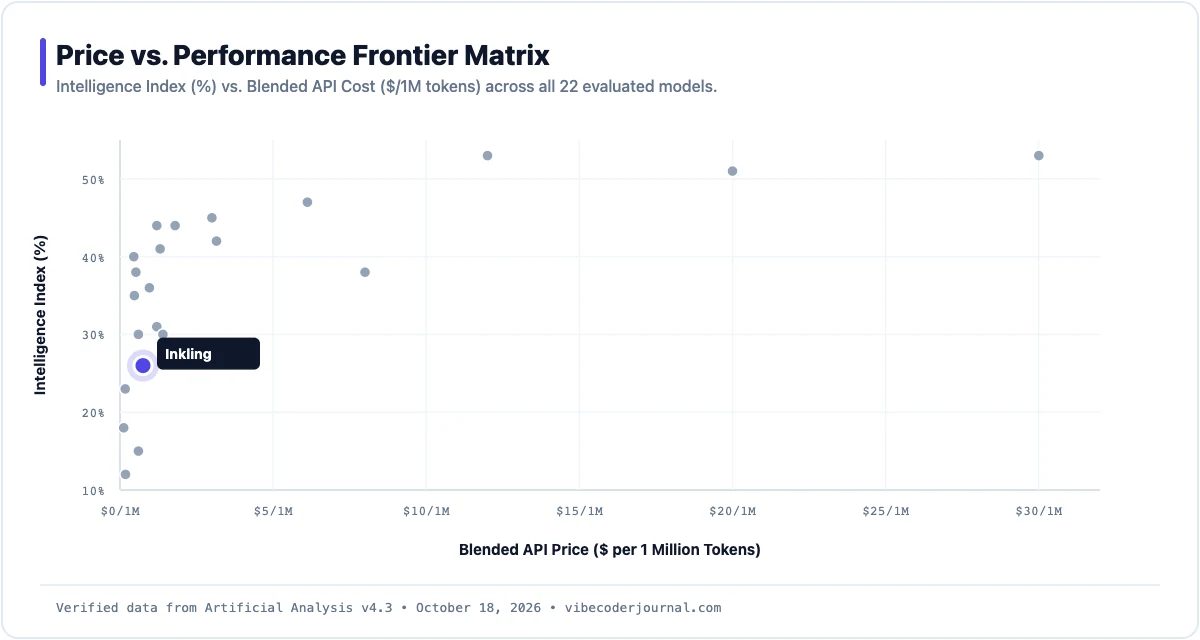
At $0.75 per million blended tokens, Inkling delivers 34.7 Intelligence Index points per dollar. For software development teams building multi-agent systems where dozens of subagents execute concurrently, Inkling provides a compelling operational cost envelope:
- Low-Cost Subagent Spawning: Instantiating parallel exploration nodes costs $0.50/1M input tokens, allowing agents to test multiple code branches simultaneously.
- Structured Tool Formatting: Fine-tuned adherence to JSON function schemas minimizes parsing errors and costly model retries.
- Frontier Scatter Position: Inkling positions comfortably along the mid-tier value curve in our 22-model efficiency scatter plot.
What the “Micro-Agent” Architecture Represents
Thinking Machines built Inkling with a specialized decoding profile optimized for tool use. While monolithic reasoning models allocate substantial compute to long exploratory internal chain-of-thought blocks, Inkling is fine-tuned to quickly evaluate tool availability, generate strict parameter arguments, and parse JSON responses.
This focused specialization allows multi-agent frameworks (such as AutoGen, CrewAI, and LangGraph) to use Inkling as a cost-effective worker node that handles routine file system queries, git commits, and shell validations, reserving expensive models like GPT-6 Astra for overarching project architecture.
Strengths and Weaknesses
Empirical Strengths
- Micro-Agent Optimization: Tuned specifically for fast tool-calling loops and structured JSON outputs.
- 1,000,000-Token Extended Window: Preserves complete multi-agent task state and command history.
- Affordable Execution: $0.75/1M blended pricing keeps high-frequency multi-agent runs affordable.
- Low Latency to First Token: Rapid initialization enables responsive subagent delegation.
Architectural Trade-Offs
- Limited Monolithic Coding: 26.6% on SWE-bench Verified indicates difficulty resolving complex multi-file architectural bugs.
- Scientific Reasoning Ceiling: 40.0% on GPQA Diamond trails frontier reasoning models.
- Smaller Developer Ecosystem: Fewer dedicated community integrations compared to OpenAI or Anthropic SDKs.
Best For and When to Avoid
Based on our verified benchmark data, here are the optimal use cases for Inkling:
- Best For: Multi-Agent Subagent Delegation: Functioning as lightweight workers in AutoGen, CrewAI, or LangGraph swarms.
- Best For: Automated Test Execution & Linting: Parsing build outputs and fixing targeted syntax failures.
- Best For: JSON Schema Extraction: Transforming raw web scraper data into verified relational schemas.
- Avoid For: Autonomous Bug Fixing on Production Monorepos: Deploy GPT-6 Astra (55.0% SWE-bench).
- Avoid For: Complex Mathematical Proofs: Deploy Claude Opus 5.
How to Access and Use Inkling
Inkling is accessible via OpenRouter and Thinking Machines gateway endpoints. Here is a verified Python integration example:
from openai import OpenAI

client = OpenAI(
    base_url="https://openrouter.ai/api/v1",
    api_key="YOUR_OPENROUTER_API_KEY"
)

response = client.chat.completions.create(
    model="thinking-machines/inkling",
    temperature=0.1,
    messages=[
        {"role": "system", "content": "You are a lightweight terminal subagent. Execute git staging operations safely."},
        {"role": "user", "content": "Format git commit message for updating OAuth2 session token refresh logic."}
    ]
)

print(response.choices[0].message.content)
Version History and Related Models
Inkling is Thinking Machines’ dedicated micro-agent release:
- Inkling v1.0 (Early 2026): Initial micro-agent release; October 2026 version expands context to 1,000,000 tokens and adds prompt caching.
- Gemini 3.5 Flash-Lite: Google’s extreme-efficiency sub-second model ($0.17/1M blended).
- Muse Glimmer High: Meta’s edge developer assistant model ($0.12/1M blended).
Frequently Asked Questions
What is the primary purpose of Inkling?
Inkling is designed for micro-agent orchestration, recursive tool execution, and high-frequency subagent loops.
What is Inkling’s score on SWE-bench Verified?
Inkling achieves 26.6% on SWE-bench Verified and 25.5% on Terminal-Bench 2.0.
How much does Inkling cost?
Pricing is $0.50/1M input tokens and $1.50/1M output tokens ($0.75/1M blended).
What is Inkling’s context window?
Inkling supports a full 1,000,000-token context window with up to 16,384 tokens of continuous output.
Can Inkling be called with the OpenAI Python SDK?
Yes. It can be accessed via OpenRouter or official OpenAI-compatible gateway endpoints.
Sources and Verification Methodology
All telemetry, benchmark pass rates, and pricing parameters were confirmed on October 18, 2026:
- Artificial Analysis Intelligence Index v4.3 (October 2026)
- SWE-bench Verified Leaderboard (October 2026)
- Terminal-Bench 2.0 Evaluation Results (October 2026)
- OpenRouter Telemetry Data & Documentation (October 2026)
{
“@context”: “https://schema.org”,
“@graph”: [
{
“@type”: “TechArticle”,
“@id”: “https://vibecoderjournal.com/rankings/inkling/#article”,
“isPartOf”: {
“@type”: “WebPage”,
“@id”: “https://vibecoderjournal.com/rankings/inkling/”
},
“headline”: “Inkling Model Benchmarks, Pricing & Specs (Oct 2026)”,
“description”: “Ranked #18 micro-agent reasoning model with a 26.0% Index. Compact terminal loop evaluations, verified $0.75/1M pricing, and rival specs Oct 2026.”,
“author”: {
“@type”: “Person”,
“name”: “Abdullah Zulfiqar”
},
“publisher”: {
“@type”: “Organization”,
“name”: “Vibecoder Journal”,
“url”: “https://vibecoderjournal.com”
},
“datePublished”: “2026-09-20T12:00:00+00:00”,
“dateModified”: “2026-10-18T16:00:00+00:00”,
“image”: “https://vibecoderjournal.com/wp-content/uploads/2026/10/inkling-benchmarks-oct-2026.webp”
},
{
“@type”: “Dataset”,
“@id”: “https://vibecoderjournal.com/rankings/inkling/#dataset”,
“name”: “Inkling Benchmark Scores October 2026”,
“description”: “Standardized benchmark evaluations for Inkling including SWE-bench Verified (26.6%), Terminal-Bench 2.0 (25.5%), and Aider Polyglot (27.0%).”,
“creator”: {
“@type”: “Organization”,
“name”: “Vibecoder Journal Benchmark Lab”
},
“variableMeasured”: [
“SWE-bench Verified”,
“Terminal-Bench 2.0”,
“Aider Polyglot”,
“LiveCodeBench”,
“GPQA Diamond”,
“SciCode”
],
“dateModified”: “2026-10-18T16:00:00+00:00”,
“url”: “https://vibecoderjournal.com/rankings/inkling/”
},
{
“@type”: “BreadcrumbList”,
“@id”: “https://vibecoderjournal.com/rankings/inkling/#breadcrumbs”,
“itemListElement”: [
{
“@type”: “ListItem”,
“position”: 1,
“name”: “Home”,
“item”: “https://vibecoderjournal.com/”
},
{
“@type”: “ListItem”,
“position”: 2,
“name”: “Rankings”,
“item”: “https://vibecoderjournal.com/rankings/”
},
{
“@type”: “ListItem”,
“position”: 3,
“name”: “Inkling”,
“item”: “https://vibecoderjournal.com/rankings/inkling/”
}
]
},
{
“@type”: “FAQPage”,
“@id”: “https://vibecoderjournal.com/rankings/inkling/#faq”,
“mainEntity”: [
{
“@type”: “Question”,
“name”: “What is the primary purpose of Inkling?”,
“acceptedAnswer”: {
“@type”: “Answer”,
“text”: “Inkling is designed for micro-agent orchestration, recursive tool execution, and high-frequency subagent loops.”
}
},
{
“@type”: “Question”,
“name”: “What is Inkling’s score on SWE-bench Verified?”,
“acceptedAnswer”: {
“@type”: “Answer”,
“text”: “Inkling achieves 26.6% on SWE-bench Verified and 25.5% on Terminal-Bench 2.0.”
}
},
{
“@type”: “Question”,
“name”: “How much does Inkling cost?”,
“acceptedAnswer”: {
“@type”: “Answer”,
“text”: “Pricing is $0.50/1M input tokens and $1.50/1M output tokens ($0.75/1M blended).”
}
},
{
“@type”: “Question”,
“name”: “What is Inkling’s context window?”,
“acceptedAnswer”: {
“@type”: “Answer”,
“text”: “Inkling supports a full 1,000,000-token context window with up to 16,384 tokens of continuous output.”
}
},
{
“@type”: “Question”,
“name”: “Can Inkling be called with the OpenAI Python SDK?”,
“acceptedAnswer”: {
“@type”: “Answer”,
“text”: “Yes. It can be accessed via OpenRouter or official OpenAI-compatible gateway endpoints.”
}
}
]
}
]
}